Question 1 of 5
(a) Define selective permeability. (b) Explain the role of the hydrophobic interior. (c) Contrast passage of O2 with passage of Na+.
Responses receive AI feedback against a rubric after submission. Scores are practice estimates.
(a) Define selective permeability. (b) Explain the role of the hydrophobic interior. (c) Contrast passage of O2 with passage of Na+.
The table lists substances. (a) Classify each as freely permeable, limited/small amounts, or protein-dependent. (b) Justify using polarity/size. (c) Predict how removing all transport proteins would affect glucose uptake.
| Substance | Notes |
|---|---|
| O2 | Small nonpolar |
| Glucose | Large polar |
| Na+ | Ion |
| H2O | Small polar uncharged |
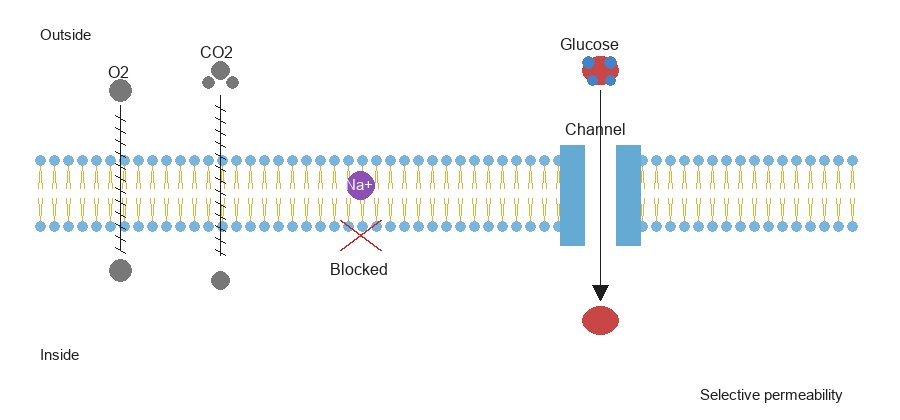
Using the permeability figure, (a) explain the X on Na+, (b) explain free arrows for O2/CO2, and (c) state why glucose is shown at a channel.
(a) State two functions of cell walls from the CED. (b) Identify which domains/kingdoms have walls. (c) Explain why animal cells are more vulnerable to osmotic lysis in distilled water.
A student claims cell walls make plasma membranes unnecessary. (a) Evaluate the claim. (b) Contrast wall vs membrane roles in selective permeability. (c) Explain why plant cells still need plasma membranes inside walls.