TOPIC 2.5 · STUDY
Membrane Transport
Selective membranes allow solutes to form concentration gradients. Passive transport is net movement from high concentration to low concentration without metabolic energy. Active transport spends energy and can move solutes the other way. Endocytosis and exocytosis use energy to move large cargo in vesicles.
2.5.A
Passive and active transport
Because a membrane lets some solutes through and holds others back, the two sides can sit at different concentrations. That difference is a concentration gradient. Gradients do not appear across a barrier that everything crosses equally.
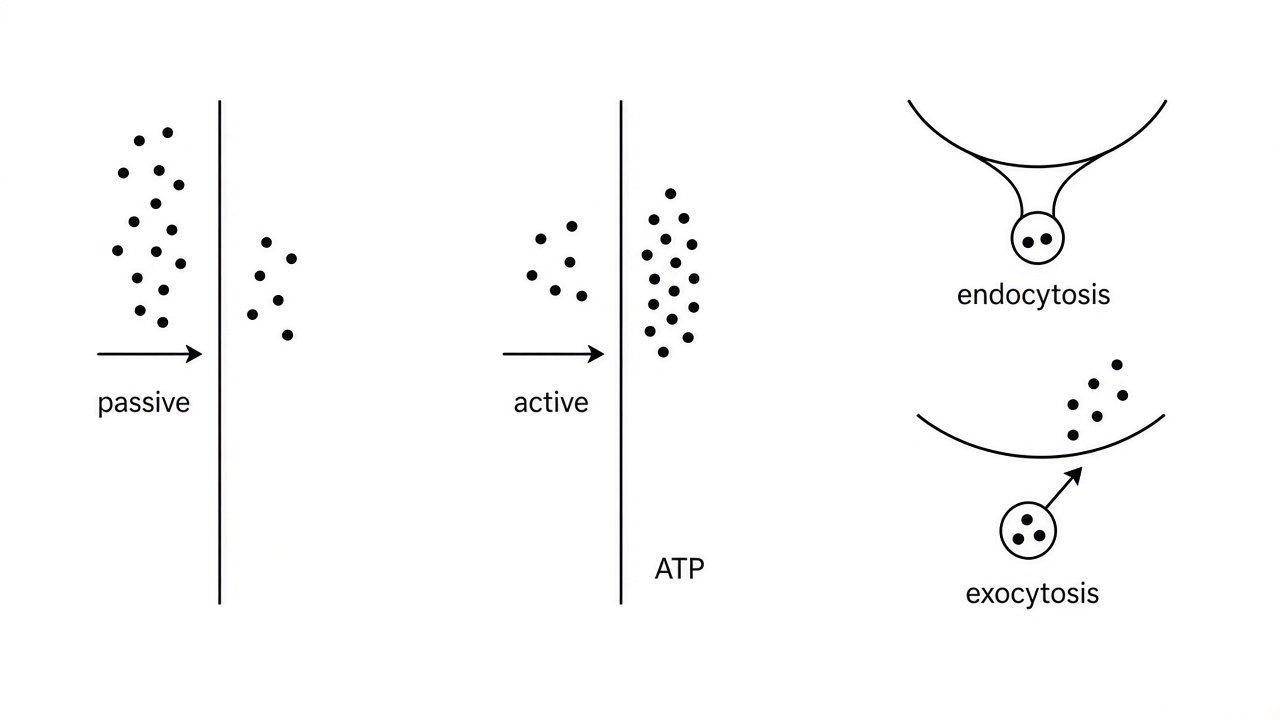
Passive net movement goes from the crowded side to the sparse side. Active movement goes toward the crowded side and is marked ATP. Endocytosis pinches in a vesicle. Exocytosis merges a vesicle with the membrane and releases its contents.
Passive transport is the net movement of molecules from a region of high concentration to a region of low concentration without the direct input of metabolic energy. A drop of dye placed in still water is the same pattern. More molecules leave the crowded region than return to it, so the dye spreads until the two regions match. The water did not spend ATP to cause that net flow.
Active transport requires a direct input of energy. It can move molecules from low concentration to high concentration, the uphill direction. A cell that keeps an ion scarcer outside than inside, or the reverse, is doing that work. Leakage through the membrane tends to erase the gradient. Active transport is what rebuilds it. If the cell can no longer supply energy, uphill movement stops and the gradient runs down.
2.5.B
Endocytosis and exocytosis
Large molecules, particles, and large amounts of material do not slip through the bilayer. The cell moves them in vesicles. Both endocytosis and exocytosis require energy.
In endocytosis the plasma membrane folds inward, engulfs material from the outside, and pinches off a new small vesicle. The cargo is now inside the cell, wrapped in membrane that used to be part of the cell surface. In exocytosis a vesicle that is already inside the cell fuses with the plasma membrane and releases its contents outside. A cell that secretes a large protein, such as a digestive enzyme, uses this route. The protein is too big and too polar to diffuse through the fatty-acid core, so the vesicle carries it.
Key points
- Selective permeability allows concentration gradients of solutes to form across a membrane.
- Passive transport is net movement from high concentration to low concentration with no direct metabolic energy.
- Active transport requires a direct input of energy and can move molecules from low concentration to high concentration.
- If energy supply stops, uphill transport stops and leakage flattens the gradient.
- Endocytosis uses energy. The membrane folds in and forms a vesicle that engulfs outside material.
- Exocytosis uses energy. An internal vesicle fuses with the plasma membrane and releases cargo outside.
Passive versus active is about direction and energy. Endocytosis and exocytosis are the bulk routes for cargo that is too large for a channel.