TOPIC 2.6 · STUDY
Facilitated Diffusion
Charged ions and large polar molecules cross the plasma membrane through channel or transport proteins. That facilitated diffusion still follows the concentration gradient and does not spend metabolic energy. Aquaporins let large amounts of water through. Ion flow through channels can also polarize the membrane.
2.6.A
Channels, carriers, and aquaporins
Facilitated diffusion is still diffusion. The substance moves from high concentration toward low concentration, and the cell does not spend ATP. The difference from simple diffusion is the path. The hydrophobic core of the bilayer blocks a fully charged ion and also blocks a large polar molecule. A channel protein or a transport protein gives that molecule a route that avoids the fatty-acid interior.
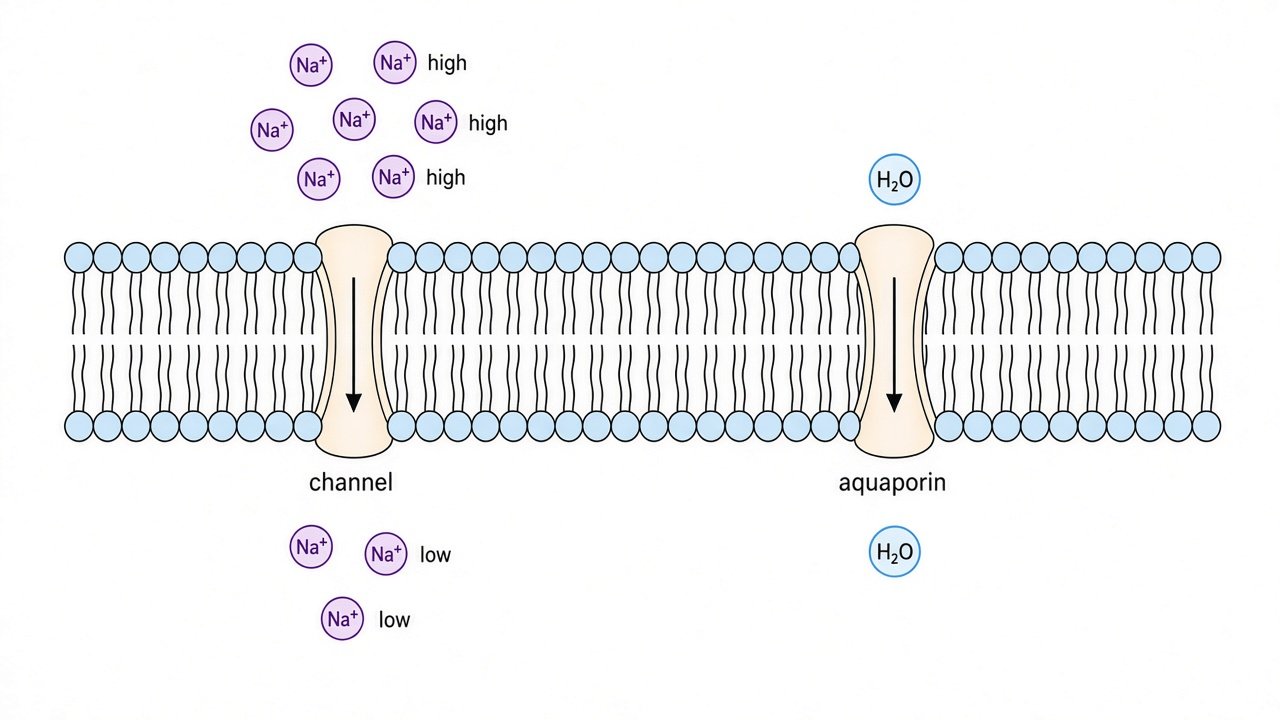
Na+ is higher on one side of the channel than the other, and the arrow through the channel follows that gradient. H2O crosses through the aquaporin. No ATP is shown.
Charged ions, including $\mathrm{Na^+}$ and $\mathrm{K^+}$, require channel proteins to cross. Each ion that crosses carries charge. If positive ions leave one side faster than they are replaced, that side becomes more negative than the other. The membrane is then polarized: the two faces differ in charge. That charge difference is a membrane potential. Closing the channels does not erase the concentration gradient, but it stops the ion flow, so the potential can change.
Large polar molecules use the same kind of help. A glucose carrier lets glucose cross when glucose is more concentrated on one side, and net movement is toward the less concentrated side. The carrier does not push glucose uphill. If the carriers are removed, that flux drops even when ATP is plentiful, because this path was never using ATP. Facilitated diffusion cannot by itself stockpile a solute on the far side of the membrane.
Water is polar, so only a small amount crosses the bilayer unaided. Aquaporins are channel proteins that transport large quantities of water. Blocking aquaporins slows that water flow. It does not close unrelated ion channels. Simple diffusion of $\mathrm{O_2}$ needs no protein. Facilitated diffusion does, because the molecule is charged or large and polar.
Key points
- Facilitated diffusion uses a channel or transport protein, follows the concentration gradient, and does not use metabolic energy.
- $\mathrm{Na^+}$ and $\mathrm{K^+}$ cross through channel proteins. That ion movement can polarize the membrane.
- A membrane potential is a charge difference across the membrane caused by unequal ion movement.
- Large polar molecules also move down their gradients through proteins, with no energy input.
- Aquaporins transport large quantities of water.
- This is not active transport. A carrier alone cannot build a higher concentration on the far side.
- Simple diffusion of $\mathrm{O_2}$ needs no protein. Facilitated diffusion does, because the solute is charged or large and polar.