Facilitated Diffusion MCQ Practice

Question 1 of 10

Why do Na+ and K+ typically require channel proteins to cross the plasma membrane during facilitated diffusion?

  1. A. Their charge prevents free passage through the hydrophobic bilayer interior
  2. B. They dissolve chromosomes and must exit as free DNA strands through tails
  3. C. They are cellulose fibers that only move during exocytosis
  4. D. They are ribosomes that enter the nucleus without needing pores
Question 2 of 10

A glucose carrier protein is present, ATP is abundant, and external glucose is higher than internal glucose. Removing the carrier proteins would most directly

  1. A. increase ATP-driven pumping of glucose against its gradient
  2. B. allow glucose to cross freely through phospholipid tails like O2
  3. C. slow protein-mediated entry of glucose down its concentration gradient
  4. D. convert aquaporins into glucose exporters

Question 3 of 10

Membranes may become polarized by

  1. A. random deletion of all proteins
  2. B. movement of ions across the membrane
  3. C. synthesis of starch in the bilayer core
  4. D. removing all water from Earth

Question 4 of 10

Large quantities of water cross membranes through

  1. A. DNA ligase
  2. B. cellulose synthase only
  3. C. nuclear lamina fibers
  4. D. aquaporins

Question 5 of 10

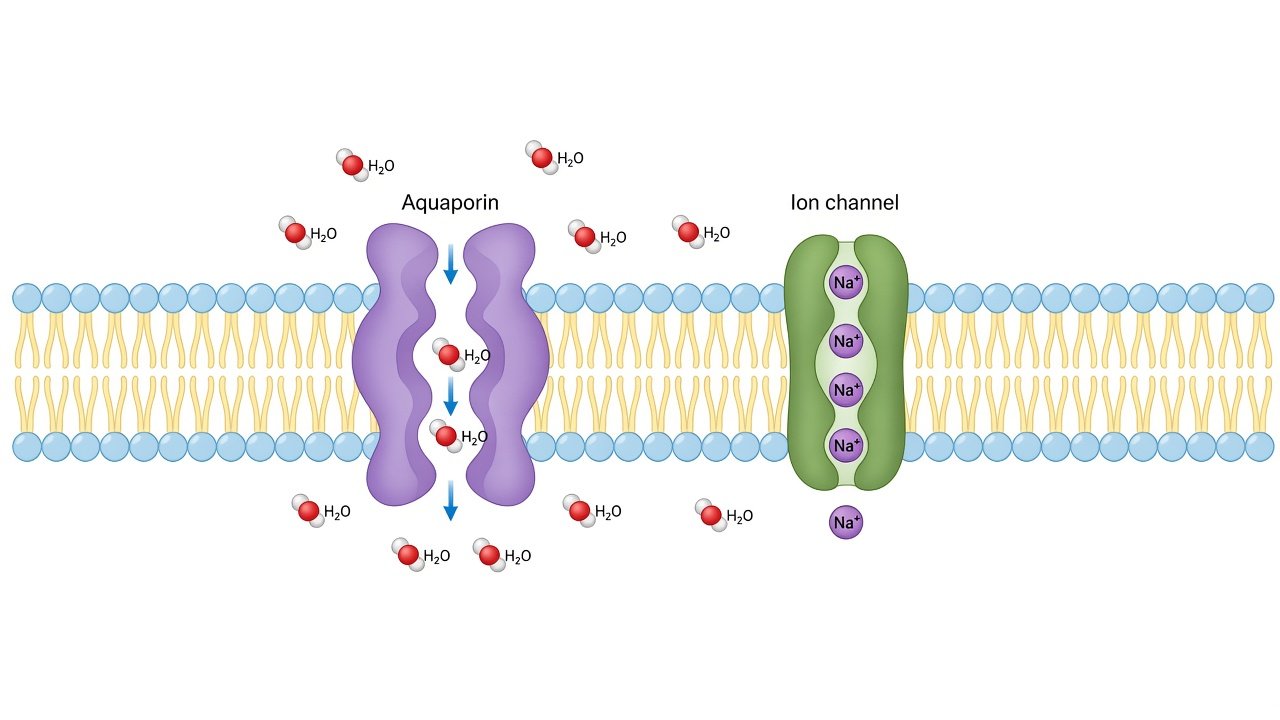
In the facilitated-diffusion figure, Na+ is shown using

Membrane with aquaporin moving H2O and an ion channel moving Na+.
  1. A. an ion channel
  2. B. free passage identical to O2
  3. C. exocytosis of single ions
  4. D. a chloroplast thylakoid only

Question 6 of 10

Which process is NOT facilitated diffusion?

  1. A. Glucose through a carrier down its gradient
  2. B. Na+ pumped out against its gradient using ATP
  3. C. K+ through a channel down its gradient
  4. D. Water through aquaporins down its water-potential gradient

Question 7 of 10

A poison blocks aquaporins but not ion channels. Expected immediate effect:

  1. A. O2 can no longer cross membranes
  2. B. All ion gradients disappear instantly
  3. C. Large-quantity water flux through aquaporins declines
  4. D. Ribosomes stop existing

Question 8 of 10

Two artificial membranes: Membrane 1 has glucose carriers; Membrane 2 does not. External glucose is high. Initial glucose flux is greater across Membrane 1 because

  1. A. facilitated diffusion via carriers accelerates polar glucose movement down its gradient
  2. B. Membrane 2 actively pumps glucose faster
  3. C. glucose is small and nonpolar like O2
  4. D. carriers consume ATP to move glucose against the gradient in Membrane 1

Question 9 of 10

The table compares pathways. Which row is correct?

Species Claimed path
O2 Requires aquaporins
Na+ Requires channel proteins
K+ Free through hydrophobic core
Water (bulk) Only through tails, no proteins
  1. A. O2 — requires aquaporins
  2. B. Na+ — requires channel proteins
  3. C. K+ — free through hydrophobic core
  4. D. Water (large quantities) — only through fatty acid tails with no proteins

Question 10 of 10

Facilitated diffusion enables large polar molecules to cross with no energy input provided they move

  1. A. only against their gradients
  2. B. only into the nucleus through nuclear pores as DNA
  3. C. through cell walls of animal cells
  4. D. down their concentration gradients via membrane proteins