Facilitated Diffusion MCQ Practice

Question 1 of 10

Facilitated diffusion of charged ions across membranes requires

  1. A. no proteins and free passage through fatty acid tails
  2. B. transport or channel proteins
  3. C. exocytosis only
  4. D. destruction of the bilayer first

Question 2 of 10

Movement of Na+ and K+ through channel proteins can

  1. A. contribute to membrane polarization
  2. B. occur freely through the hydrophobic core without proteins
  3. C. happen only by endocytosis of each ion
  4. D. synthesize DNA directly

Question 3 of 10

Facilitated diffusion of large polar molecules

  1. A. always requires ATP hydrolysis at the carrier
  2. B. moves solutes against their concentration gradients
  3. C. moves substances down their concentration gradients with no energy input
  4. D. is identical to exocytosis

Question 4 of 10

Aquaporins

  1. A. pump Na+ against its gradient using ATP
  2. B. synthesize proteins
  3. C. transport DNA across nuclear pores only
  4. D. transport large quantities of water across membranes

Question 5 of 10

Which pair correctly matches molecule class to membrane path?

  1. A. K+ — channel protein; glucose — protein-mediated path down its gradient
  2. B. K+ — free diffusion like O2; glucose — free diffusion like CO2
  3. C. Both K+ and glucose — only exocytosis
  4. D. Both — only through cell walls of animals

Question 6 of 10

Using the figure, water moving through the labeled aquaporin is an example of
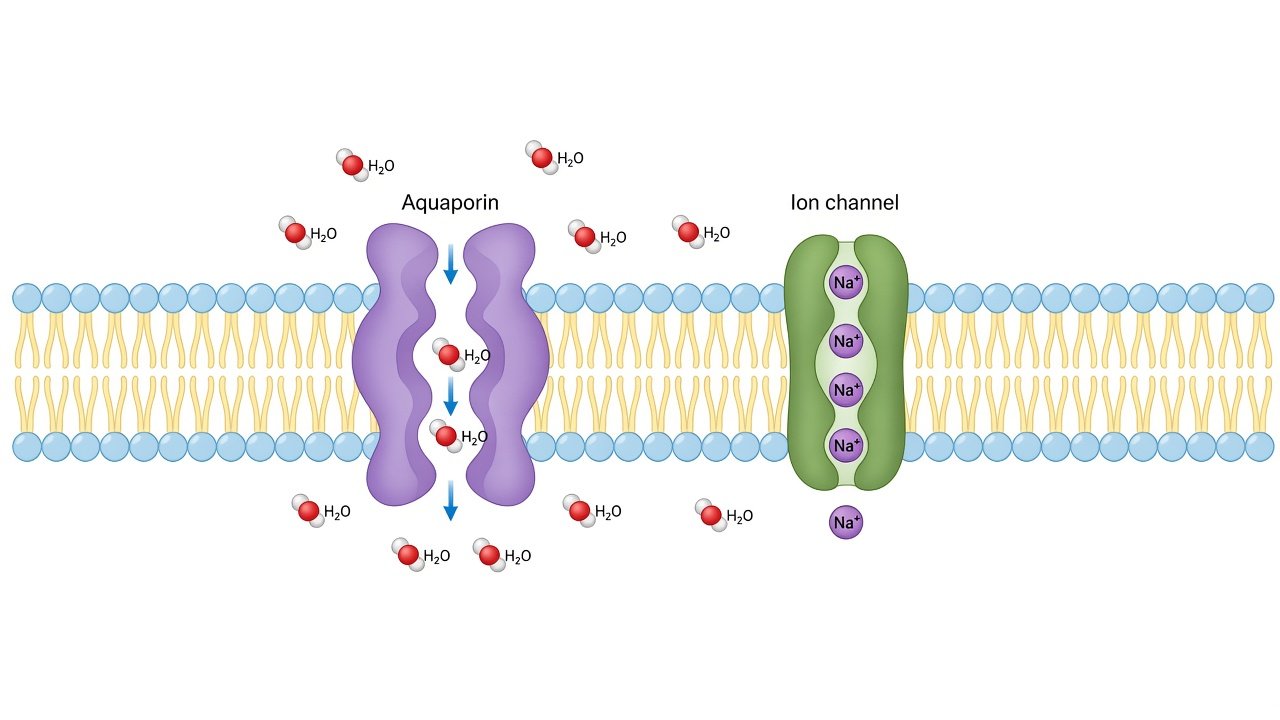
Membrane with aquaporin moving H2O and an ion channel moving Na+.
  1. A. active Na+/K+ pumping
  2. B. facilitated movement of large quantities of water through a channel
  3. C. simple free diffusion of a protein
  4. D. endocytosis of aquaporins

Question 7 of 10

If ion channels suddenly close while concentration gradients remain, membrane potential may change because

  1. A. ions never affect polarization
  2. B. channels synthesize ATP
  3. C. altered facilitated ion fluxes change charge separation across the membrane
  4. D. aquaporins pump Na+

Question 8 of 10

Facilitated diffusion differs from simple diffusion of O2 mainly because facilitated diffusion

  1. A. requires membrane proteins for the permeating solute
  2. B. always consumes ATP
  3. C. moves solutes only against gradients
  4. D. occurs only in cell walls

Question 9 of 10

The table shows glucose uptake with and without a transporter inhibitor (ATP unchanged). Uptake falls with inhibitor. Best conclusion:

Condition Relative glucose uptake
Control 1.0
Transporter inhibitor 0.2
  1. A. Glucose crosses only by dissolving in tails like O2
  2. B. A large fraction of glucose entry uses facilitated protein pathways
  3. C. Glucose entry is purely exocytosis
  4. D. Inhibitor created new aquaporins

Question 10 of 10

Charged ions such as Na+ and K+ do not freely cross the bilayer because

  1. A. they are small nonpolar gases
  2. B. the hydrophobic membrane interior excludes them, so they need channel proteins
  3. C. they are identical to water in all properties
  4. D. cells never contain ions