TOPIC 2.7 · STUDY
Tonicity and Osmoregulation
Water moves by osmosis from high water potential to low water potential, which is from a hypotonic region toward a hypertonic region. Water potential is pressure potential plus solute potential. Solute potential becomes more negative as dissolved solute increases. Osmoregulation is how organisms keep that water balance and their internal solute mix.
2.7.A
Tonicity and water potential
Compare the solution outside a cell with the solution inside. A hypotonic outside has a lower solute concentration than the cell, so water enters and an animal cell swells. A hypertonic outside has a higher solute concentration, so water leaves and the cell shrivels. An isotonic outside matches the cell, so there is no net movement of water. The same rule can be said without naming the cell: water moves from hypotonic regions to hypertonic regions.
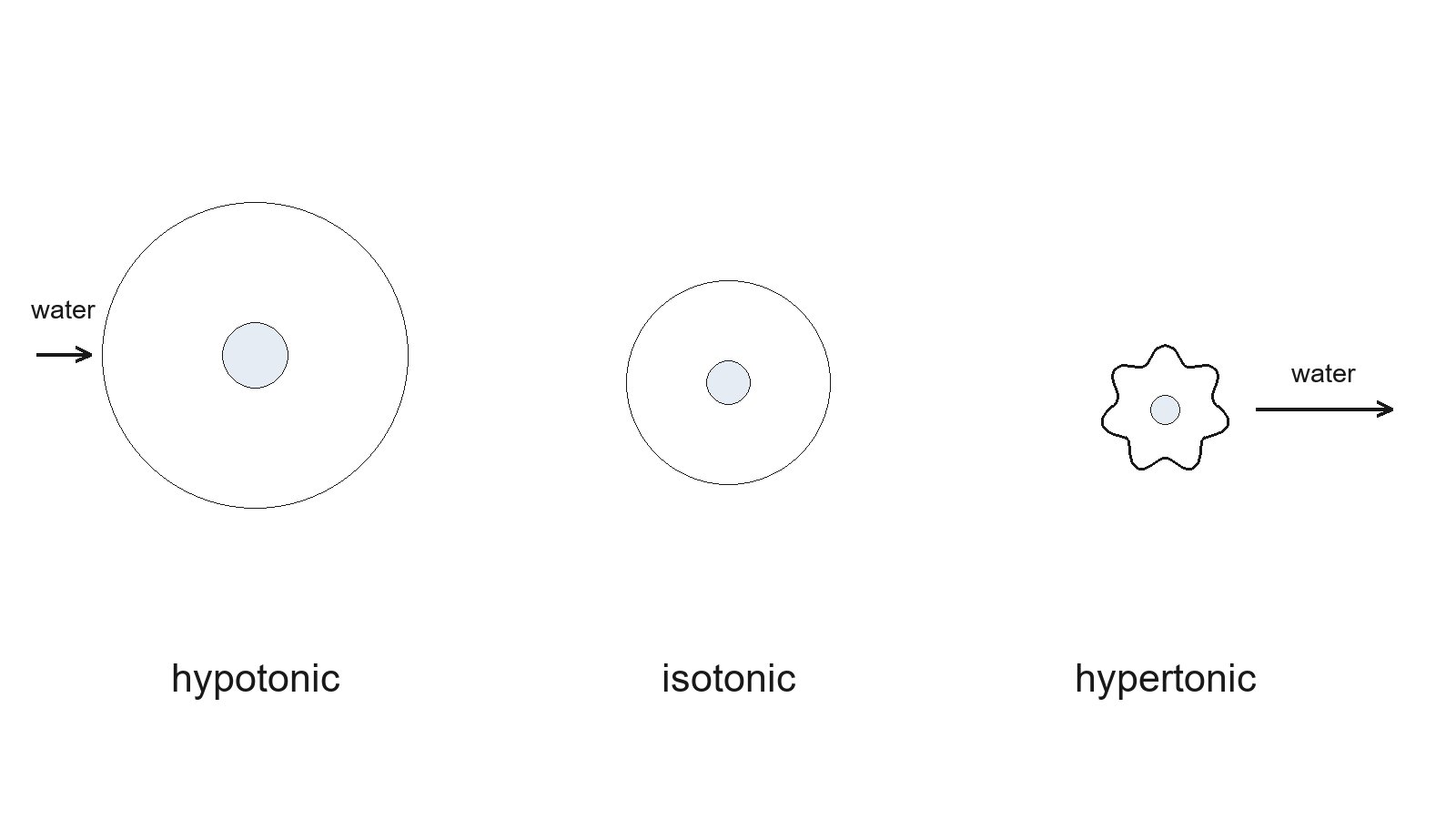
Water enters the large cell in the hypotonic bath and leaves the small irregular cell in the hypertonic bath. The middle cell is isotonic and has no water arrow.
Water potential describes the same direction with a number. Water moves from high water potential to low water potential. The equation is $\psi = \psi_p + \psi_s$, where $\psi$ is water potential, $\psi_p$ is pressure potential, and $\psi_s$ is solute potential. Dissolved solute makes $\psi_s$ more negative, which lowers $\psi$. In an open container the pressure potential is zero, so water potential equals solute potential.
Two open beakers have $\psi_p = 0$. Pure water has $\psi_s = 0$, so its water potential is $0$. A beaker of sucrose has a negative solute potential, so its water potential is lower. Net water movement is from the pure water into the sucrose solution.
2.7.B
Osmoregulation
Growth and homeostasis depend on molecules moving across membranes all the time, not on a single filling of the cell. Osmoregulation is the set of mechanisms that keep water balance and let an organism control its internal solute composition and water potential. Water moves from regions of low osmolarity, meaning low solute concentration, toward regions of high osmolarity. That matches the hypotonic-to-hypertonic rule: the high-osmolarity side is hypertonic and, if pressure potentials are equal, it has the lower water potential.
Solute potential of a solution is $\psi_s = -iCRT$. The ionization constant $i$ is $1.0$ for sucrose, because sucrose does not break into ions. $C$ is the molar concentration. $R$ is the pressure constant, $0.0831$ liter bars per mole per kelvin. $T$ is the temperature in kelvin, which is degrees Celsius plus $273$. The minus sign means a higher concentration makes solute potential more negative. If the solute ionizes, $i$ is greater than $1$, and the same molarity makes $\psi_s$ more negative.
Take a $0.20$ M sucrose solution at $27$ degrees Celsius. Then $i = 1$, $C = 0.20$, $R = 0.0831$, and $T = 300$. So $\psi_s = -(1)(0.20)(0.0831)(300) = -4.986$ bar, about $-5.0$ bar. In an open beaker, $\psi_p = 0$, so $\psi$ is about $-5.0$ bar. Pure water open to the air has $\psi = 0$. Water moves into the sucrose solution.
Organisms act on these gradients. A freshwater protist lives in a hypotonic pond, gains water, and uses a contractile vacuole to pump the excess back out. A plant cell stores water in its large central vacuole. In a hypotonic bath that vacuole presses outward and the cell becomes turgid, which is the healthy firm state. Incoming water raises $\psi_p$ until the water potential inside matches the outside and net flow stops. In a hypertonic bath, water leaves, the cytoplasm pulls away from the wall, and the cell risks plasmolysis. An animal cell has no wall to stop swelling, so an isotonic surrounding is the safe match.
Key points
- Hypotonic surroundings: water enters. Hypertonic surroundings: water leaves. Isotonic surroundings: no net water movement.
- Water moves from high water potential to low water potential, and from hypotonic regions toward hypertonic regions.
- Water potential is $\psi = \psi_p + \psi_s$. In an open container, $\psi_p = 0$, so $\psi = \psi_s$.
- Solute potential is $\psi_s = -iCRT$, with $R = 0.0831$ liter bars per mole per kelvin and $T$ in kelvin. Sucrose has $i = 1$.
- A $0.20$ M sucrose solution at $27$ degrees Celsius has $\psi_s$ about $-5.0$ bar.
- Osmoregulation keeps water balance and internal solutes. A contractile vacuole pumps excess water out of a protist.
- The plant central vacuole stores water and supports turgor. High outside osmolarity draws water out.
Use degrees Celsius plus 273 for kelvin, and use i = 1 only when the solute does not ionize. The result of the solute-potential equation is in bars.