TOPIC 2.3 · STUDY
Plasma Membrane
Phospholipids form a bilayer with phosphate heads toward water and fatty-acid tails toward each other. Proteins sit in that bilayer according to which parts are polar and which are nonpolar. In the fluid mosaic model, proteins, cholesterol, glycoproteins, and glycolipids can move sideways in the phospholipid framework.
2.3.A
Phospholipids and membrane proteins
Each phospholipid has a hydrophilic part and a hydrophobic part. The phosphate head is polar, so it stays in contact with water. The fatty-acid tails are nonpolar, so they avoid water and face each other in the interior of the membrane. In a cell, one row of heads faces the watery outside and the other faces the cytosol. That bilayer is what marks off an internal environment from the surroundings.
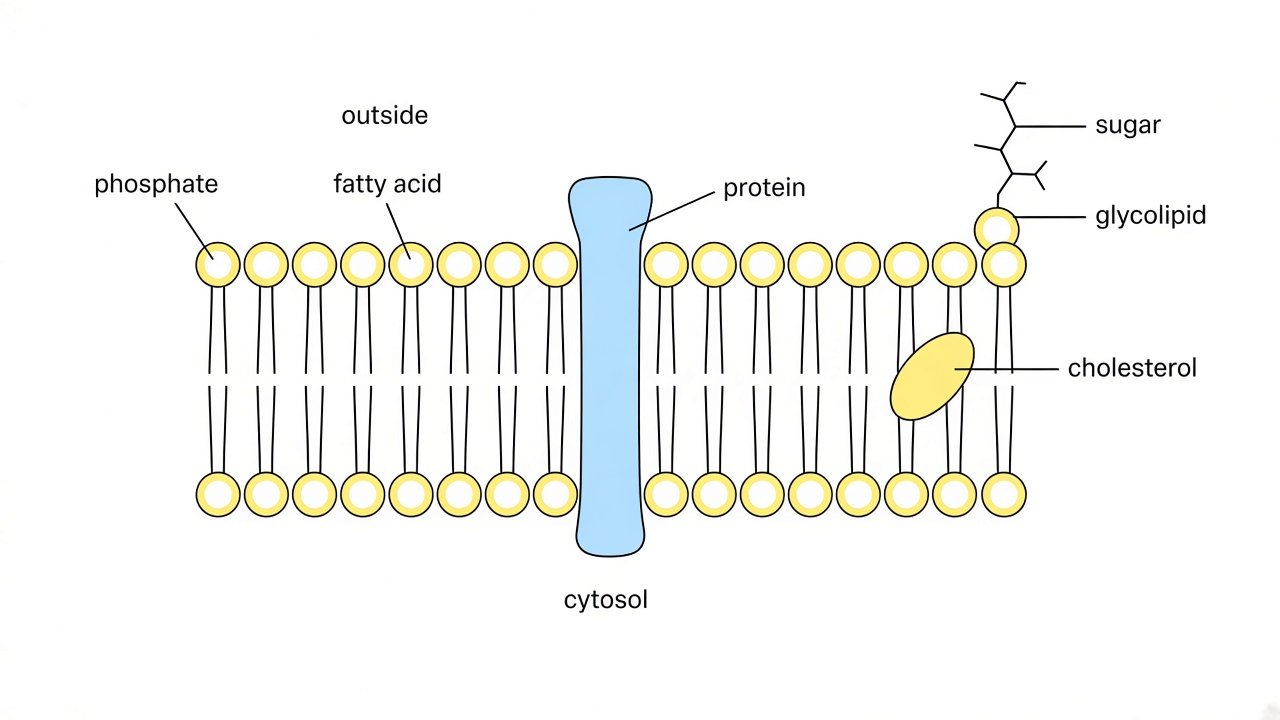
Phosphate heads face the outside and the cytosol. Fatty-acid tails meet in the middle. A protein spans the bilayer, cholesterol sits among the tails, and a glycolipid carries sugar on the outer surface.
An embedded protein can be hydrophilic, hydrophobic, or both. Hydrophilic regions have charged or polar side groups. They are exposed to the cytosol, or they line watery spaces inside the protein, such as the pore of a channel. The part of the protein that faces the watery outside of the cell is hydrophilic for the same reason: it contacts water. Hydrophobic regions have nonpolar side groups. They form the surface of the protein that touches the fatty acids in the membrane interior. A protein that crosses the bilayer therefore needs a nonpolar belt where it meets the tails, even when its ends are polar.
2.3.B
The fluid mosaic model
The plasma membrane is a phospholipid framework with other molecules set into it: proteins, steroids such as cholesterol in vertebrate animals, glycoproteins, and glycolipids. The fluid mosaic model says these components are not locked in place. They can move around within the plane of the membrane. Fluid refers to that sideways movement. Mosaic refers to the mixture of different molecules, rather than a sheet made of one repeating part.
Cholesterol is a steroid that nests among the hydrophobic tails in animal membranes and adds structural stability to the moving bilayer. Sugar chains on glycoproteins and glycolipids face the watery exterior. They help the cell interact with its surroundings. Because the pieces can move, the cell can rearrange which proteins sit in a given patch of membrane. Transport and signaling, taken up in later topics, still depend on this fluid structure. The membrane is not a static wall.
Key points
- Phosphate heads are hydrophilic and face water on both sides of the bilayer. Fatty-acid tails are hydrophobic and face inward.
- Hydrophilic protein regions contact water: the cytosol, the cell exterior, or an aqueous pore. Hydrophobic regions contact the fatty-acid core.
- The fluid mosaic is a phospholipid framework plus proteins, steroids such as cholesterol, glycoproteins, and glycolipids.
- Fluid means those components can move sideways in the membrane. Mosaic means the membrane is a mixture of molecules.
- In vertebrate animals, cholesterol among the tails adds structural stability.
- Sugars of glycoproteins and glycolipids face the outside of the cell.