Plasma Membrane MCQ Practice

Question 1 of 10

In an aqueous environment, phospholipid bilayers spontaneously organize so that

  1. A. hydrophobic tails point into water and heads hide
  2. B. heads face only the extracellular side, never the cytosol
  3. C. hydrophilic heads face water on both sides and tails form a hydrophobic core
  4. D. tails covalently bind water molecules
Question 2 of 10

Which property of phosphate heads explains their orientation toward cytosol and extracellular fluid?

  1. A. They are polar/hydrophilic
  2. B. They are nonpolar hydrocarbons
  3. C. They are identical to fatty acid tails
  4. D. They lack any interaction with water

Question 3 of 10

A transmembrane channel protein must span the hydrophobic core. Therefore it must include

  1. A. only hydrophilic amino acids throughout its length
  2. B. hydrophobic regions that interact with fatty acid tails
  3. C. no amino acids at all
  4. D. cellulose repeats

Question 4 of 10

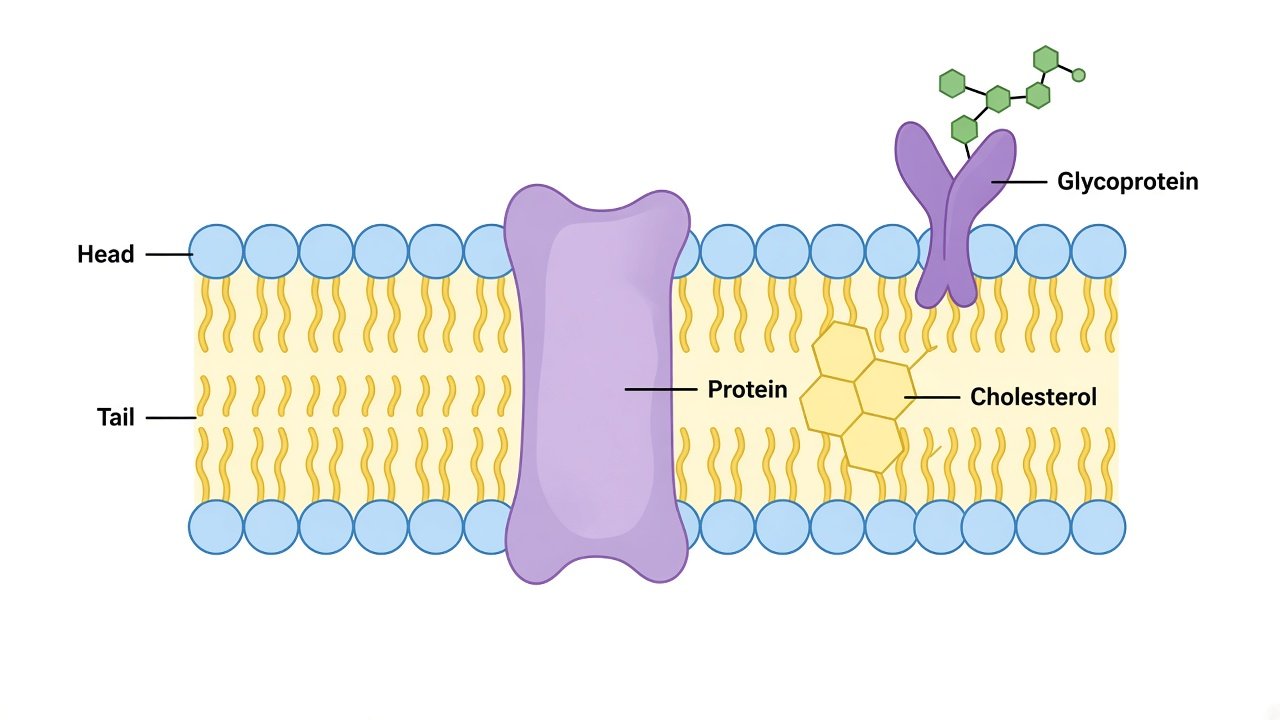
Looking at the figure, fatty acid tails are shown facing

Plasma membrane cross-section with phospholipid heads and tails, transmembrane protein, cholesterol, and glycoprotein labeled.
  1. A. only the extracellular water
  2. B. only the cytosol water
  3. C. both aqueous sides exclusively
  4. D. each other within the membrane interior

Question 5 of 10

Embedded proteins that are hydrophilic with charged/polar side groups often

  1. A. expose those groups to aqueous environments
  2. B. bury all charges permanently among tails only
  3. C. dissolve the entire bilayer into free nucleotides
  4. D. function only as DNA primers

Question 6 of 10

The table compares molecule parts. Which pairing is accurate?

Part Interaction with water
Fatty acid tail Hydrophilic
Phosphate head Hydrophobic
Correct pairing Tail hydrophobic; head hydrophilic
  1. A. Fatty acid tail — strongly hydrophilic
  2. B. Phosphate head — strongly hydrophobic
  3. C. Fatty acid tail — hydrophobic; phosphate head — hydrophilic
  4. D. Both head and tail — equally hydrophilic

Question 7 of 10

According to the fluid mosaic model, membrane components

  1. A. are permanently welded in place and never move
  2. B. can move around the surface of the cell within the membrane
  3. C. exist only as free DNA in the cytosol
  4. D. exclude all proteins by definition

Question 8 of 10

Steroids such as cholesterol in vertebrate membranes are

  1. A. part of the structural mosaic alongside phospholipids and proteins
  2. B. the sole component of prokaryotic cell walls
  3. C. identical to messenger RNA
  4. D. found only in chloroplast stroma

Question 9 of 10

Which list correctly names fluid mosaic components?

  1. A. Only cellulose and peptidoglycan
  2. B. Only naked DNA and RNA
  3. C. Phospholipids, proteins, steroids, glycoproteins, and glycolipids
  4. D. Only starch granules

Question 10 of 10

The membrane figure is consistent with the fluid mosaic model because it shows

Plasma membrane cross-section with phospholipid heads and tails, transmembrane protein, cholesterol, and glycoprotein labeled.
  1. A. a membrane made only of protein crystals
  2. B. no lipids at all
  3. C. DNA double helices spanning the bilayer as the main fabric
  4. D. phospholipids with embedded proteins and other amphipathic molecules