Plasma Membrane MCQ Practice

Question 1 of 10

Phospholipids have hydrophilic phosphate regions and hydrophobic fatty acid regions. In a bilayer, the hydrophilic regions are oriented

  1. A. toward each other in the membrane interior
  2. B. toward the aqueous environments inside and outside the cell
  3. C. only toward the nucleus
  4. D. away from all water at all times

Question 2 of 10

Hydrophobic fatty acid tails of phospholipids face each other within the membrane because

  1. A. they are nonpolar and associate away from water
  2. B. they carry permanent positive charges that attract
  3. C. they dissolve completely in the cytosol
  4. D. they bind covalently to DNA

Question 3 of 10

An embedded membrane protein has both hydrophilic and hydrophobic regions. Where are hydrophobic regions typically located?

  1. A. Only in the aqueous cytosol far from the membrane
  2. B. Only covalently attached to cellulose outside plant walls
  3. C. On the protein surface that contacts fatty acid tails in the membrane interior
  4. D. Exclusively inside the nucleus

Question 4 of 10

Hydrophilic regions of membrane proteins are often

  1. A. buried only among fatty acid tails with no water contact
  2. B. made entirely of cholesterol rings
  3. C. identical to cellulose fibers
  4. D. exposed to the cytosol or lining aqueous parts of the protein

Question 5 of 10

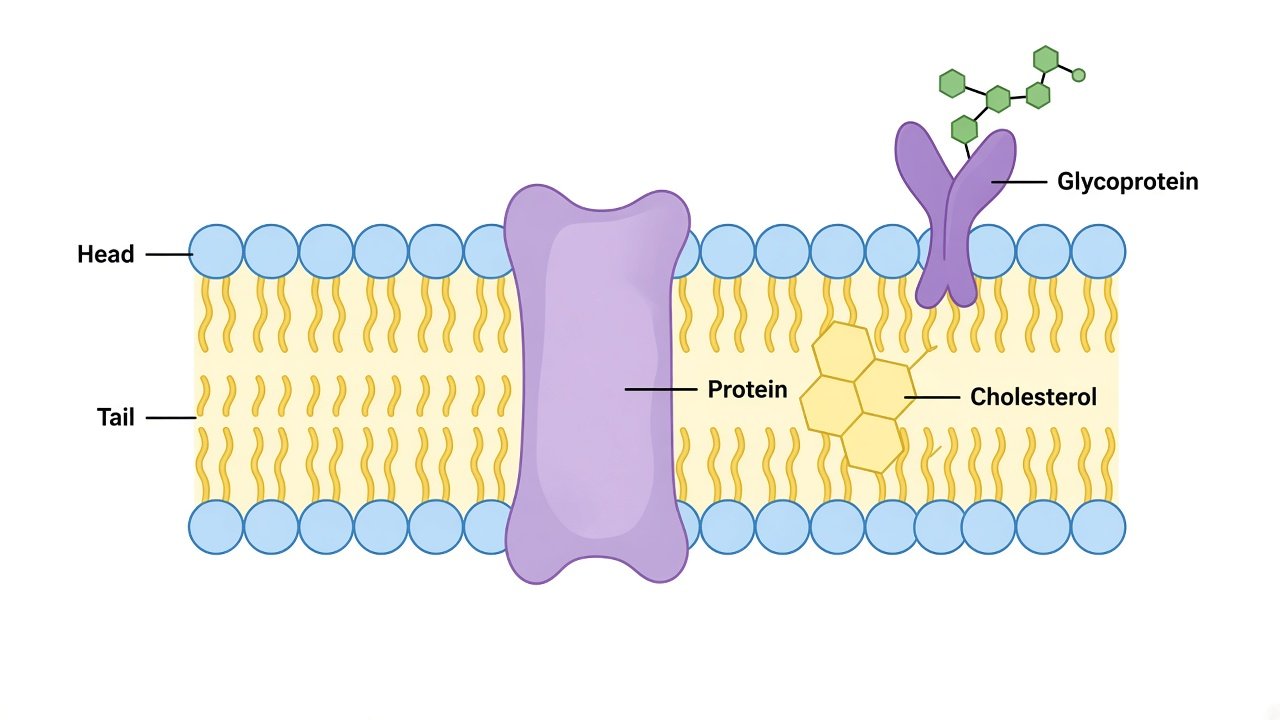
Using the figure, which labeled part is a polar hydrophilic region of a phospholipid?

Plasma membrane cross-section with phospholipid heads and tails, transmembrane protein, cholesterol, and glycoprotein labeled.
  1. A. Head
  2. B. Tail
  3. C. Only cholesterol
  4. D. Only the glycoprotein sugar alone without a lipid

Question 6 of 10

The table lists membrane component properties. Which row is correct?

Feature Property claimed
Fatty acid tails Hydrophilic
Phosphate heads Hydrophilic
Bilayer interior Fully aqueous
All proteins Only hydrophobic
  1. A. Fatty acid tails — hydrophilic
  2. B. Phosphate heads — hydrophilic
  3. C. Entire bilayer interior — fully aqueous like cytosol
  4. D. All embedded proteins — exclusively hydrophobic with no polar groups

Question 7 of 10

The fluid mosaic model describes plasma membranes as

  1. A. a rigid, unchanging crystal of only proteins
  2. B. a single layer of cellulose with no lipids
  3. C. a phospholipid framework with embedded proteins, steroids, glycoproteins, and glycolipids that can move within the membrane
  4. D. DNA strands floating in the membrane core

Question 8 of 10

Cholesterol in vertebrate animal membranes primarily contributes to

  1. A. structural stability within the fluid mosaic
  2. B. encoding hereditary information
  3. C. forming the cell wall of fungi
  4. D. replacing all phospholipids

Question 9 of 10

Which observation best supports membrane fluidity?

  1. A. Membrane components never change position after synthesis
  2. B. Labeled proteins can move laterally within the bilayer over time
  3. C. Phospholipids are covalently locked to DNA
  4. D. Membranes are solid ice at physiological temperature always

Question 10 of 10

Glycoproteins and glycolipids in the plasma membrane

  1. A. are found only in the mitochondrial matrix
  2. B. cannot move and are excluded from the mosaic model
  3. C. are identical to free ribosomes
  4. D. are membrane components that can move within the membrane surface as part of the fluid mosaic