TOPIC 2.2 · STUDY
Cell Size
Nutrients, wastes, and heat are exchanged across a surface. As a cell or an organism gets larger, volume grows faster than surface area, so the surface area-to-volume ratio falls. Cells stay small or add folds, and smaller organisms usually have a higher metabolic rate per unit of body mass.
2.2.A
Surface area, volume, and exchange
A cell obtains nutrients, dumps wastes, and gains or loses heat across its surface. Volume is the space that must be supplied and cleaned. The surface area-to-volume ratio, written SA/V, asks how much surface is available for each unit of volume. A high ratio means more efficient exchange with the environment. A low ratio means the interior is harder to serve.
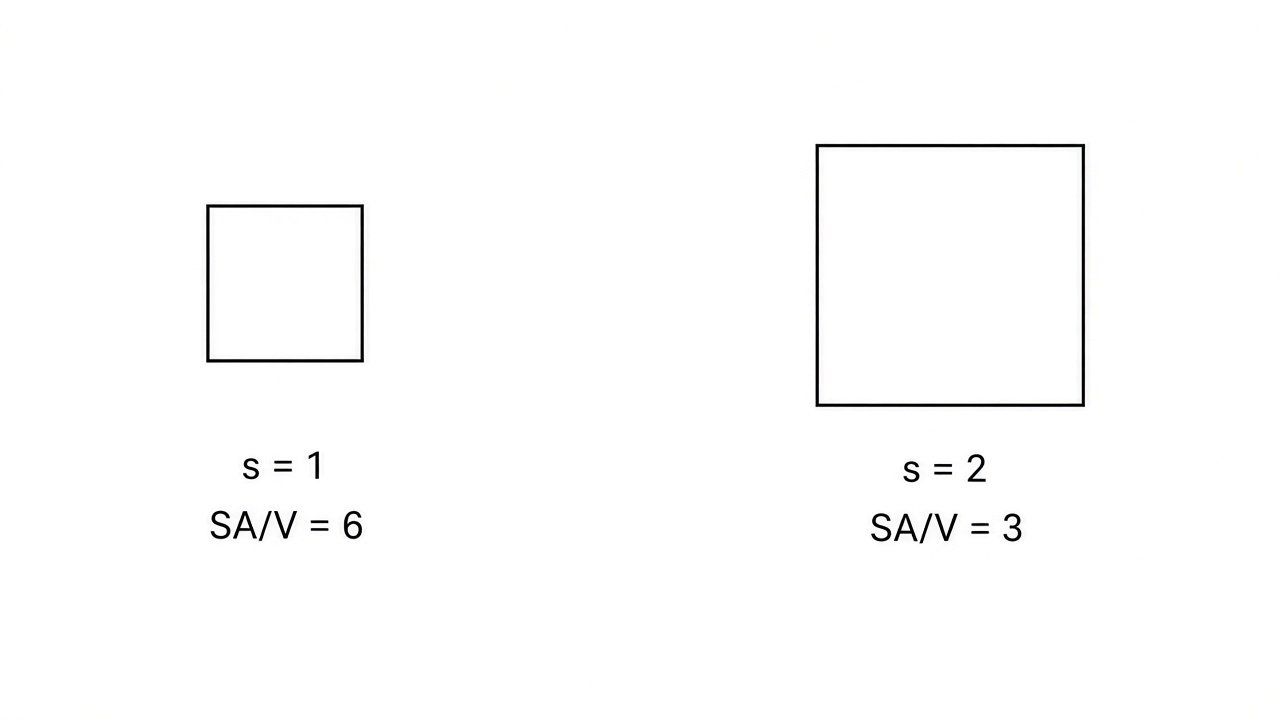
Each square stands for a cube of side length s. For a cube, SA/V equals 6/s, so side 1 gives a ratio of 6 and side 2 gives a ratio of 3.
For a cube of side length $s$, surface area is $SA = 6s^2$ and volume is $V = s^3$. The ratio simplifies to $SA/V = 6/s$. A cube with $s = 1$ has $SA/V = 6$. A cube with $s = 2$ has surface area $24$ and volume $8$, so $SA/V = 3$. Volume increased by a factor of $8$, while surface area increased only by a factor of $4$.
For a sphere, $SA = 4\pi r^2$ and $V = \frac{4}{3}\pi r^3$, so $SA/V = 3/r$. Radius $1$ gives ratio $3$. Radius $3$ gives ratio $1$. A rectangular solid has $V = lwh$ and $SA = 2lh + 2lw + 2wh$. A cylinder has $V = \pi r^2 h$ and $SA = 2\pi rh + 2\pi r^2$, so $SA/V = 2/r + 2/h$. Lengthen a cylinder without changing its radius and $SA/V$ falls, because the $2/h$ term gets smaller.
The plasma membrane must be large enough for the volume it encloses. That is why cell size and shape are limited. As a cell grows, SA/V drops and the demand for internal resources rises, so exchange lags behind need. Cells that must exchange a lot add area without a matching jump in volume. Root hairs are thin extensions of root cells. The folded surface of gut epithelium, including microvilli, does the same job in an animal. Cilia add surface and move fluid across a lining. Guard cells open and close stomata, which changes how much leaf surface exchanges gases with the air. Membrane folds inside mitochondria and chloroplasts are the same geometric idea at a smaller scale: more membrane area in about the same volume.
Whole organisms follow the same rule. A small body of a given shape has a higher SA/V than a large body of that shape. A smaller mass therefore exchanges proportionally more heat with the surroundings. As mass increases, both SA/V and the rate of heat exchange decrease. Among multicellular organisms, the smaller one typically has the higher metabolic rate per unit of body mass, which helps replace heat and supply a body that loses materials quickly across its surface.
Key points
- SA/V controls exchange of nutrients, wastes, chemicals, and heat with the environment.
- Cube: $SA = 6s^2$, $V = s^3$, and $SA/V = 6/s$. Sphere: $SA/V = 3/r$.
- A cube of side $1$ has $SA/V = 6$. A cube of side $2$ has $SA/V = 3$.
- Larger cells have a lower SA/V, so they need folds, hairs, or another shape change to keep exchanging enough material.
- For a cylinder, $SA/V = 2/r + 2/h$. A longer cylinder of the same radius has a lower ratio.
- As an organism gets larger, SA/V and the rate of heat exchange both decrease.
- Smaller multicellular organisms usually have a higher metabolic rate per unit of body mass.
These area and volume formulas are on the AP Biology equation sheet. Use the shape the problem gives, then compare the ratios.