Cell Size MCQ Practice

Question 1 of 10

Surface area-to-volume ratios affect a cell’s ability to

  1. A. change the genetic code of its DNA without mutation
  2. B. obtain nutrients, eliminate wastes, and exchange energy with the environment
  3. C. eliminate the need for a plasma membrane
  4. D. stop all osmosis permanently

Question 2 of 10

For a cube-shaped model cell of side length $s$, surface area is $6s^2$ and volume is $s^3$. As $s$ increases, SA/V

  1. A. decreases, reducing exchange efficiency per unit volume
  2. B. increases without bound
  3. C. remains constant for all $s$
  4. D. becomes undefined because volume is zero

Question 3 of 10

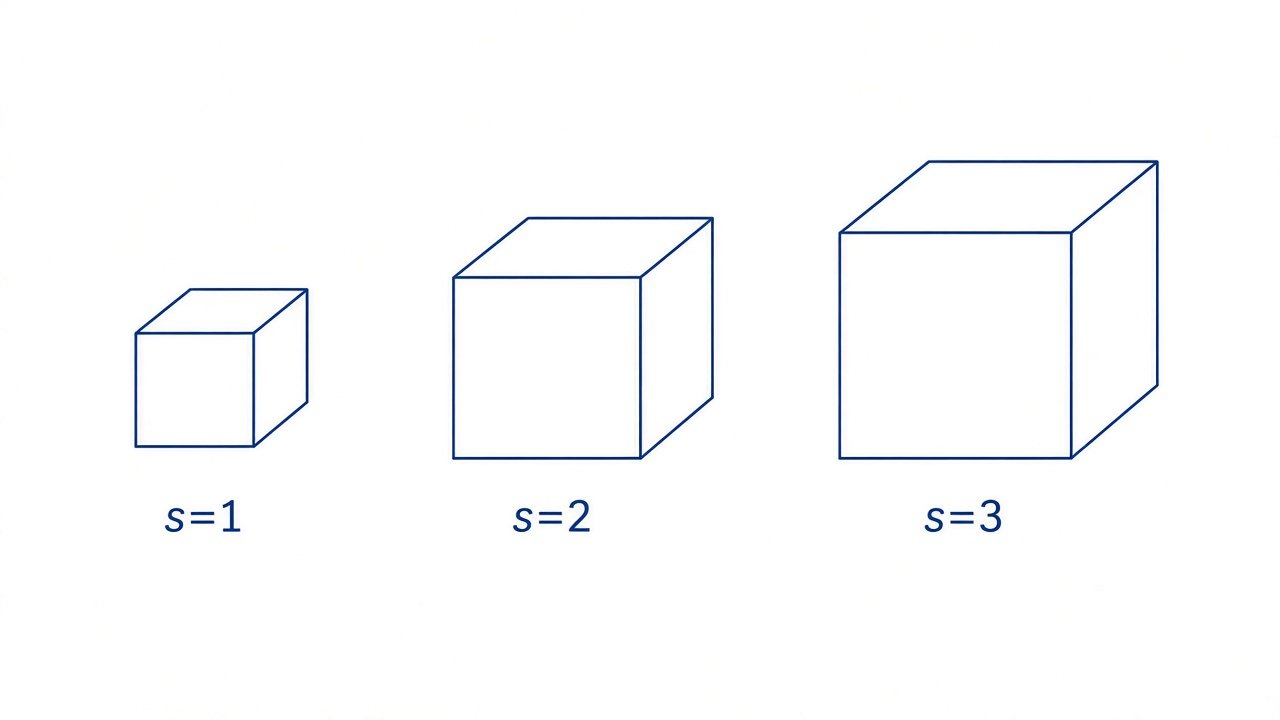
The figure shows three cubes. Which cube has the highest surface area-to-volume ratio?

Three model-cell cubes labeled s=1, s=2, and s=3 in increasing size.
  1. A. The cube with $s=1$
  2. B. The cube with $s=2$
  3. C. The cube with $s=3$
  4. D. All three have identical SA/V

Question 4 of 10

As a spherical cell grows larger without changing shape, demand for resources typically

  1. A. falls because volume shrinks
  2. B. is unrelated to size
  3. C. increases as volume grows faster relative to surface area
  4. D. disappears because membranes become unnecessary

Question 5 of 10

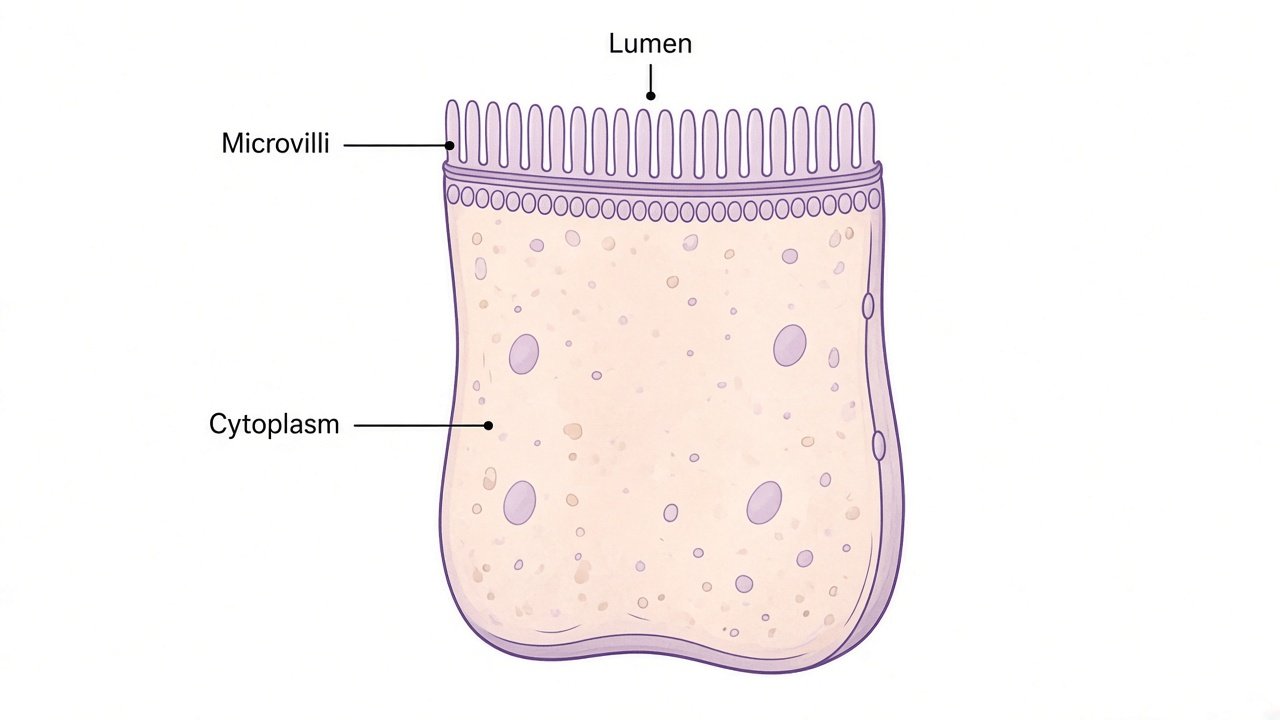
Root hairs and intestinal microvilli both

Intestinal epithelial cell with apical microvilli facing a lumen.
  1. A. decrease membrane surface area to slow exchange
  2. B. increase membrane surface area to enhance material exchange
  3. C. eliminate the need for concentration gradients
  4. D. convert the cell into a prokaryote

Question 6 of 10

Compared with a large mammal of similar shape, a small mammal typically has

  1. A. a higher surface area-to-volume ratio and exchanges heat with the environment more rapidly per unit mass
  2. B. a lower SA/V and never loses heat
  3. C. identical heat exchange rates regardless of mass
  4. D. zero surface area because skin is impermeable

Question 7 of 10

The graph shows SA/V versus cube side length. Which conclusion is best?

Graph of surface area-to-volume ratio versus cube side length s from 1 to 4, declining as s increases.
  1. A. SA/V increases linearly as cells enlarge
  2. B. SA/V is maximal at the largest cube
  3. C. SA/V declines as side length increases, limiting efficient exchange in large cells
  4. D. SA/V is independent of geometry

Question 8 of 10

Complex membrane folds become necessary as cells enlarge because

  1. A. folds destroy all transport proteins
  2. B. volume must always exceed surface area by law
  3. C. DNA replication requires folds
  4. D. additional membrane area is needed to exchange materials adequately with the environment

Question 9 of 10

Two organisms have the same shape but different mass. Organism Q has four times the mass of organism P. Relative to P, Q is expected to have

  1. A. a higher SA/V and higher metabolic rate per unit body mass
  2. B. a lower SA/V and typically a lower metabolic rate per unit body mass
  3. C. identical SA/V and identical mass-specific metabolic rate
  4. D. undefined metabolic rate because mass cancels SA/V

Question 10 of 10

The table lists calculated SA and V for two model cells. Which cell exchanges materials more efficiently relative to its volume?

Cell SA (units$^2$) V (units$^3$)
X 24 4
Y 96 32
  1. A. Cell X
  2. B. Cell Y
  3. C. Neither, because SA/V is identical
  4. D. Cell Y, because it has larger volume alone