Cell Size MCQ Practice

Question 1 of 10

Why must plasma membrane surface area be large enough relative to cell volume?

  1. A. To prevent ribosomes from functioning
  2. B. To store all DNA outside the nucleus
  3. C. To adequately exchange materials with the environment
  4. D. To eliminate osmosis

Question 2 of 10

For cubes, SA/V equals $6/s$. A cube with $s=4$ has SA/V

  1. A. 24
  2. B. 6
  3. C. 4
  4. D. 1.5

Question 3 of 10

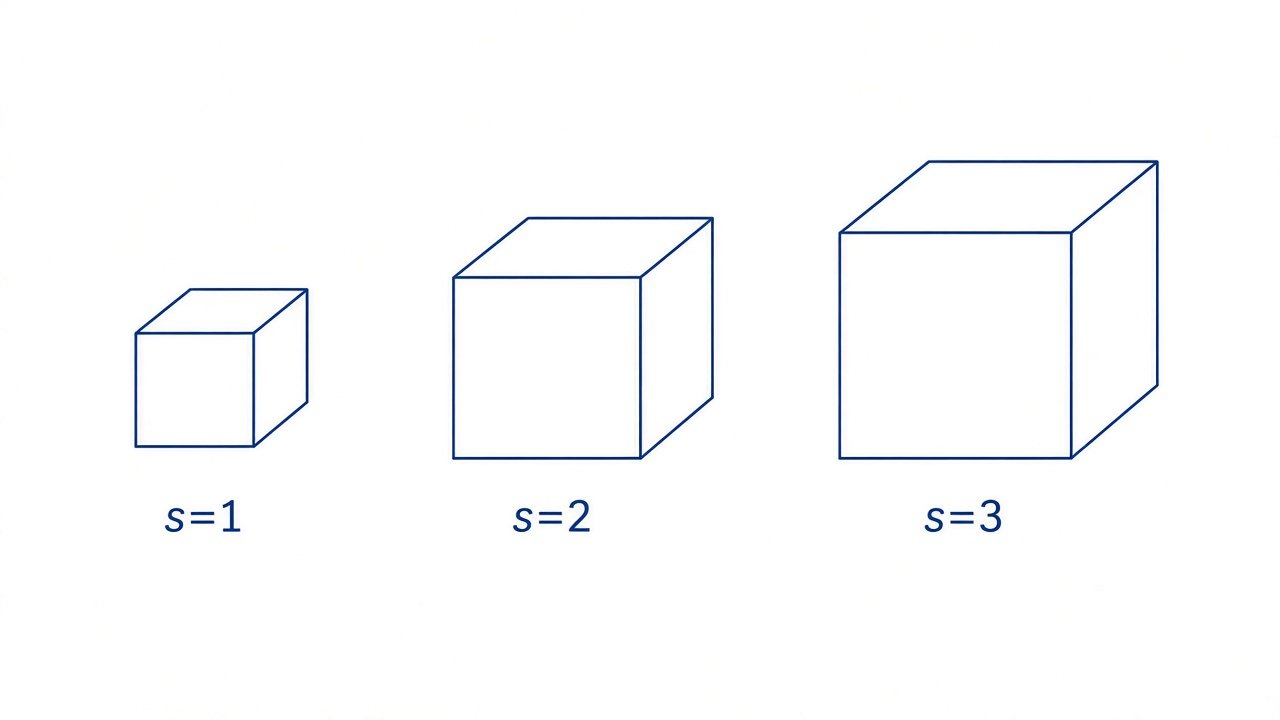
Which statement about the cube figure is correct?

Three model-cell cubes labeled s=1, s=2, and s=3 in increasing size.
  1. A. The largest cube has the highest SA/V
  2. B. The smallest cube has the highest SA/V
  3. C. SA/V is the same for $s=1$ and $s=3$
  4. D. Volume alone determines SA/V without surface area

Question 4 of 10

Guard cells and stomata relate to SA/V ideas because they

  1. A. are structures involved in exchange of gases with the environment
  2. B. remove all membranes from leaf cells
  3. C. increase cell volume without surface area changes
  4. D. prevent any water movement in plants

Question 5 of 10

A cylindrical cell lengthens while diameter stays fixed. Relative to a shorter cylinder of the same diameter, the longer cell’s SA/V generally

  1. A. increases without limit
  2. B. is unaffected by length
  3. C. decreases as volume rises faster than the added surface from the ends
  4. D. becomes infinite

Question 6 of 10

Which graph feature in the SA/V versus $s$ plot supports the claim that cell size is constrained?

Graph of surface area-to-volume ratio versus cube side length s from 1 to 4, declining as s increases.
  1. A. Rising SA/V with larger $s$
  2. B. Falling SA/V as $s$ increases
  3. C. A horizontal line at SA/V $=0$
  4. D. Negative volumes

Question 7 of 10

Organism A has higher metabolic rate per unit body mass than organism B of similar shape. The pattern is most consistent with organism A being

  1. A. smaller, with higher SA/V
  2. B. larger, with lower SA/V
  3. C. identical in mass to B
  4. D. nonliving

Question 8 of 10

Membrane folds in mitochondria or chloroplasts are analogous to cell-size strategies because both

  1. A. reduce reaction surface intentionally
  2. B. eliminate the need for ATP
  3. C. increase volume while decreasing membrane area
  4. D. increase membrane surface area available for reactions or exchange

Question 9 of 10

Using the table of spherical model cells, which has the greatest SA/V? (Sphere SA $=4\pi r^2$, V $=\tfrac{4}{3}\pi r^3$, so SA/V $=3/r$.)

Sphere Radius
P 1
Q 2
R 3
  1. A. Radius $1$
  2. B. Radius $2$
  3. C. Radius $3$
  4. D. All equal

Question 10 of 10

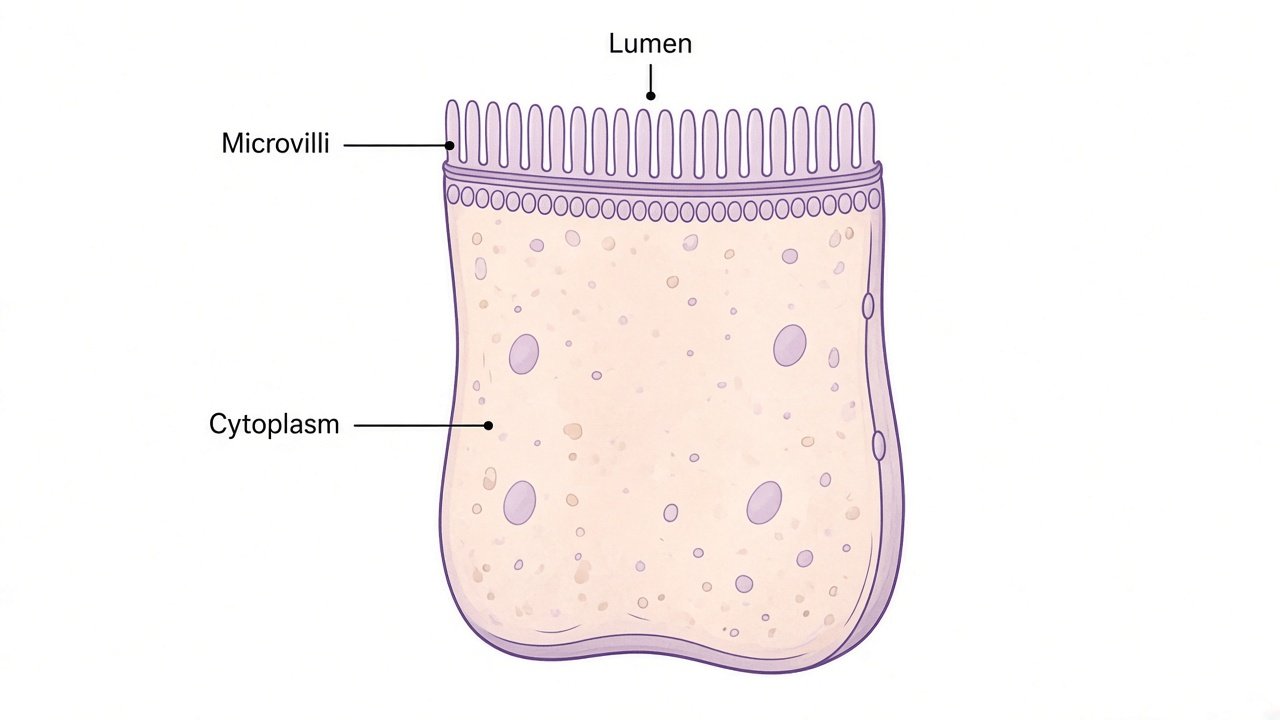
The microvilli figure best supports which claim?

Intestinal epithelial cell with apical microvilli facing a lumen.
  1. A. Flattened membranes always maximize SA/V
  2. B. Cells never need specialized exchange surfaces
  3. C. Folded plasma membrane increases area for exchange with the lumen
  4. D. Microvilli store DNA