Question 1 of 5
A cube model cell has side length $2.0$ arbitrary units. (a) Calculate surface area and volume. (b) Calculate SA/V. (c) Explain how SA/V would change if side length doubled.
Responses receive AI feedback against a rubric after submission. Scores are practice estimates.
A cube model cell has side length $2.0$ arbitrary units. (a) Calculate surface area and volume. (b) Calculate SA/V. (c) Explain how SA/V would change if side length doubled.
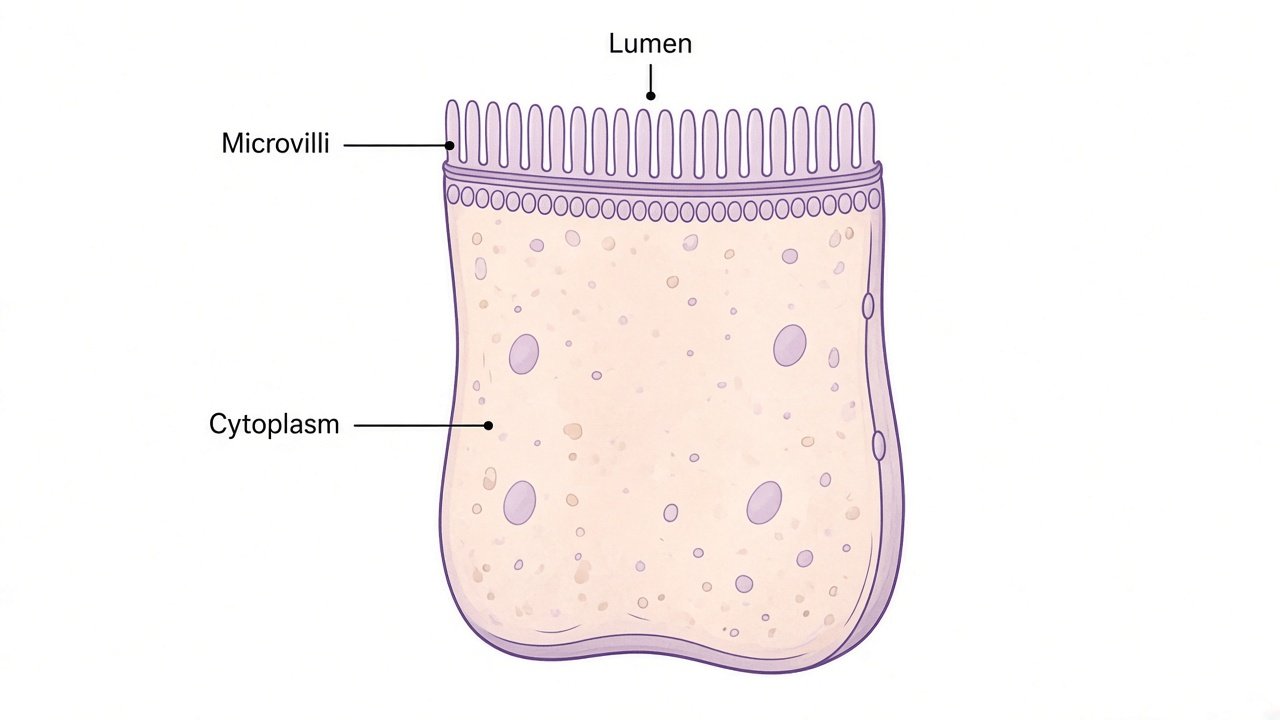
Using the microvilli figure, (a) describe how the apical folds affect surface area, (b) explain the advantage for nutrient absorption, and (c) predict what would happen to absorption rate if microvilli were flattened, assuming transporters per membrane area stay similar.
Two agar cubes of different sizes are soaked in indicator and then placed in vinegar that diffuses inward. (a) Predict which cube becomes clear first and why in terms of SA/V. (b) Relate the model to limits on living cell size. (c) State one biological adaptation that increases exchange area without shrinking the whole organism.
Explain heat exchange in terms of SA/V. (a) Compare a small and large animal of similar shape. (b) State how mass affects SA/V. (c) Connect the pattern to why small endotherms often need high mass-specific metabolic rates.
A student claims any cell can grow indefinitely if it synthesizes enough enzymes. Critique the claim. (a) Identify the physical constraint involving membranes. (b) Use SA/V reasoning. (c) Describe how multicellularity or membrane folding can mitigate the constraint without violating exchange limits.