TOPIC 9.1 · STUDY
Kinetic Theory of Temperature and Pressure
Pressure on a wall is the normal force per area from molecular collisions that deliver perpendicular momentum. Average translational kinetic energy per molecule is (3/2) k T, so absolute temperature sets the scale of molecular speeds without being a property of one slow molecule.
9.1.A
Kinetic theory
Pressure on a wall is the normal force per area. That force is the rate at which perpendicular momentum is delivered by molecular collisions. Only the component of velocity straight toward the wall matters for the impulse on the wall.
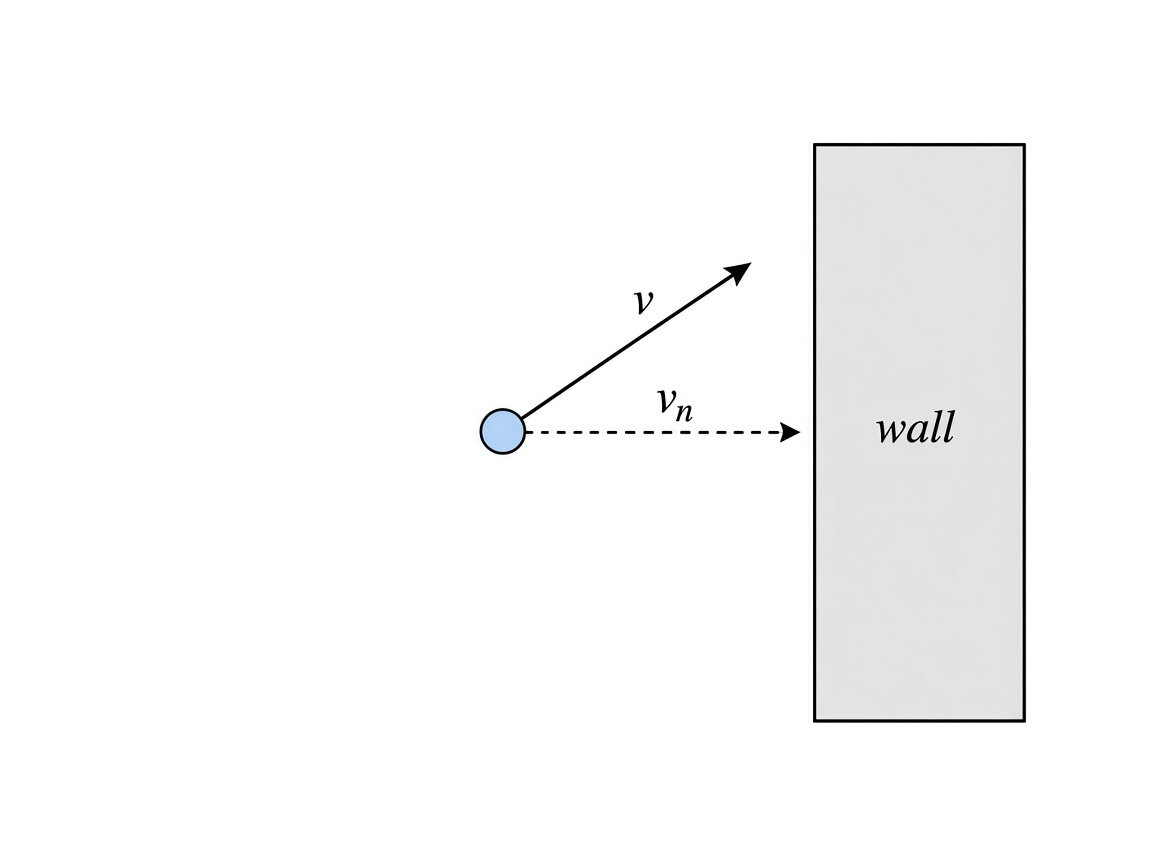
Only the perpendicular component vn reverses when the molecule rebounds from a fixed wall. The parallel component is unchanged.
For an elastic rebound from a fixed wall, if the incoming perpendicular speed is $v_{\mathrm{n}}$, the perpendicular momentum changes by $2mv_{\mathrm{n}}$. Example: $m=4.0\times 10^{-26}\,\mathrm{kg}$ and $v_{\mathrm{n}}=250\,\mathrm{m/s}$ give $$\Delta p=2mv_{\mathrm{n}}=2(4.0\times 10^{-26})(250)=2.0\times 10^{-23}\,\mathrm{kg\,m/s}.$$ A molecule moving parallel to the wall has $v_{\mathrm{n}}=0$, so it transfers no perpendicular momentum to that wall.
If the molecule sticks instead of rebounding, the outgoing perpendicular speed is zero. The momentum transfer is only $mv_{\mathrm{n}}$, half the elastic value $2mv_{\mathrm{n}}$.
Wall pressure depends on how often molecules hit and how much perpendicular momentum each hit delivers. Doubling $v_{\mathrm{rms}}$ at fixed $N$ and $V$ doubles both the collision rate and the momentum per collision, so pressure increases by a factor of $4$.
The average translational kinetic energy per molecule is $$\frac{1}{2}m\overline{v^{2}}=\frac{3}{2}kT,$$ with Boltzmann's constant $k=1.38\times 10^{-23}\,\mathrm{J/K}$. At $T=300\,\mathrm{K}$ that average is $$\frac{3}{2}(1.38\times 10^{-23})(300)=6.21\times 10^{-21}\,\mathrm{J}.$$ Temperature is a property of the sample, not of one slow molecule whose speed happens to be far below $v_{\mathrm{rms}}$.
Writing $\frac{1}{2}mv_{\mathrm{rms}}^{2}=\frac{3}{2}kT$ gives $$v_{\mathrm{rms}}=\sqrt{\frac{3kT}{m}}.$$ At the same $T$, $v_{\mathrm{rms}}$ scales as $1/\sqrt{m}$. A molecule with $4$ times the mass has half the rms speed. Doubling $v_{\mathrm{rms}}$ multiplies $T$ by $4$, because $T$ is proportional to $v_{\mathrm{rms}}^{2}$.
The rms speed is the square root of the average of $v^{2}$, not the average speed. Molecules with a spread of speeds have $\overline{v}$ and $v_{\mathrm{rms}}$ that are close but not identical; the kinetic-theory link to temperature uses $v_{\mathrm{rms}}$.
Absolute temperature must be used. Warming from $27\,^{\circ}\mathrm{C}$ ($300\,\mathrm{K}$) to $327\,^{\circ}\mathrm{C}$ ($600\,\mathrm{K}$) doubles the average translational kinetic energy per molecule. Do not use the Celsius ratio $327/27$; that ratio is meaningless for kinetic energy.
Two gases at the same $T$ have the same average translational kinetic energy per molecule, $\frac{3}{2}kT$, even if their molecular masses and rms speeds differ. The heavier gas has the smaller $v_{\mathrm{rms}}$ at that shared temperature.
A thin disk inside the gas feels equal average pressure on both faces when the sample is in equilibrium. The net force on the disk can be zero while each face still feels many collisions; the impulses from opposite sides cancel on average.
Key points
- Pressure is normal force per area; that force is the rate of perpendicular momentum delivery by collisions.
- Elastic rebound from a fixed wall changes perpendicular momentum by $2mv_{\mathrm{n}}$; sticking transfers only $mv_{\mathrm{n}}$.
- A molecule moving parallel to the wall transfers no perpendicular momentum to that wall.
- Doubling $v_{\mathrm{rms}}$ at fixed $N$ and $V$ multiplies pressure by $4$.
- Average translational KE per molecule is $\frac{3}{2}kT$; $v_{\mathrm{rms}}=\sqrt{3kT/m}$.
- At fixed $T$, $v_{\mathrm{rms}}$ scales as $1/\sqrt{m}$; doubling $v_{\mathrm{rms}}$ multiplies $T$ by $4$.
- Use absolute temperature: $300\,\mathrm{K}$ to $600\,\mathrm{K}$ doubles average translational KE, not a Celsius ratio.
- Equal average pressure on both faces of a disk can give zero net force while collisions continue on each face.
Temperature measures average translational kinetic energy per molecule, $\frac{3}{2}kT$.