Kinetic Theory of Temperature and Pressure FRQ Practice

Responses receive AI feedback against a rubric after submission. Scores are practice estimates.

Question 1 of 5

The figure shows one molecule just before it hits a fixed wall. The molecule’s mass is $5.0\times 10^{-26}\,\mathrm{kg}$. The component of velocity perpendicular to the wall is $300\,\mathrm{m/s}$ toward the wall, and the component parallel to the wall is $400\,\mathrm{m/s}$. The collision is elastic and the wall does not move. (a) Calculate the magnitude of the molecule’s change in momentum. (b) State the magnitude and direction of the impulse delivered to the wall. (c) Explain why the parallel component does not affect the pressure on this wall.
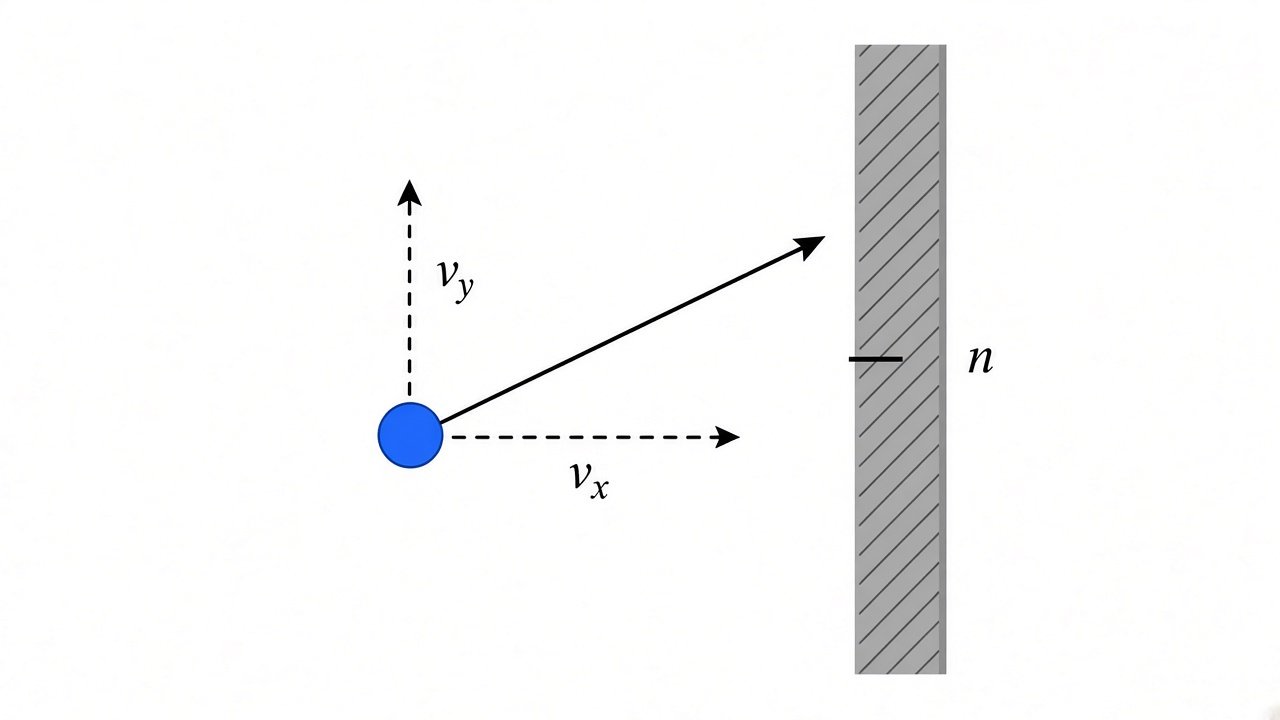
A molecule approaching a wall, with a velocity component perpendicular to the wall and a component parallel to the wall.

Question 2 of 5

A sealed rigid container holds a fixed number of molecules of one ideal gas. The rms speed of the molecules is doubled. Using the kinetic-theory picture of wall collisions, (a) explain how the rate of collisions with a wall depends on molecular speed, (b) explain how the normal impulse delivered in one elastic collision depends on mass and speed, and (c) determine the factor by which the pressure changes and the factor by which the temperature changes.

Question 3 of 5

Two molecules have equal mass $m$. Before they collide, molecule 1 has velocity $(400\,\mathrm{m/s},\,0)$ and molecule 2 is at rest. After the collision, molecule 1 has velocity $(200\,\mathrm{m/s},\,200\,\mathrm{m/s})$ and molecule 2 has velocity $(200\,\mathrm{m/s},\,-200\,\mathrm{m/s})$. (a) Show that momentum is conserved. (b) Show that kinetic energy is conserved. (c) These two molecules are an isolated sample. State whether this collision changes the temperature of the sample, and justify the answer.

Question 4 of 5

Start from $\tfrac12 m v_{\mathrm{rms}}^2=\tfrac32 kT$. (a) Solve for $v_{\mathrm{rms}}$. (b) A helium atom has mass $6.64\times 10^{-27}\,\mathrm{kg}$ and the gas is at $300\,\mathrm{K}$. Use $k=1.38\times 10^{-23}\,\mathrm{J/K}$ to calculate $v_{\mathrm{rms}}$. (c) A different molecule has four times that mass and is at the same temperature. Calculate its rms speed.

Question 5 of 5

Two ideal gases are at the same temperature. A molecule of gas Q has four times the mass of a molecule of gas P. (a) Find the ratio of the average translational kinetic energy per molecule, $K_Q/K_P$. (b) Find $v_{\mathrm{rms},Q}/v_{\mathrm{rms},P}$. (c) A student says gas Q must be colder because its molecules move more slowly. Explain the error, using the relationship between temperature and kinetic energy.