The Ideal Gas Law FRQ Practice

Responses receive AI feedback against a rubric after submission. Scores are practice estimates.

Question 1 of 5

A rigid sealed tank contains $n=2.00\,\mathrm{mol}$ of ideal gas at pressure $P=1.2465\times 10^{5}\,\mathrm{Pa}$ and volume $V=0.0600\,\mathrm{m}^3$. Use $R=8.31\,\mathrm{J/(mol\cdot K)}$ and $k_{B}=1.38\times 10^{-23}\,\mathrm{J/K}$. (a) Calculate the temperature of the gas. (b) Calculate the number of molecules $N$ in the tank. (c) A classmate claims that doubling only the number of moles at fixed $P$ and $V$ would leave $T$ unchanged. Explain whether that claim agrees with the ideal-gas law.
Question 2 of 5

A fixed amount of ideal gas is held at constant volume while its Celsius temperature and pressure are measured. Two data points on the resulting $P$–$T$ graph are $(27^{\circ}\mathrm{C},\,1.00\times 10^{5}\,\mathrm{Pa})$ and $(127^{\circ}\mathrm{C},\,1.333\times 10^{5}\,\mathrm{Pa})$. (a) Determine the slope of the $P$–$T_{\mathrm{C}}$ line. (b) Extrapolate to find the Celsius temperature at which $P=0$. (c) Explain why that extrapolated temperature is identified with absolute zero for an ideal gas.

P versus Celsius temperature line through (27 C, 1.00e5 Pa) and (127 C, 1.333e5 Pa).

Question 3 of 5

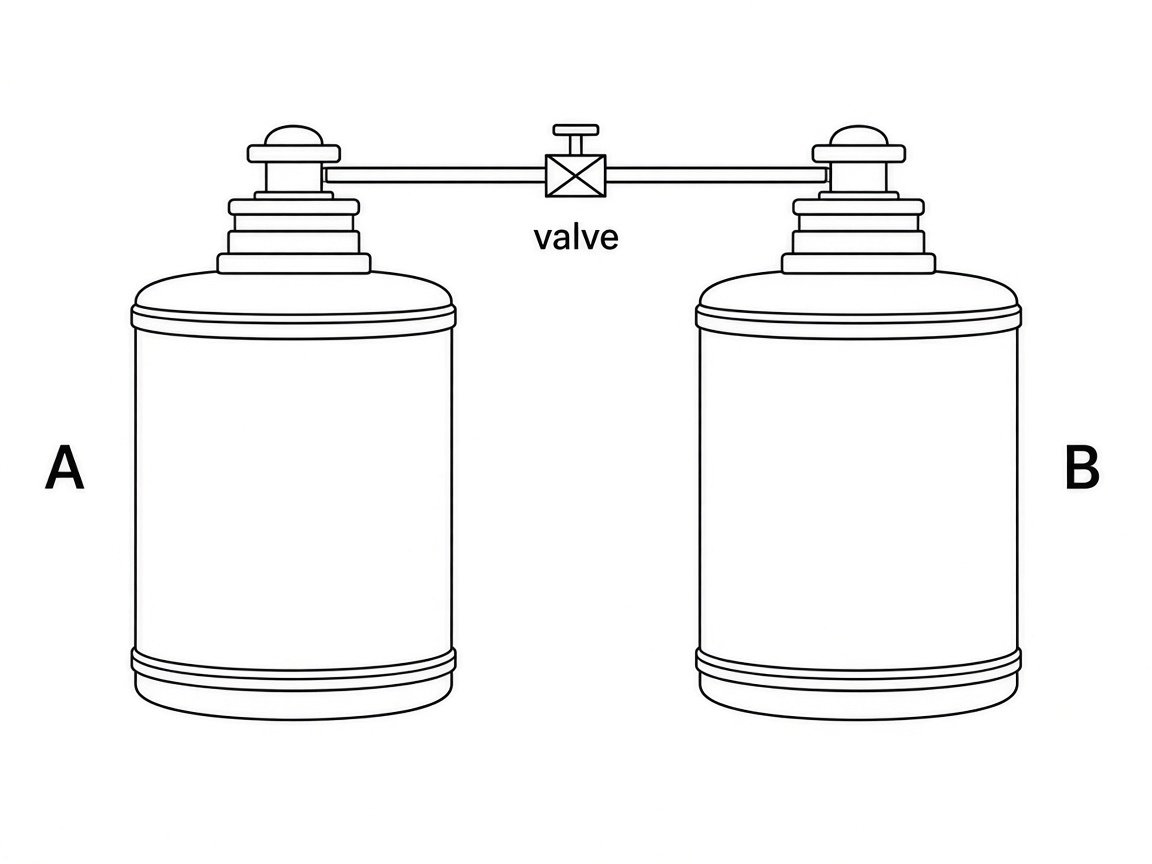
The figure shows two rigid sealed containers connected by a closed valve. The drawing is not to scale. Container A holds $n_{A}=1.50\,\mathrm{mol}$ of ideal gas at $T_{A}=300\,\mathrm{K}$ in volume $V_{A}=0.0400\,\mathrm{m}^3$. Container B holds $n_{B}=0.750\,\mathrm{mol}$ of the same ideal gas at $T_{B}=400\,\mathrm{K}$ in volume $V_{B}=0.0200\,\mathrm{m}^3$. Use $R=8.31\,\mathrm{J/(mol\cdot K)}$. (a) Calculate $P_{A}$ and $P_{B}$ before the valve is opened. (b) Determine $P_{A}/P_{B}$. (c) A student claims the pressures must be equal because both containers hold the same ideal gas. Use the ideal-gas law to refute or support that claim with the calculated values.

Two sealed gas containers labeled A and B connected by a tube with a closed valve.

Question 4 of 5

Recall the classical ideal-gas assumptions: molecular velocities are random, molecular volumes are negligible compared with the container volume, collisions are elastic, and forces between molecules are appreciable only during collisions. (a) Identify which assumption fails in a dense gas where molecules occupy a sizable fraction of the container. (b) Explain how that failure changes the relationship between the measured container volume and the volume that should enter $PV=nRT$. (c) Separately, suppose molecular collisions can store energy inside the molecules, so the collisions are inelastic. Explain why the ideal-gas model requires elastic collisions if the only energy it tracks is the translational kinetic energy of the molecules.

Question 5 of 5

The graph shows an isotherm for a fixed amount of ideal gas. Along the curve, $PV=9.00\times 10^{3}\,\mathrm{Pa\cdot m}^3$. The temperature of the isotherm is $T=360\,\mathrm{K}$. Use $R=8.31\,\mathrm{J/(mol\cdot K)}$. (a) Read approximate coordinates of one point on the curve and verify that $PV$ matches $9.00\times 10^{3}\,\mathrm{Pa\cdot m}^3$. (b) Calculate the number of moles $n$. (c) If a second isotherm for the same $n$ lies entirely above this curve on the $P$–$V$ plot, is its temperature higher or lower? Justify with $PV=nRT$.

Hyperbolic isotherm P=9000/V for an ideal gas, with a marked point near V=0.030 m^3, P=3.00e5 Pa.