TOPIC 9.2 · STUDY
The Ideal Gas Law
The ideal gas law links pressure, volume, absolute temperature, and amount of gas. Fixed-n processes follow simple ratios, and a constant-volume graph of pressure versus temperature points to absolute zero.
9.2.A
The ideal gas law
An ideal gas obeys $$PV=nRT$$ and also $$PV=NkT.$$ Here $P$ is pressure, $V$ is volume, $T$ is absolute temperature in kelvin, $n$ is the amount in moles, $N$ is the number of molecules, $R=8.31\,\mathrm{J/(mol\cdot K)}$, and $k=1.38\times 10^{-23}\,\mathrm{J/K}$. The forms match because $N=nR/k$. Always use kelvin for $T$; Celsius values are not absolute temperature.
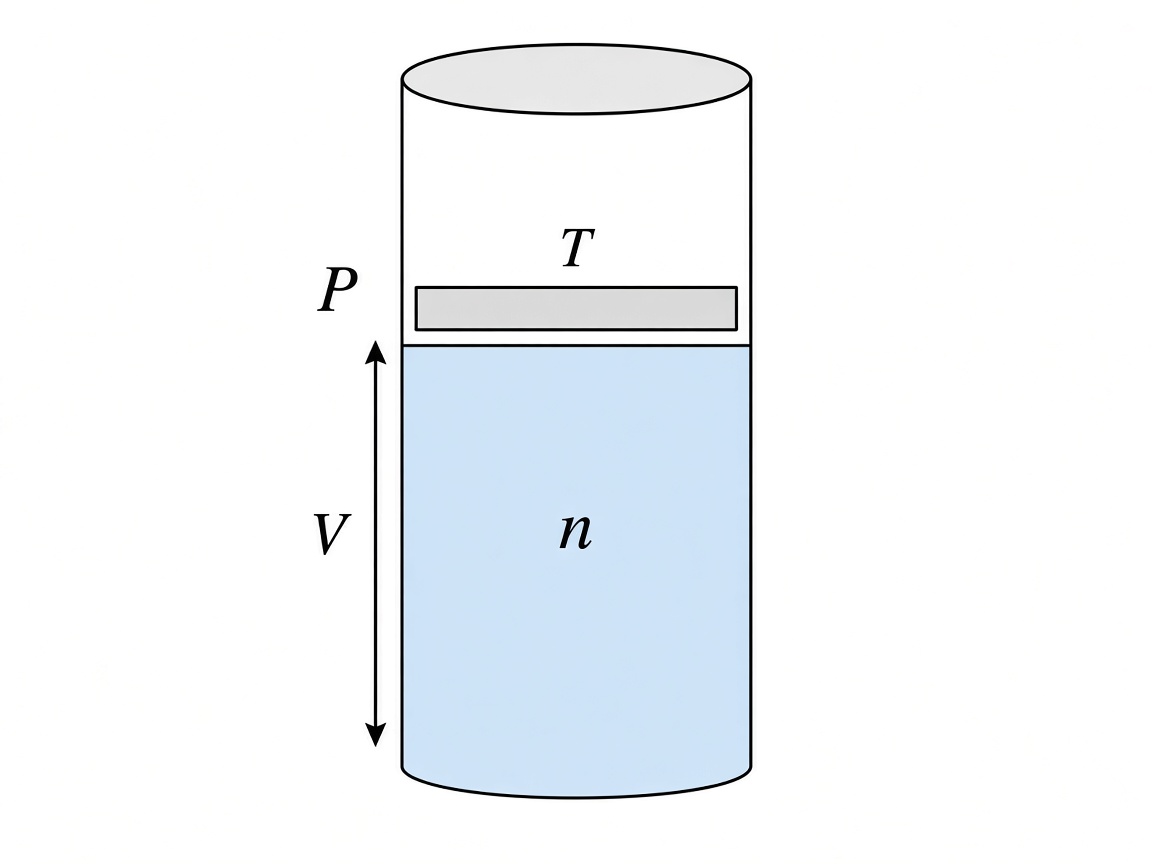
An ideal-gas sample is fixed by pressure P, volume V, absolute temperature T, and amount n.
Example: take $n=2.00\,\mathrm{mol}$, $V=0.0500\,\mathrm{m}^{3}$, and $T=300\,\mathrm{K}$. Then $$P=\frac{nRT}{V}=\frac{(2.00)(8.31)(300)}{0.0500}=9.97\times 10^{4}\,\mathrm{Pa}.$$
When $n$ is fixed, the ideal gas law rearranges to $$\frac{P_{2}}{P_{1}}=\left(\frac{T_{2}}{T_{1}}\right)\left(\frac{V_{1}}{V_{2}}\right).$$ Halving $V$ and doubling $T$ therefore multiplies $P$ by $4$.
Isothermal means constant $T$. With fixed $n$ as well, $P_{1}V_{1}=P_{2}V_{2}$. Example: a sample at $1.50\times 10^{5}\,\mathrm{Pa}$ and $0.040\,\mathrm{m}^{3}$ is compressed isothermally to $0.025\,\mathrm{m}^{3}$, so $$P_{2}=\frac{P_{1}V_{1}}{V_{2}}=\frac{(1.50\times 10^{5})(0.040)}{0.025}=2.40\times 10^{5}\,\mathrm{Pa}.$$
Isochoric means constant volume. With fixed $n$, $P$ is proportional to absolute $T$, so a graph of $P$ versus $T$ in kelvin is a straight line through the origin. Heating from $300\,\mathrm{K}$ to $450\,\mathrm{K}$ multiplies the pressure by $3/2$.
A graph of $P$ versus Celsius temperature at constant volume is still a straight line, but it crosses $P=0$ near $-273\,^{\circ}\mathrm{C}$, not at $0\,^{\circ}\mathrm{C}$. That intercept is absolute zero.
Isobaric means constant pressure. With fixed $n$, $V$ is proportional to absolute $T$ in kelvin.
At the same $n$ and $T$, pressure and volume are inversely related. Tripling the volume therefore divides the pressure by $3$.
Ideal-gas assumptions: molecular velocities are random, the volume of the molecules themselves is negligible compared with the container volume, collisions are elastic, and forces between molecules are appreciable only during collisions. If the molecules take up a sizable volume, the free volume is smaller than the container volume, so $PV=nRT$ using the container volume is no longer accurate. If molecules attract between collisions, they hit the walls less hard, so the measured pressure is lower than the ideal-gas value.
Key points
- Ideal gas law: $PV=nRT$ or $PV=NkT$, with $N=nR/k$; use $R=8.31\,\mathrm{J/(mol\cdot K)}$ and $k=1.38\times 10^{-23}\,\mathrm{J/K}$.
- Absolute temperature $T$ must be in kelvin.
- Fixed $n$: $P_{2}/P_{1}=(T_{2}/T_{1})(V_{1}/V_{2})$; halving $V$ and doubling $T$ multiplies $P$ by $4$.
- Isothermal, fixed $n$: $P_{1}V_{1}=P_{2}V_{2}$.
- Isochoric, fixed $n$: $P$ is proportional to $T$ in kelvin (line through the origin); $300\,\mathrm{K}$ to $450\,\mathrm{K}$ multiplies $P$ by $3/2$.
- Constant-volume $P$ versus Celsius is a straight line that reaches $P=0$ near $-273\,^{\circ}\mathrm{C}$ (absolute zero).
- Isobaric, fixed $n$: $V$ is proportional to $T$ in kelvin; same $n$ and $T$, tripling $V$ divides $P$ by $3$.
- Ideal-gas model fails when molecular volume is not negligible or when attractions reduce the wall pressure.
The $T$ in the ideal gas law is absolute temperature in kelvin.