TOPIC 15.6 · STUDY
Compton Scattering
In Compton scattering a photon collides with an electron and leaves with less energy and a longer wavelength. The wavelength shift grows with the scattering angle and is largest at 180 degrees. Energy and both components of momentum are conserved.
15.6.A
Compton scattering
A photon that scatters from an electron at rest transfers energy and momentum. The scattered photon has lower energy, lower frequency, lower momentum, and longer wavelength. For a photon, $E=pc$. The wavelength shift is $$\Delta\lambda=\frac{h}{m_e c}(1-\cos\theta),$$ where $\theta$ is the photon's scattering angle. The Compton wavelength $h/(m_e c)$ is $2.43\times 10^{-12}\,\mathrm{m}$.
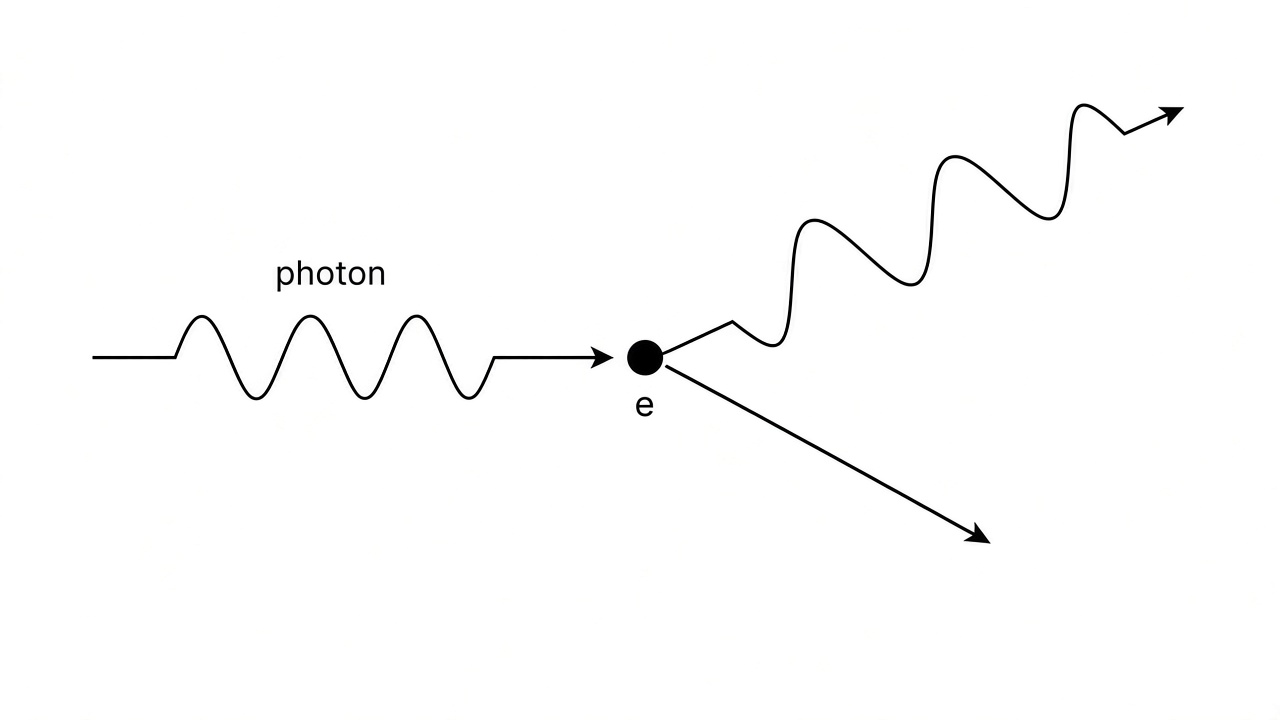
The scattered photon's wave is longer than the incoming wave. The electron carries away the lost energy and momentum.
At $90^\circ$, $1-\cos\theta=1$, so $\Delta\lambda=2.43\times 10^{-12}\,\mathrm{m}$. At $180^\circ$, $1-\cos\theta=2$, so $\Delta\lambda=4.86\times 10^{-12}\,\mathrm{m}$, the largest shift. An incoming wavelength $5.00\times 10^{-12}\,\mathrm{m}$ scattered at $90^\circ$ leaves at $$\lambda'=5.00\times 10^{-12}+2.43\times 10^{-12}=7.43\times 10^{-12}\,\mathrm{m}.$$ A photon momentum example: $\lambda=2.00\times 10^{-11}\,\mathrm{m}$ gives $p=h/\lambda=3.32\times 10^{-23}\,\mathrm{kg\cdot m/s}$.
Energy conservation fixes the electron's kinetic energy. If the photon drops from $60\,\mathrm{keV}$ to $45\,\mathrm{keV}$, the electron, initially at rest, gains $15\,\mathrm{keV}$. In two dimensions both the forward and the sideways components of momentum are conserved. A classical continuous wave does not produce this particle-like collision.
Key points
- The scattered photon has less energy and a longer wavelength.
- $\Delta\lambda=(h/m_e c)(1-\cos\theta)$, with $h/(m_e c)=2.43\times 10^{-12}\,\mathrm{m}$.
- At $90^\circ$, $\Delta\lambda=2.43\times 10^{-12}\,\mathrm{m}$. At $180^\circ$, the shift is twice that.
- Example: $5.00\times 10^{-12}\,\mathrm{m}$ at $90^\circ$ becomes $7.43\times 10^{-12}\,\mathrm{m}$.
- Photon: $E=pc$ and $p=h/\lambda$.
- Electron kinetic energy equals the photon's energy loss.
- Both components of momentum are conserved in the collision.
The wavelength shift depends on the angle, not on the target's chemical identity, when the electron is free and at rest.