Compton Scattering MCQ Practice

Question 1 of 10

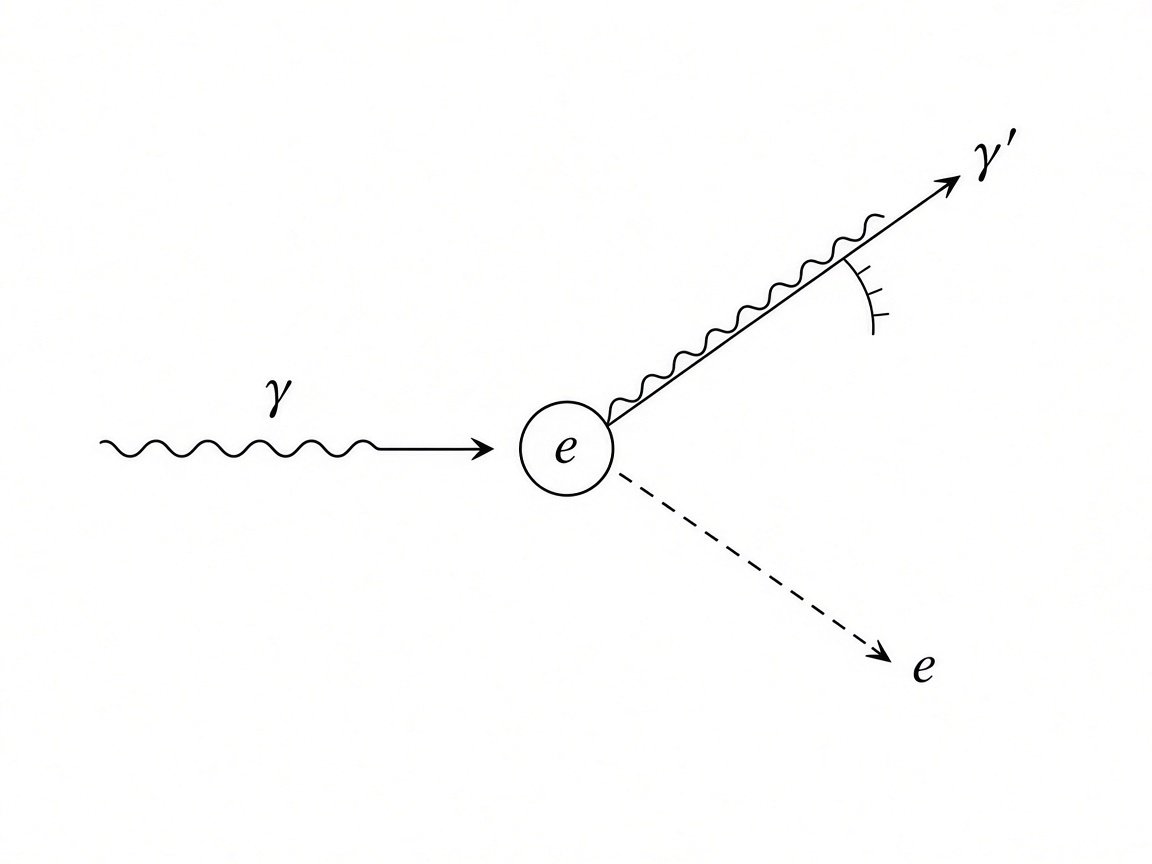
Compton scattering: incident photon, scattered photon, and recoil electron.

In Compton scattering, the scattered photon compared with the incident photon has

  1. A. higher energy and shorter wavelength
  2. B. lower energy and longer wavelength
  3. C. unchanged energy for every scattering angle
  4. D. zero momentum after the collision

Question 2 of 10

A photon scatters from a free electron at rest through $90^\circ$. Use $h=6.63\times 10^{-34}\,\mathrm{J\cdot s}$, $c=3.00\times 10^{8}\,\mathrm{m/s}$, and $m_e=9.11\times 10^{-31}\,\mathrm{kg}$. The wavelength increase $\Delta\lambda$ is closest to

  1. A. $1.21\times 10^{-12}\,\mathrm{m}$
  2. B. $2.43\times 10^{-12}\,\mathrm{m}$
  3. C. $4.86\times 10^{-12}\,\mathrm{m}$
  4. D. $0$ (no shift at $90^\circ$)

Question 3 of 10

Compton scattering supports a particle model of light because the wavelength shift is explained by

  1. A. classical continuous wave absorption without momentum transfer
  2. B. conservation of energy and momentum treating the photon as a particle colliding with an electron
  3. C. diffraction through the electron’s orbital cloud only
  4. D. nuclear alpha emission

Question 4 of 10

For fixed incident wavelength, which scattering angle produces the largest $\Delta\lambda$?

  1. A. $0^\circ$
  2. B. $60^\circ$
  3. C. $90^\circ$
  4. D. $180^\circ$

Question 5 of 10

An x-ray photon has wavelength $2.00\times 10^{-11}\,\mathrm{m}$ and scatters at $180^\circ$ from an electron at rest. Use $\lambda_C=h/(m_ec)=2.43\times 10^{-12}\,\mathrm{m}$. The scattered wavelength is

  1. A. $1.51\times 10^{-11}\,\mathrm{m}$
  2. B. $2.00\times 10^{-11}\,\mathrm{m}$
  3. C. $2.49\times 10^{-11}\,\mathrm{m}$
  4. D. $4.86\times 10^{-11}\,\mathrm{m}$

Question 6 of 10

A photon has energy $E$ and momentum magnitude $p$. For a photon in vacuum,

  1. A. $E=pc$
  2. B. $E=p^{2}/(2m)$ with $m$ the electron mass
  3. C. $E=0$ always
  4. D. $p=0$ while $E>0$

Question 7 of 10

Incident photon energy is $100\,\mathrm{keV}$. After Compton scattering, the photon has $80\,\mathrm{keV}$. The kinetic energy gained by the electron (initially at rest) is

  1. A. $20\,\mathrm{keV}$
  2. B. $80\,\mathrm{keV}$
  3. C. $100\,\mathrm{keV}$
  4. D. $180\,\mathrm{keV}$

Question 8 of 10

After Compton scattering, which photon quantities change?

  1. A. only polarization, never energy
  2. B. energy, momentum, frequency, and wavelength
  3. C. only charge
  4. D. rest mass

Question 9 of 10

In a 2D Compton collision, the electron recoils at angle $\phi$ below the forward axis while the photon scatters at angle $\theta$ above it. Momentum conservation requires

  1. A. only x-components to balance; y-components may be ignored
  2. B. both x- and y-components of total momentum to be conserved
  3. C. photon momentum to remain unchanged
  4. D. electron momentum to be zero after collision

Question 10 of 10

Use $h=6.63\times 10^{-34}\,\mathrm{J\cdot s}$ and $c=3.00\times 10^{8}\,\mathrm{m/s}$. A photon with $\lambda=1.00\times 10^{-11}\,\mathrm{m}$ has momentum magnitude

  1. A. $6.63\times 10^{-23}\,\mathrm{kg\cdot m/s}$
  2. B. $6.63\times 10^{-22}\,\mathrm{kg\cdot m/s}$
  3. C. $2.21\times 10^{-23}\,\mathrm{kg\cdot m/s}$
  4. D. $1.99\times 10^{-15}\,\mathrm{kg\cdot m/s}$