Compton Scattering MCQ Practice

Question 1 of 10

For Compton scattering, $\Delta\lambda=(h/m_ec)(1-\cos\theta)$. At $\theta=0^\circ$, $\Delta\lambda$ is

  1. A. $h/m_ec$
  2. B. $2h/m_ec$
  3. C. $0$
  4. D. infinite

Question 2 of 10

Incident photon momentum is $p$ along $+x$. After scattering, photon momentum is $p/2$ at $60^\circ$ above $+x$. The x-component of the electron’s recoil momentum is

  1. A. $p$
  2. B. $p/2$
  3. C. $p+(p/2)\cos 60^\circ$
  4. D. $p-(p/2)\cos 60^\circ$

Question 3 of 10

Compton scattering interacts a photon with

  1. A. a free electron
  2. B. a nucleus via alpha decay only
  3. C. a blackbody cavity mode only
  4. D. a macroscopic mirror with zero momentum transfer

Question 4 of 10

Electron rest energy $E_0=511\,\mathrm{keV}$. A $511\,\mathrm{keV}$ photon backscatters ($\theta=180^\circ$). Using $E'=E/(1+2E/E_0)$, $E'$ is

  1. A. $170\,\mathrm{keV}$
  2. B. $255\,\mathrm{keV}$
  3. C. $341\,\mathrm{keV}$
  4. D. $511\,\mathrm{keV}$

Question 5 of 10

If the scattered photon’s wavelength increases, its frequency

  1. A. increases
  2. B. decreases
  3. C. is unchanged
  4. D. becomes zero

Question 6 of 10

Use $h=6.63\times 10^{-34}\,\mathrm{J\cdot s}$, $c=3.00\times 10^{8}\,\mathrm{m/s}$, and $E_0=8.19\times 10^{-14}\,\mathrm{J}$. The Compton wavelength $h/(m_ec)=hc/E_0$ is closest to
  1. A. $2.43\times 10^{-12}\,\mathrm{m}$
  2. B. $2.43\times 10^{-15}\,\mathrm{m}$
  3. C. $1.00\times 10^{-10}\,\mathrm{m}$
  4. D. $5.11\times 10^{-11}\,\mathrm{m}$

Question 7 of 10

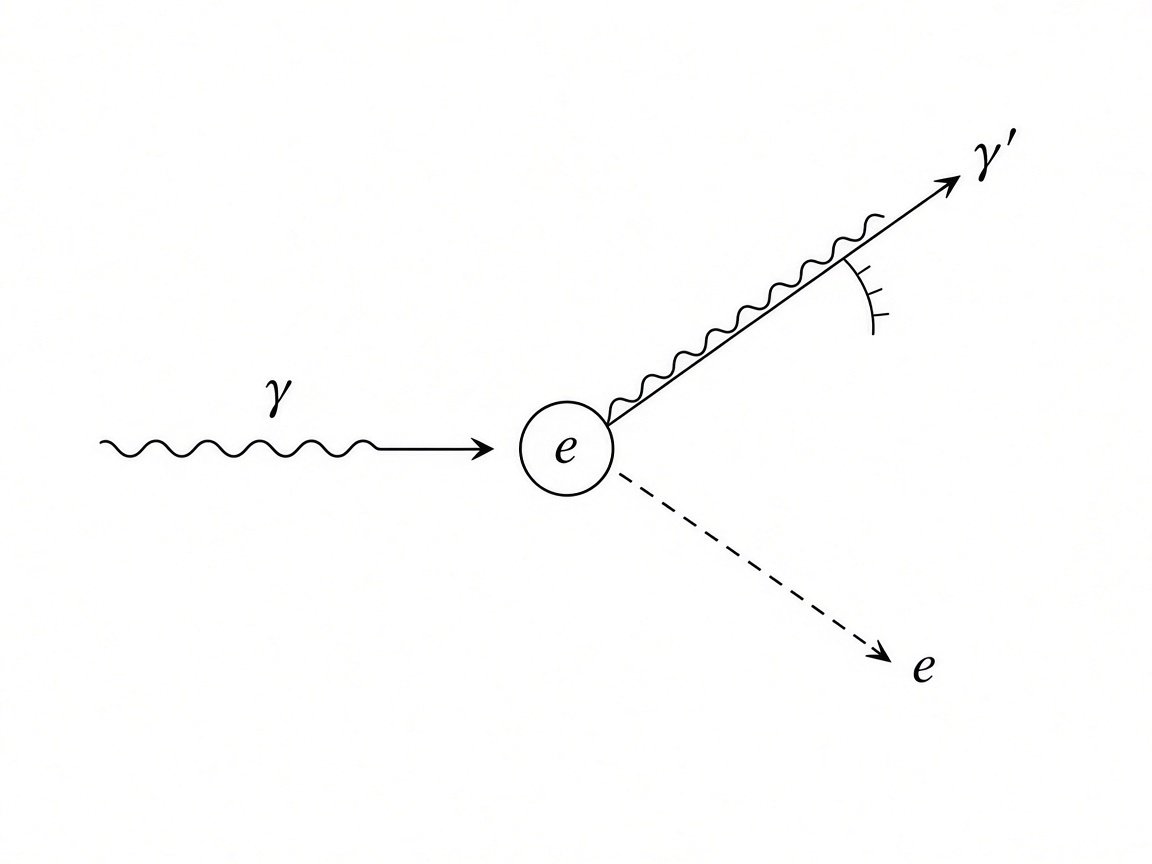
Photon–electron Compton collision schematic.

The electron is initially

  1. A. moving at $c$
  2. B. free and at rest (standard treatment)
  3. C. bound in a nucleus as a proton
  4. D. massless

Question 8 of 10

Incident photon energy $150\,\mathrm{keV}$; scattered photon $120\,\mathrm{keV}$. Electron KE after the collision is

  1. A. $30\,\mathrm{keV}$
  2. B. $120\,\mathrm{keV}$
  3. C. $150\,\mathrm{keV}$
  4. D. $270\,\mathrm{keV}$

Question 9 of 10

The factor $(1-\cos\theta)$ in the Compton formula shows that $\Delta\lambda$ depends on

  1. A. only the incident intensity
  2. B. the photon’s scattering direction
  3. C. only the electron’s charge sign
  4. D. the blackbody temperature

Question 10 of 10

Compared with forward scattering ($\theta\approx 0$), backscattering transfers

  1. A. less energy to the electron
  2. B. more energy to the electron
  3. C. identical energy for all $\theta$
  4. D. zero energy because $\Delta\lambda=0$ at $180^\circ$