TOPIC 15.7 · STUDY
Fission, Fusion, and Nuclear Decay
Fusion joins lighter nuclei and fission splits a heavy nucleus. The strong force dominates nucleon interactions, and nucleon number is conserved. Released energy matches a mass change through E = mc squared. A large sample decays by half-life, while one nucleus has no definite decay time.
15.7.A
Fission, fusion, and mass-energy
At nuclear distances the strong force dominates the interactions of protons and neutrons. Fusion combines lighter nuclei into a heavier one. Fission splits a heavy nucleus into lighter ones. Whether fission happens on its own or needs an energy input depends on the binding energy.
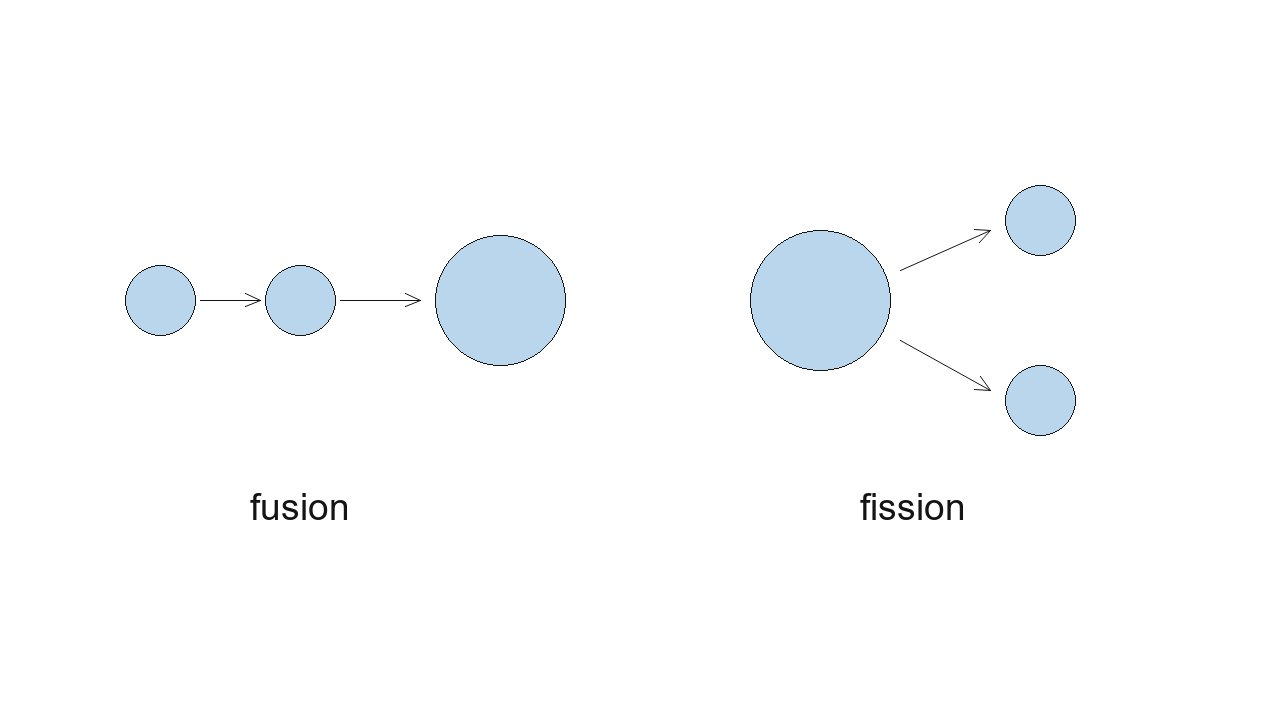
Fusion builds one nucleus from two lighter ones. Fission sends two fragments away from a heavier nucleus.
Nucleon number is conserved. A tally with 238 nucleons on the left and 235 on the right is not an allowed reaction. The energy released when the mass decreases by $\Delta m$ is $E=\Delta m\, c^{2}$. For $E=4.50\times 10^{-12}\,\mathrm{J}$ and $c=3.00\times 10^{8}\,\mathrm{m/s}$, $$\Delta m=\frac{4.50\times 10^{-12}}{9.00\times 10^{16}}=5.00\times 10^{-29}\,\mathrm{kg}.$$ That energy can leave as kinetic energy of the products or as photons.
15.7.B
Half-life
The number of nuclei in a large sample follows $N=N_0(1/2)^{t/t_{1/2}}$, which is the same as $N=N_0 e^{-\lambda t}$ with $\lambda=\ln 2/t_{1/2}$. After one half-life, half remain. After three half-lives, one eighth remain. A sample with $t_{1/2}=4.0\,\mathrm{h}$ has $1/8$ of its nuclei left after $12\,\mathrm{h}$. Starting from $N_0=3.2\times 10^{15}$, two half-lives leave $N=8.0\times 10^{14}$.
For $t_{1/2}=10.0\,\mathrm{min}$, $\lambda=\ln 2/10.0=0.069\,\mathrm{min}^{-1}$. The decay time of one nucleus cannot be predicted. The sample rate is predictable because the decay of each nucleus is a probability. Half-lives are given in a problem. They are not values to memorize for named isotopes.
Key points
- Fusion combines light nuclei. Fission splits a heavy nucleus.
- The strong force dominates nucleon interactions at nuclear scales.
- Nucleon number is conserved. Energy released: $E=\Delta m\, c^{2}$.
- Example: $4.50\times 10^{-12}\,\mathrm{J}$ corresponds to $\Delta m=5.00\times 10^{-29}\,\mathrm{kg}$.
- Three half-lives leave $1/8$ of the nuclei. Example: $4.0\,\mathrm{h}$ half-life, $12\,\mathrm{h}$ elapsed.
- $\lambda=\ln 2/t_{1/2}$. For $10.0\,\mathrm{min}$, $\lambda=0.069\,\mathrm{min}^{-1}$.
- One nucleus has no definite decay time. A large sample follows the half-life rule.
Binding energy decides whether fission is spontaneous or needs an energy input. The half-life still has to be given.