TOPIC 15.8 · STUDY
Types of Radioactive Decay
Alpha decay emits a helium-4 nucleus and lowers both the mass number and the atomic number. Beta-minus emits an electron and raises the atomic number. Beta-plus emits a positron and lowers it. Gamma decay emits a photon and changes neither number.
15.8.A
Alpha, beta, and gamma decay
An alpha particle is a ${}^{4}_{2}\mathrm{He}$ nucleus: 2 protons and 2 neutrons. Alpha decay changes the parent by $\Delta A=-4$ and $\Delta Z=-2$. ${}^{230}_{90}\mathrm{Th}$ becomes ${}^{226}_{88}\mathrm{Ra}$. Nucleon number balances: $230=226+4$.
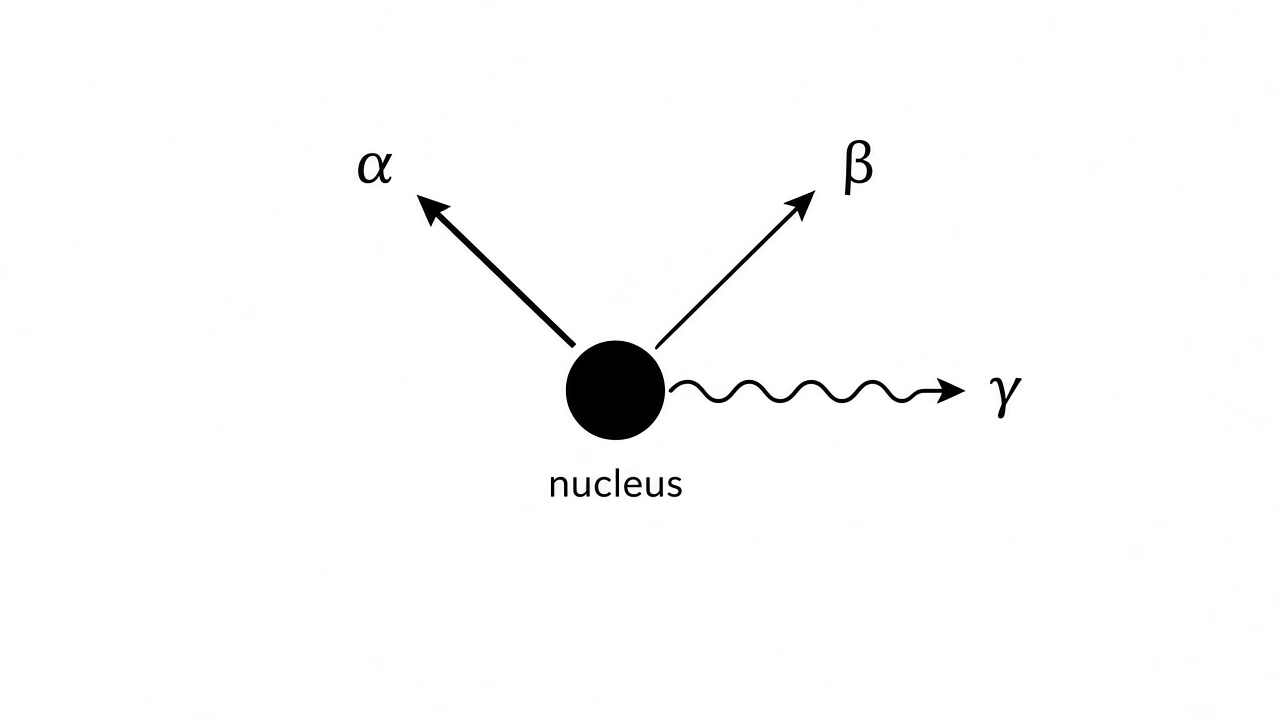
Alpha is a helium-4 nucleus, beta is an electron or a positron, and gamma is a photon. One decay emits one of these, not all three at once.
In beta-minus decay a neutron becomes a proton and the nucleus emits an electron. $A$ stays the same and $Z$ increases by 1. ${}^{32}_{15}\mathrm{P}$ becomes ${}^{32}_{16}\mathrm{S}$. In beta-plus decay a proton becomes a neutron and the nucleus emits a positron. $A$ stays the same and $Z$ decreases by 1. ${}^{18}_{9}\mathrm{F}$ becomes ${}^{18}_{8}\mathrm{O}$. A positron has the electron's mass and the opposite charge.
Gamma decay emits a photon as an excited nucleus drops to a lower nuclear energy. $A$ and $Z$ do not change, so the element stays the same. Alpha, beta-minus, and beta-plus all change $Z$, so they change the element. Charge is conserved: in alpha decay the daughter's charge plus the alpha particle's $+2e$ equals the parent's charge. Neutron emission and electron capture are outside this course, and so is a weak-force account of beta decay. Which isotope uses which mode, and any particular half-life, are given in the problem rather than memorized.
Key points
- Alpha: ${}^{4}_{2}\mathrm{He}$. $A$ decreases by 4 and $Z$ decreases by 2.
- Example: ${}^{230}_{90}\mathrm{Th}\to {}^{226}_{88}\mathrm{Ra}+{}^{4}_{2}\mathrm{He}$.
- Beta-minus: electron emitted, $Z$ increases by 1, $A$ unchanged. ${}^{32}_{15}\mathrm{P}\to {}^{32}_{16}\mathrm{S}$.
- Beta-plus: positron emitted, $Z$ decreases by 1, $A$ unchanged. ${}^{18}_{9}\mathrm{F}\to {}^{18}_{8}\mathrm{O}$.
- A positron has charge $+e$ and the electron's mass.
- Gamma: a photon. $A$ and $Z$ stay the same.
- Do not memorize which isotope uses which mode, or any half-life.
The figure shows the three emissions as separate possibilities. A single decay step is one mode.