TOPIC 11.3 · STUDY
Resistance, Resistivity, and Ohm's Law
Resistance depends on the material and the shape of the conductor. For an ohmic resistor, potential difference and current stay proportional.
11.3.A
Resistance and Ohm's law
Resistance of a uniform conductor depends on the material and the shape: $$R=\frac{\rho L}{A},$$ where $\rho$ is resistivity, $L$ is length, and $A$ is cross-sectional area.
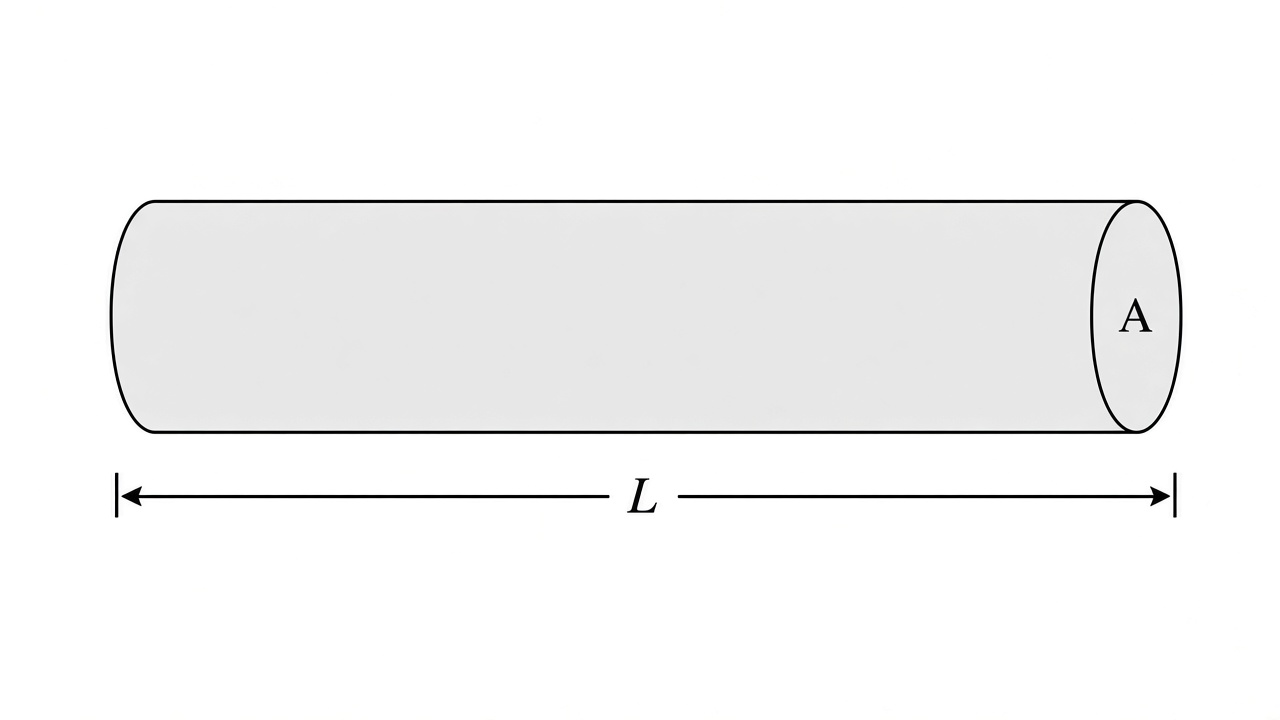
Resistance grows with length L and resistivity, and it falls as the cross-sectional area A grows.
Example: $\rho=1.7\times 10^{-8}\,\Omega\cdot\mathrm{m}$, $L=2.0\,\mathrm{m}$, and $A=1.0\times 10^{-6}\,\mathrm{m^{2}}$ give $$R=\frac{(1.7\times 10^{-8})(2.0)}{1.0\times 10^{-6}}=0.034\,\Omega.$$
Twice the length and twice the diameter: length doubles $R$, while diameter doubled means radius doubled and area becomes 4 times, which cuts $R$ by 4, so the net resistance becomes half. Halving the area alone doubles $R$.
Resistivity $\rho$ is a material property. A conductor's resistivity typically rises with temperature. Resistance also depends on length and area, so two wires of the same material can have different $R$.
Ohm's law is $\Delta V=IR$. Example: $R=12\,\Omega$ and $\Delta V=6.0\,\mathrm{V}$ give $I=\Delta V/R=0.50\,\mathrm{A}$.
Ohmic means $R$ is constant and the $I$-versus-$V$ graph is a straight line through the origin; the slope is $1/R$. A device whose $R$ changes between trials is non-ohmic. Resistors convert electrical energy to thermal energy.
Key points
- Resistance: $R=\rho L/A$.
- Larger $L$ or $\rho$ raises $R$; larger $A$ lowers $R$.
- Twice length and twice diameter: area is 4 times, so $R$ becomes half.
- Halving area doubles $R$.
- Resistivity is a material property and typically rises with temperature for a conductor.
- Ohm's law: $\Delta V=IR$.
- Ohmic: constant $R$ and a straight $I$-versus-$V$ line through the origin with slope $1/R$.
- Resistors convert electrical energy to thermal energy.
Resistivity belongs to the material; resistance also depends on length and area.