TOPIC 11.4 · STUDY
Electric Power
Electric power is current times potential difference. Bulb brightness increases with the power the bulb dissipates.
11.4.A
Electric power
Electric power is the rate of energy transfer. Across a circuit element, $$P=IV.$$ With Ohm's law, that is also $P=I^{2}R$ and $P=V^{2}/R$ for an ohmic resistor.
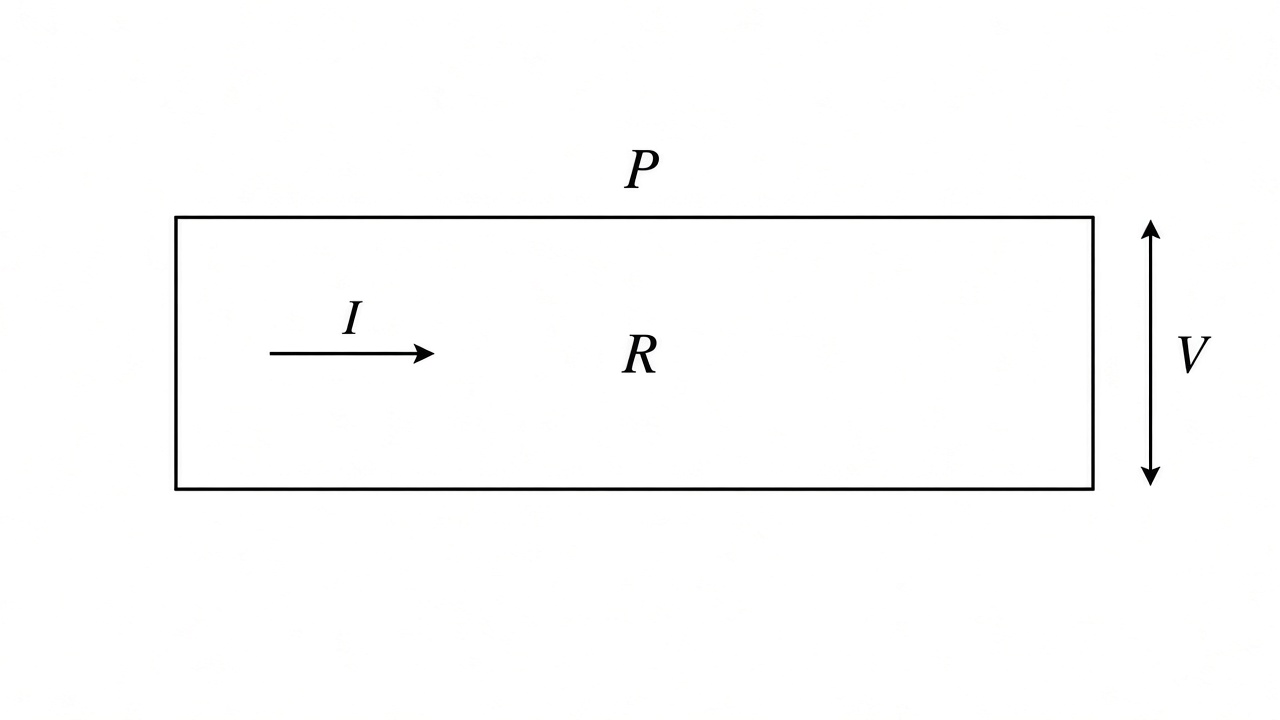
Power dissipated in the resistor is P = I V. For an ohmic resistor that is also I squared R and V squared over R.
Example: $I=2.0\,\mathrm{A}$ and $V=12\,\mathrm{V}$ give $P=IV=24\,\mathrm{W}$.
Example: $R=8.0\,\Omega$ and $V=12\,\mathrm{V}$ give $I=V/R=1.5\,\mathrm{A}$ and $P=V^{2}/R=(12)^{2}/8.0=18\,\mathrm{W}$. The same power is $P=I^{2}R=(1.5)^{2}(8.0)=18\,\mathrm{W}$.
Doubling $I$ at fixed $R$ multiplies $P=I^{2}R$ by 4. Halving $V$ at fixed $R$ multiplies $P=V^{2}/R$ by $1/4$.
Energy transferred is $E=Pt$. A power of $24\,\mathrm{W}$ for $10\,\mathrm{s}$ transfers $240\,\mathrm{J}$.
Bulb brightness increases with the power the bulb dissipates. Equal current does not force equal brightness if the potential differences differ, because $P=IV$.
Key points
- Power: $P=IV$.
- For an ohmic resistor, $P=I^{2}R$ and $P=V^{2}/R$.
- Example: $I=2.0\,\mathrm{A}$ and $V=12\,\mathrm{V}$ give $P=24\,\mathrm{W}$.
- Example: $R=8.0\,\Omega$ and $V=12\,\mathrm{V}$ give $I=1.5\,\mathrm{A}$ and $P=18\,\mathrm{W}$.
- Doubling $I$ at fixed $R$ multiplies $P$ by 4; halving $V$ at fixed $R$ multiplies $P$ by $1/4$.
- Energy is $E=Pt$; $24\,\mathrm{W}$ for $10\,\mathrm{s}$ transfers $240\,\mathrm{J}$.
- Brightness increases with power dissipated.
- Equal current does not force equal brightness if the potential differences differ.
Brightness follows power, not current alone.