TOPIC 5.2 · STUDY
Connecting Linear and Rotational Motion
Linear and rotational quantities link by the radius: arc length, tangential speed, and both acceleration pieces scale with r while every rigid point shares the same omega and alpha. Directions follow the rotation sense, and total acceleration is the Pythagorean mix of tangential and inward parts.
5.2.A
Connecting linear and rotational motion
Angles in this topic are in radians. A point at distance $r$ from a fixed axis that rotates through angle $\theta$ travels along an arc of length $$s=r\theta.$$ That arc length is the path distance along the circle, not the straight-line displacement between the start and end positions. After half a revolution ($\theta=\pi$), a rim point on a disk of radius $R$ has path length $\pi R$ but displacement magnitude $2R$.
Example: take $R=0.80\,\mathrm{m}$. Half a turn gives path $s=\pi(0.80)\approx 2.5\,\mathrm{m}$ while the chord from one side of the disk to the opposite side has length $2(0.80)=1.6\,\mathrm{m}$. For a smaller turn with $r=0.50\,\mathrm{m}$ and $\theta=2.0\,\mathrm{rad}$, the arc is $s=(0.50)(2.0)=1.0\,\mathrm{m}$.
Instantaneous linear speed and the two acceleration pieces connect the same way: $$v=r\omega,\qquad a_{\mathrm{t}}=r\alpha,\qquad a_{\mathrm{in}}=r\omega^{2}.$$ Here $a_{\mathrm{t}}$ is tangential (along the circle) and $a_{\mathrm{in}}$ is inward (toward the axis). At the axis itself $r=0$, so $v=0$ even when the disk is spinning.
On a rigid disk every point shares the same $\omega$ and the same $\alpha$ at a given instant. Linear speed and both acceleration magnitudes still grow with $r$: a point twice as far from the axis has twice the $v$, twice the $|a_{\mathrm{t}}|$, and twice the $a_{\mathrm{in}}$. Diametrically opposite rim points have equal speed magnitudes but opposite tangential velocity directions.
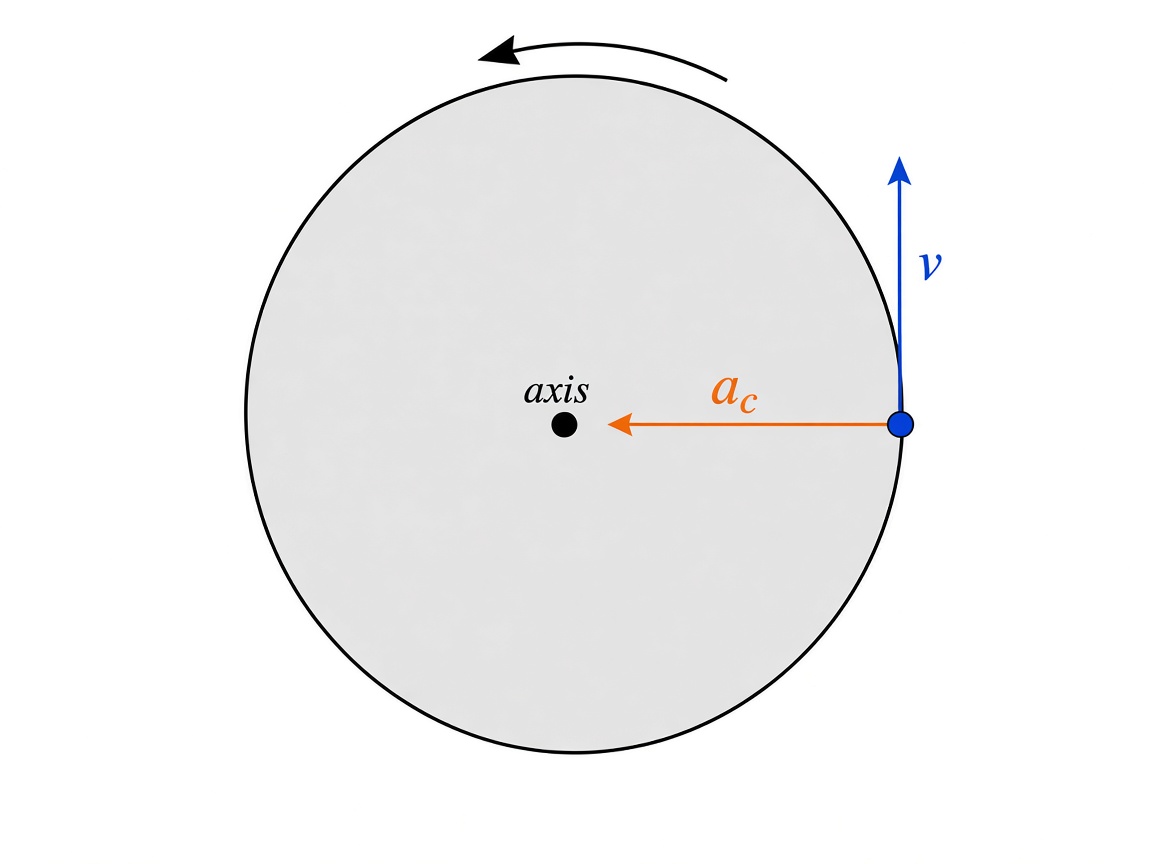
Counterclockwise disk: at the rightmost rim point, tangential velocity points up and inward acceleration points left toward the axis.
Directions follow the sense of rotation. For counterclockwise motion with the marker at the rightmost point, $\vec{v}$ is upward as in the figure. If the disk is speeding up, $a_{\mathrm{t}}$ points the same way as $\vec{v}$ (up). If it is slowing, $a_{\mathrm{t}}$ points opposite $\vec{v}$ (down). The inward acceleration always points toward the center, so at that rightmost point it is leftward. For clockwise rotation with the marker at the top of the disk, $\vec{v}$ points to the right.
Constant nonzero $\omega$ means $\alpha=0$, so $a_{\mathrm{t}}=0$ while $a_{\mathrm{in}}=r\omega^{2}$ is still nonzero: speed is steady but the velocity direction keeps changing. At the instant $\omega=0$ with nonzero $\alpha$, $a_{\mathrm{in}}=0$ while $a_{\mathrm{t}}=r\alpha$ is not zero: the point is just starting (or reversing) along the arc.
Tangential and inward accelerations are perpendicular, so the magnitude of the total acceleration is $$a=\sqrt{a_{\mathrm{t}}^{2}+a_{\mathrm{in}}^{2}},$$ not $a_{\mathrm{t}}+a_{\mathrm{in}}$. Example: $r=0.25\,\mathrm{m}$, $\omega=4.0\,\mathrm{rad/s}$, $\alpha=2.0\,\mathrm{rad/s^{2}}$ give $a_{\mathrm{t}}=(0.25)(2.0)=0.50\,\mathrm{m/s^{2}}$ and $a_{\mathrm{in}}=(0.25)(4.0)^{2}=4.0\,\mathrm{m/s^{2}}$. Then $a=\sqrt{(0.50)^{2}+(4.0)^{2}}\approx 4.0\,\mathrm{m/s^{2}}$.
| Situation | $a_{\mathrm{t}}$ | $a_{\mathrm{in}}$ |
|---|---|---|
| Constant nonzero $\omega$ | $0$ | $r\omega^{2}>0$ |
| Instant $\omega=0$, $\alpha\ne 0$ | $r\alpha\ne 0$ | $0$ |
| Speeding up, $\omega\ne 0$ | same direction as $\vec{v}$ | toward axis |
| Slowing, $\omega\ne 0$ | opposite $\vec{v}$ | toward axis |
A no-slip belt or string matches rim speed to belt speed: $\omega=v/r$. A larger pulley on the same belt therefore turns more slowly. Both pulleys share the belt's tangential acceleration, so each has $\alpha=a_{\mathrm{belt}}/r$. When a string unwinds without slip, the length released equals the arc length $r\theta$.
Example: a belt at $3.0\,\mathrm{m/s}$ rides a pulley of radius $0.12\,\mathrm{m}$, so $\omega=(3.0)/(0.12)=25\,\mathrm{rad/s}$. A second pulley of radius $0.24\,\mathrm{m}$ on the same belt has $\omega=(3.0)/(0.24)=12.5\,\mathrm{rad/s}$. If a string leaves a spool of radius $0.050\,\mathrm{m}$ through $\theta=6.0\,\mathrm{rad}$, the released length is $(0.050)(6.0)=0.30\,\mathrm{m}$.
Convert revolutions to radians when needed: one revolution is $2\pi$ rad, so $2.0\,\mathrm{rev/s}$ is $2.0\cdot 2\pi=4\pi\,\mathrm{rad/s}$. A graph of linear speed $v$ versus radius $r$ at one fixed instant is a straight line through the origin with slope equal to the shared $\omega$, because $v=\omega r$.
Key points
- Arc length is $s=r\theta$ (radians); path distance is not the chord displacement ($\pi R$ versus $2R$ for half a turn).
- Connect with $v=r\omega$, $a_{\mathrm{t}}=r\alpha$, and $a_{\mathrm{in}}=r\omega^{2}$; the axis point has $v=0$.
- Rigid body: one shared $\omega$ and $\alpha$; linear speed and both $|a|$ values scale with $r$.
- Constant $\omega\ne 0$ means $a_{\mathrm{t}}=0$ but $a_{\mathrm{in}}\ne 0$; at $\omega=0$ with $\alpha\ne 0$, $a_{\mathrm{in}}=0$ but $a_{\mathrm{t}}\ne 0$.
- Total acceleration magnitude is $\sqrt{a_{\mathrm{t}}^{2}+a_{\mathrm{in}}^{2}}$, not the plain sum of the pieces.
- At the rightmost point for counterclockwise rotation, $\vec{v}$ is up and $a_{\mathrm{in}}$ is left; speeding up keeps $a_{\mathrm{t}}$ with $\vec{v}$.
- No-slip belt or string: rim speed equals belt speed so $\omega=v/r$; unwound length is $r\theta$; $2\,\mathrm{rev/s}=4\pi\,\mathrm{rad/s}$.
- A snapshot graph of $v$ versus $r$ is a line through the origin with slope $\omega$.
Sharing the same angular velocity does not mean sharing the same linear velocity: $v$ still scales with $r$.