Connecting Linear and Rotational Motion FRQ Practice

Responses receive AI feedback against a rubric after submission. Scores are practice estimates.

Question 1 of 5

Points P and Q are fixed on the same radial line of a rigid disk at radii r and 2r from a fixed axis through O. The disk rotates counterclockwise, with angular speed w and angular acceleration a>0 in the same rotational sense. (a) Compare their angular velocities. (b) Derive each linear speed. (c) Compare their tangential and inward accelerations.
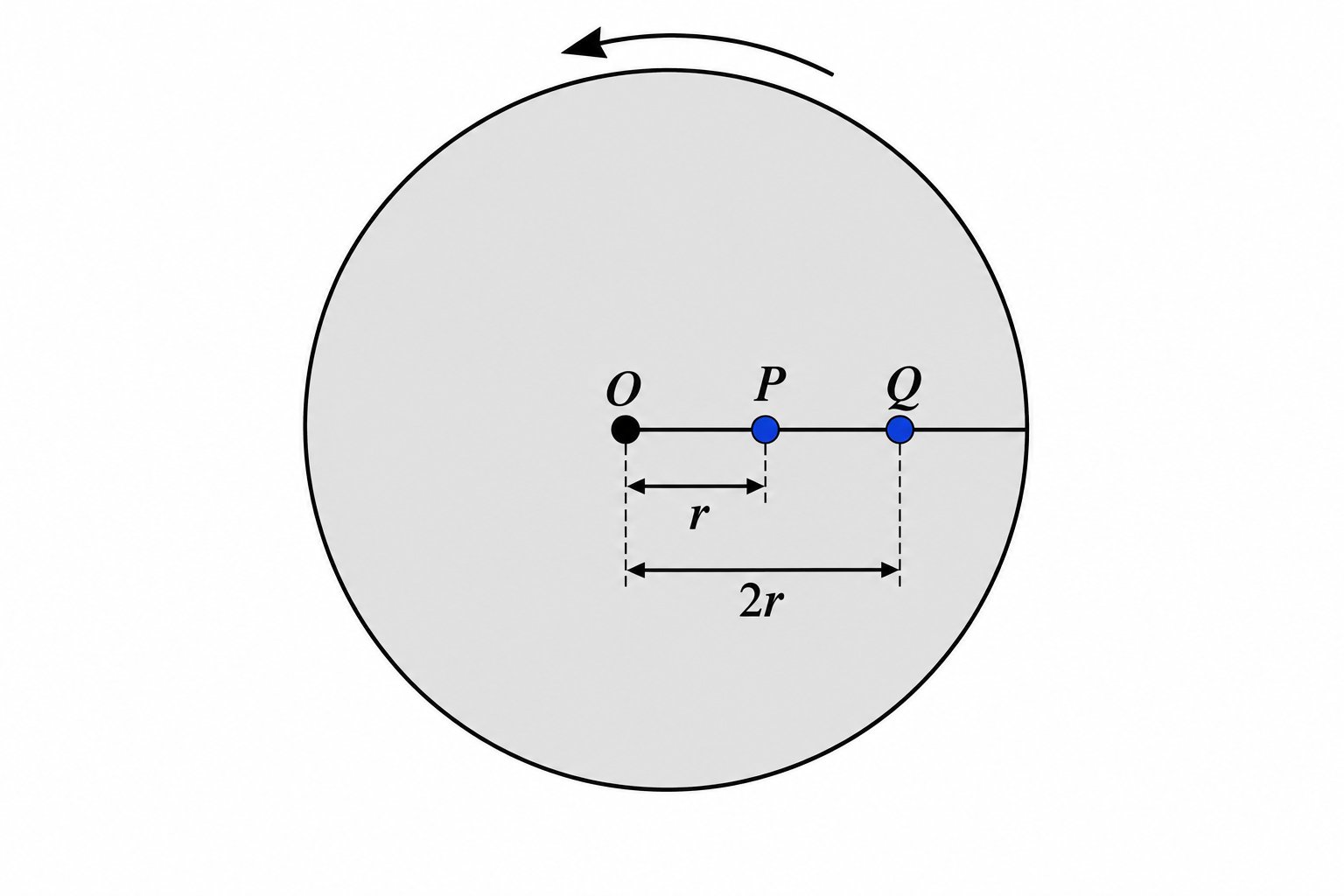
A counterclockwise rotating disk has P at radius r and Q at radius 2r on the same radial line from O.

Schematic; dimensions and force-arrow lengths are not to scale.

Question 2 of 5

A string unwinds without slipping from a fixed-axis pulley of radius 0.25 m. The string starts from rest and has constant linear acceleration 0.50 m/s² for 4 s. (a) Find the angular acceleration. (b) Find the angular displacement. (c) Find the length of string unwound.

Question 3 of 5

A point on a disk is 0.20 m from a fixed axis. At one instant omega=3 rad/s and alpha=4 rad/s². (a) Find the tangential acceleration. (b) Find the inward acceleration. (c) Find the total acceleration magnitude and explain why the components cannot simply be added.

Question 4 of 5

A student measures marker speeds at several radii on a steadily rotating disk. Design a test of v=r omega using a camera and a ruler. (a) Describe measurements of v and r. (b) Specify a graph and its expected form. (c) Explain how to compare the slope with a separately measured angular speed.

Question 5 of 5

A wheel of radius R turns through one-half revolution about its fixed center. (a) Find the distance traveled by a marked rim point. (b) Find the magnitude of its displacement. (c) Explain why substituting angular displacement into s=R theta gives distance along the path rather than the straight-line displacement.