Connecting Linear and Rotational Motion FRQ Practice

Responses receive AI feedback against a rubric after submission. Scores are practice estimates.

Question 1 of 5

Two pulleys of radii R and 2R are connected by a belt without slipping. The belt speed rises uniformly from zero to v in time T. (a) Find each final angular speed. (b) Find each angular acceleration magnitude. (c) Compare the tangential accelerations of their rims.
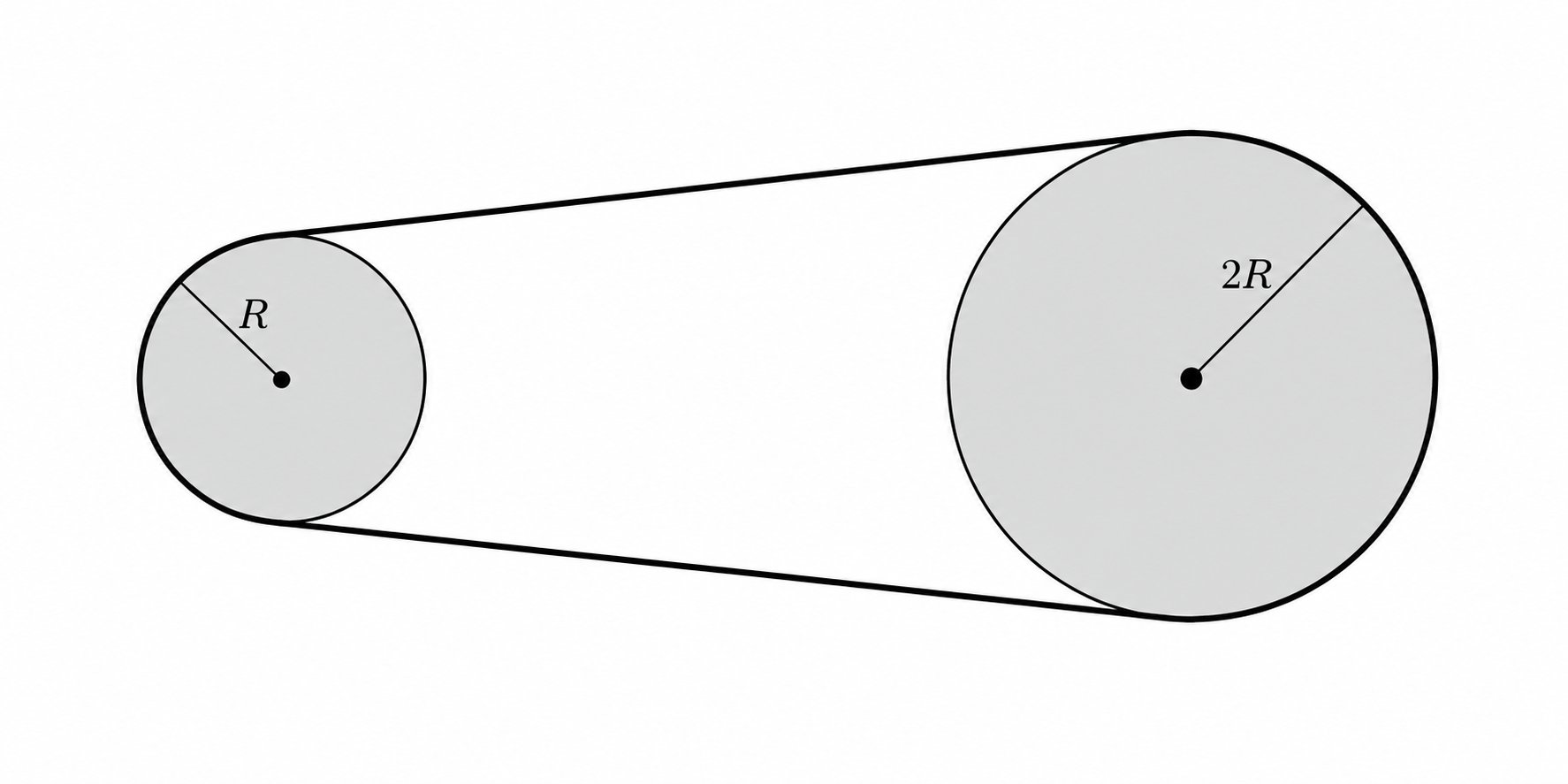
Two fixed-axis pulleys of radii R and 2R are connected by a taut belt.

Schematic; dimensions and force-arrow lengths are not to scale.

Question 2 of 5

A marker on a fixed-axis disk has the speed-time data shown. Its radius is 0.40 m and the disk does not reverse. (a) Determine angular speed at each time. (b) Determine the constant angular acceleration consistent with the data. (c) Find the distance the marker travels from 0 to 4 s, assuming linear speed changes between measurements.

t (s) v (m/s)
0 0.8
2 2.0
4 3.2

Question 3 of 5

A student claims that all points on a rigid disk have the same velocity because they have the same angular velocity. (a) Explain the error using two different radii. (b) Explain why even two diametrically opposite points at the same radius have different velocities. (c) State a quantity those two opposite points do share.

Question 4 of 5

A wheel rim marker is slowing while moving counterclockwise about a fixed center. At the instant the marker is at the rightmost edge, (a) state its velocity direction, (b) state the tangential and inward acceleration directions, and (c) explain what changes if the wheel instead rotates at constant speed.

Question 5 of 5

A motor rotates a shaft at constant angular speed w. A drum on the shaft pulls a string without slipping, with one layer of string so the effective radius stays R. (a) Derive the string speed. (b) Derive the time needed to pull length L. (c) Explain how doubling R changes that time and which no-slip measurement could test the prediction.