Question 1 of 5
Explain the difference between distance and displacement for motion along a straight sidewalk. Include whether each is a scalar or a vector.
Responses receive AI feedback against a rubric after submission. Scores are practice estimates.
Explain the difference between distance and displacement for motion along a straight sidewalk. Include whether each is a scalar or a vector.
A skater’s positions (north positive) are in the table. (a) Find displacement from $t=0$ to $t=20\,\mathrm{s}$. (b) Find distance traveled in that interval. (c) Find average velocity.
| t (s) | x (m) |
|---|---|
| 0 | 5 |
| 10 | 2 |
| 20 | -3 |
Take right as positive. Combine $\vec u=+6\,\mathrm{m}$ and $\vec w=-10\,\mathrm{m}$. (a) Find $\vec u+\vec w$. (b) Find $|\vec u|+|\vec w|$. (c) Why are (a) and (b) different ideas?
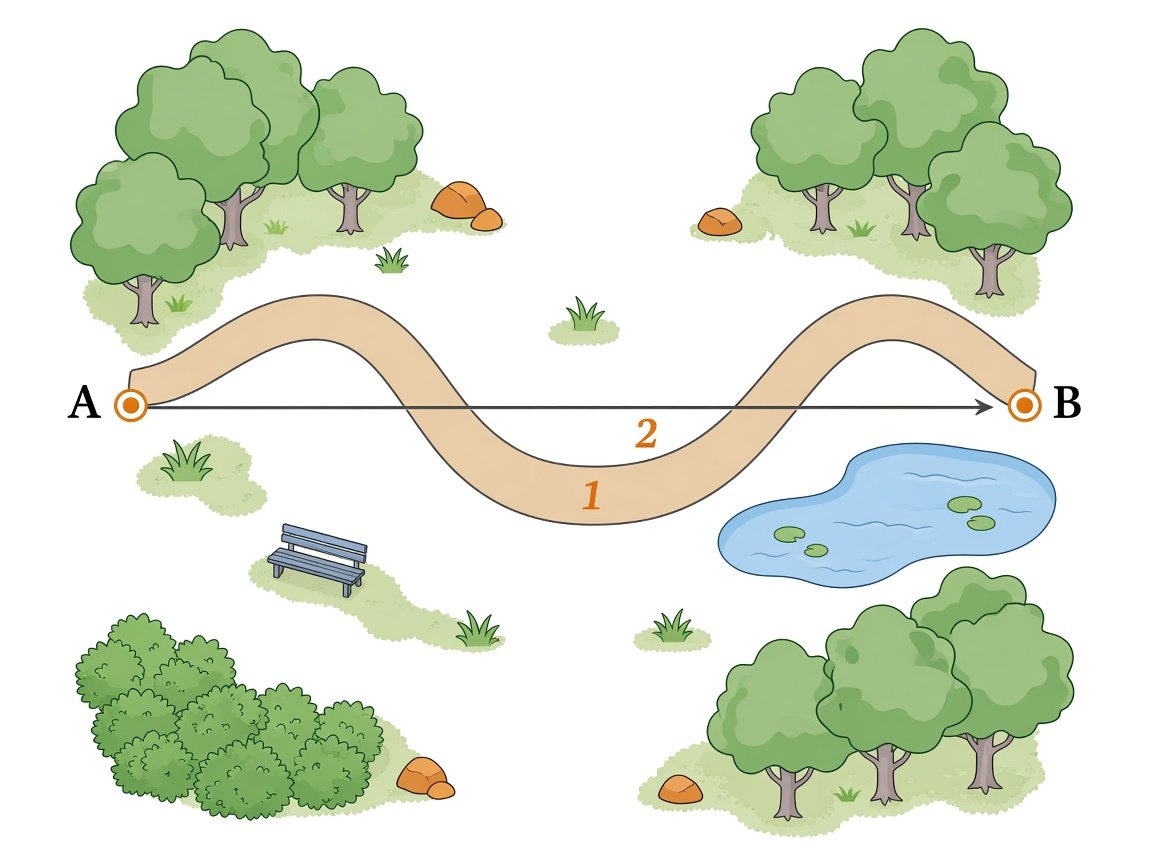
Using the park-path figure, a student walks from $A$ to $B$ along the curved trail. (a) Which labeled quantity is distance? (b) Which is displacement? (c) If the student later returns to $A$ along any route, what is the net displacement for the round trip?
A sensor reports velocity as a signed number on a straight road. (a) What does the sign tell you? (b) What does the absolute value tell you? (c) Give one sentence a driver could say that reports speed but not velocity.