Scalars and Vectors in One Dimension MCQ Practice

Question 1 of 10

A thermometer reads $-5^\circ\mathrm{C}$, and a cart’s displacement is $-5\,\mathrm{m}$ along a track. Why is only the displacement a vector?

  1. A. Any quantity measured in meters is a vector, while any quantity measured in degrees is a scalar.
  2. B. The minus sign gives the displacement a magnitude, but temperature has no magnitude.
  3. C. For displacement, the sign specifies direction relative to the chosen positive axis; for temperature, it specifies a value below the scale’s zero.
  4. D. Negative quantities are vectors only when their magnitudes are greater than one.
Question 2 of 10

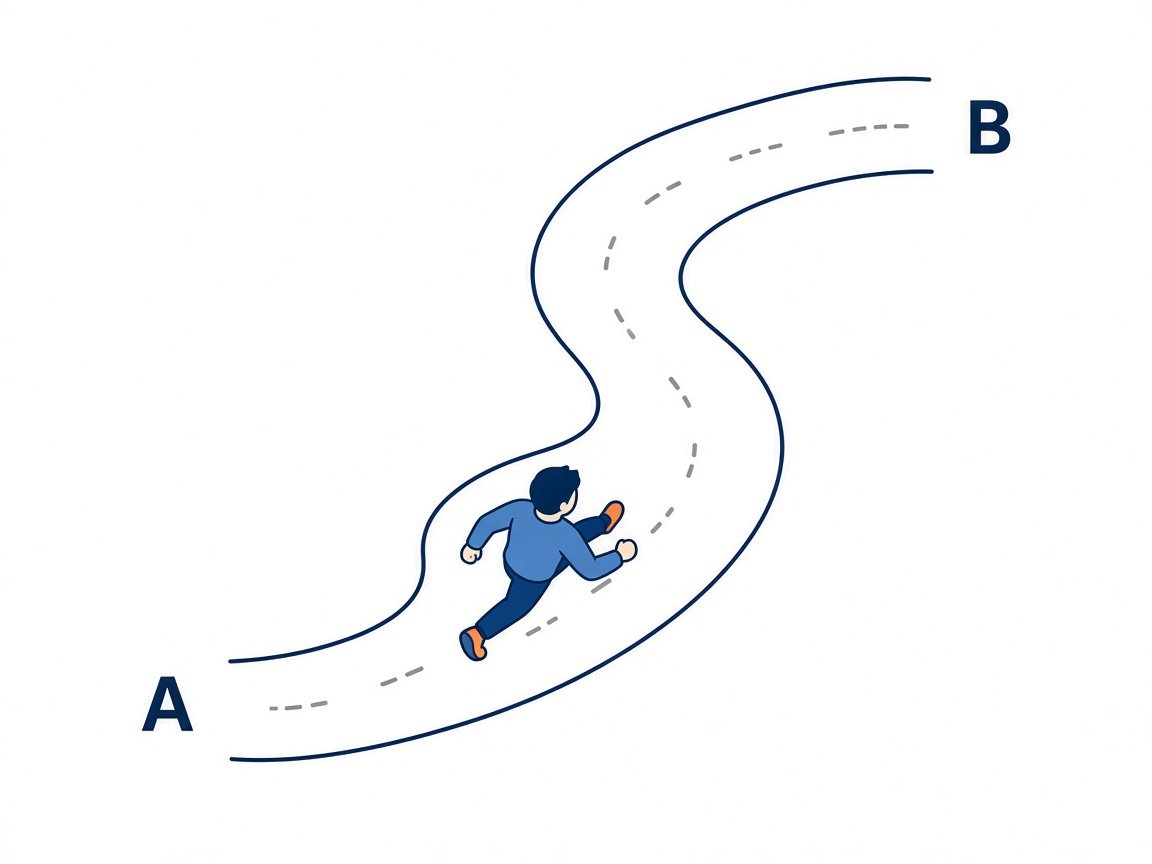
For the curved walk from $A$ to $B$ shown, which comparison is always true?

Curved path versus straight displacement from A to B.
  1. A. Distance equals the magnitude of displacement.
  2. B. Displacement equals the path length.
  3. C. Distance is at least as large as the magnitude of displacement.
  4. D. Displacement is a scalar equal to distance.

Question 3 of 10

Taking east as positive, a scooter’s velocity is $+8\,\mathrm{m/s}$. A moment later its velocity is $-8\,\mathrm{m/s}$. What changed?

  1. A. Only its speed changed.
  2. B. Its direction of motion reversed; speed stayed $8\,\mathrm{m/s}$.
  3. C. It stopped, because velocity became negative.
  4. D. Its mass changed sign.

Question 4 of 10

A bee flies $2\,\mathrm{m}$ forward, $2\,\mathrm{m}$ backward, and $2\,\mathrm{m}$ forward along a straight wire. Distance traveled is

  1. A. $0$
  2. B. $2\,\mathrm{m}$
  3. C. $4\,\mathrm{m}$
  4. D. $6\,\mathrm{m}$

Question 5 of 10

Positions increase to the right. An ant goes from $x=-2.0\,\mathrm{m}$ to $x=+5.0\,\mathrm{m}$. Displacement is

  1. A. $+7.0\,\mathrm{m}$
  2. B. $-7.0\,\mathrm{m}$
  3. C. $+3.0\,\mathrm{m}$
  4. D. $+5.0\,\mathrm{m}$

Question 6 of 10

Which measurement does not require choosing a positive direction on a line?

  1. A. Reporting a velocity of $-2\,\mathrm{m/s}$
  2. B. Reporting a displacement of $+40\,\mathrm{cm}$
  3. C. Reporting that a trip covered $40\,\mathrm{cm}$ of path length
  4. D. Reporting an acceleration of $-1\,\mathrm{m/s^2}$

Question 7 of 10

Two displacements on a line are $+9\,\mathrm{m}$ and $-4\,\mathrm{m}$. Their vector sum is

  1. A. $+13\,\mathrm{m}$
  2. B. $+5\,\mathrm{m}$
  3. C. $-5\,\mathrm{m}$
  4. D. $-13\,\mathrm{m}$

Question 8 of 10

A student claims, “If average velocity is zero, average speed must be zero.” Which counterexample fits one-dimensional motion?

  1. A. Walk east $10\,\mathrm{m}$ and then west $10\,\mathrm{m}$ in equal times.
  2. B. Remain at rest for the entire interval.
  3. C. Move only east at constant speed.
  4. D. Move only west at constant speed.

Question 9 of 10

Magnitudes of two 1D vectors are $a$ and $b$ with $a>b>0$. The magnitude of their sum is greatest when the vectors

  1. A. point in opposite directions
  2. B. are perpendicular (not possible on a single line)
  3. C. have a random mix of signs
  4. D. point in the same direction

Question 10 of 10

At $t=0$ a cart is at $x=+2\,\mathrm{m}$. At $t=4\,\mathrm{s}$ it is at $x=-6\,\mathrm{m}$. The average velocity over that interval is

t (s) x (m)
0 +2
4 -6
  1. A. $-1\,\mathrm{m/s}$
  2. B. $+2\,\mathrm{m/s}$
  3. C. $-2\,\mathrm{m/s}$
  4. D. $+8\,\mathrm{m/s}$