Displacement, Velocity, and Acceleration FRQ Practice

Responses receive AI feedback against a rubric after submission. Scores are practice estimates.

Question 1 of 5

A model rocket is launched from rest at ground level and rises with a constant upward acceleration of $30\,\mathrm{m/s^2}$ for $2.0\,\mathrm{s}$, at which point the engine cuts out. Take up as positive, use $g=10\,\mathrm{m/s^2}$, and ignore air resistance. (a) Determine the rocket’s velocity and height at engine cutout. (b) Determine the maximum height it reaches. (c) Determine its speed just before it strikes the ground. (d) Explain why the acceleration immediately after cutout is $-10\,\mathrm{m/s^2}$ even though the rocket is still moving upward.
Question 2 of 5

A sensor records the velocity of a glider on a straight air track; positive is taken to the right. The readings appear in the table. (a) Determine the glider’s average acceleration between $t=0$ and $t=4.0\,\mathrm{s}$. (b) Determine the glider’s displacement from $t=0$ to $t=8.0\,\mathrm{s}$, and state one assumption your method requires. (c) Determine the time at which the glider is momentarily at rest, and determine how far it is from its starting point at that instant.

$t$ (s) $v$ (m/s)
$0$ $+8.0$
$2.0$ $+4.0$
$4.0$ $0$
$6.0$ $-4.0$
$8.0$ $-8.0$

Question 3 of 5

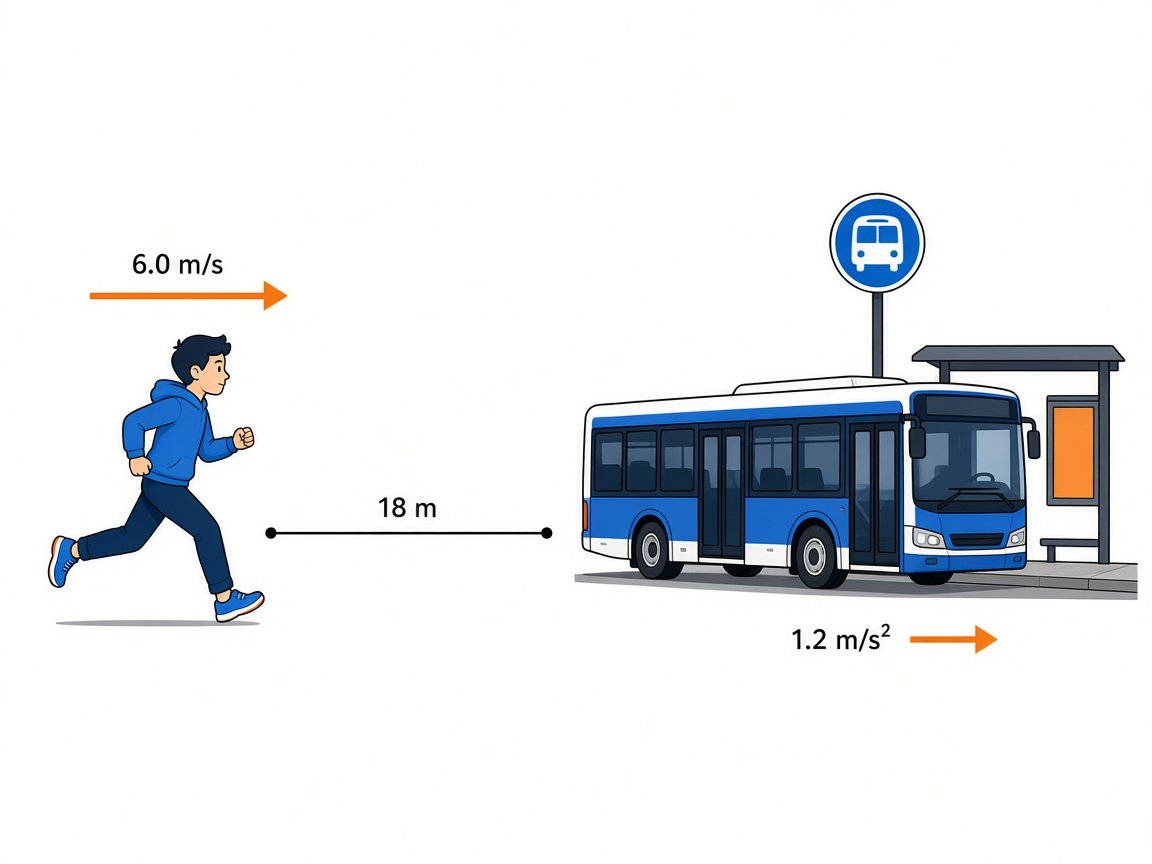
A bus starts from rest at a stop and accelerates uniformly at $1.2\,\mathrm{m/s^2}$ along a straight street. At that same instant a student who is $18\,\mathrm{m}$ behind the bus begins running after it at a constant $6.0\,\mathrm{m/s}$. (a) Write position expressions for the student and the bus, measured from the student’s starting point. (b) Show by calculation that the student never catches the bus. (c) Determine the smallest gap between them and the time at which it occurs, and explain how you know that instant gives the minimum.

A student runs toward a bus that starts 18 meters ahead and accelerates away.

Question 4 of 5

A student drops a ball from rest and uses video analysis to record the distance it has fallen at $0.10\,\mathrm{s}$ intervals. The data appear in the table. (a) Determine the ball’s average velocity between $t=0.20\,\mathrm{s}$ and $t=0.40\,\mathrm{s}$. (b) Use the data to determine an experimental value for $g$, showing your method. (c) The student’s value is smaller than $9.8\,\mathrm{m/s^2}$. Identify one physical cause and explain the direction of its effect.

$t$ (s) Distance fallen (m)
$0.10$ $0.048$
$0.20$ $0.192$
$0.30$ $0.432$
$0.40$ $0.768$
$0.50$ $1.200$

Question 5 of 5

An elevator moves along a vertical shaft; take up as positive. Starting from rest at the ground floor, it accelerates upward at $1.5\,\mathrm{m/s^2}$ for $4.0\,\mathrm{s}$, travels at constant velocity for $6.0\,\mathrm{s}$, and then slows uniformly to rest in $3.0\,\mathrm{s}$. (a) Determine the elevator’s velocity at the end of each of the three phases. (b) Determine the total displacement. (c) State the sign of the acceleration during each phase and explain why the elevator continues to move upward during the third phase even though its acceleration is negative.