Displacement, Velocity, and Acceleration FRQ Practice

Responses receive AI feedback against a rubric after submission. Scores are practice estimates.

Question 1 of 5

A motion sensor records the position of a cart on a straight track; positive is taken down the track. The data appear in the table. (a) Determine the cart’s average velocity from $t=0$ to $t=0.60\,\mathrm{s}$. (b) Estimate the cart’s instantaneous velocity at $t=0.45\,\mathrm{s}$, and explain why your method gives a better estimate than using the interval from $t=0$ to $t=0.45\,\mathrm{s}$. (c) State, with support from the data, whether the cart is speeding up or slowing down, and determine its acceleration.

$t$ (s) $x$ (m)
$0$ $0$
$0.15$ $0.18$
$0.30$ $0.42$
$0.45$ $0.72$
$0.60$ $1.08$

Question 2 of 5

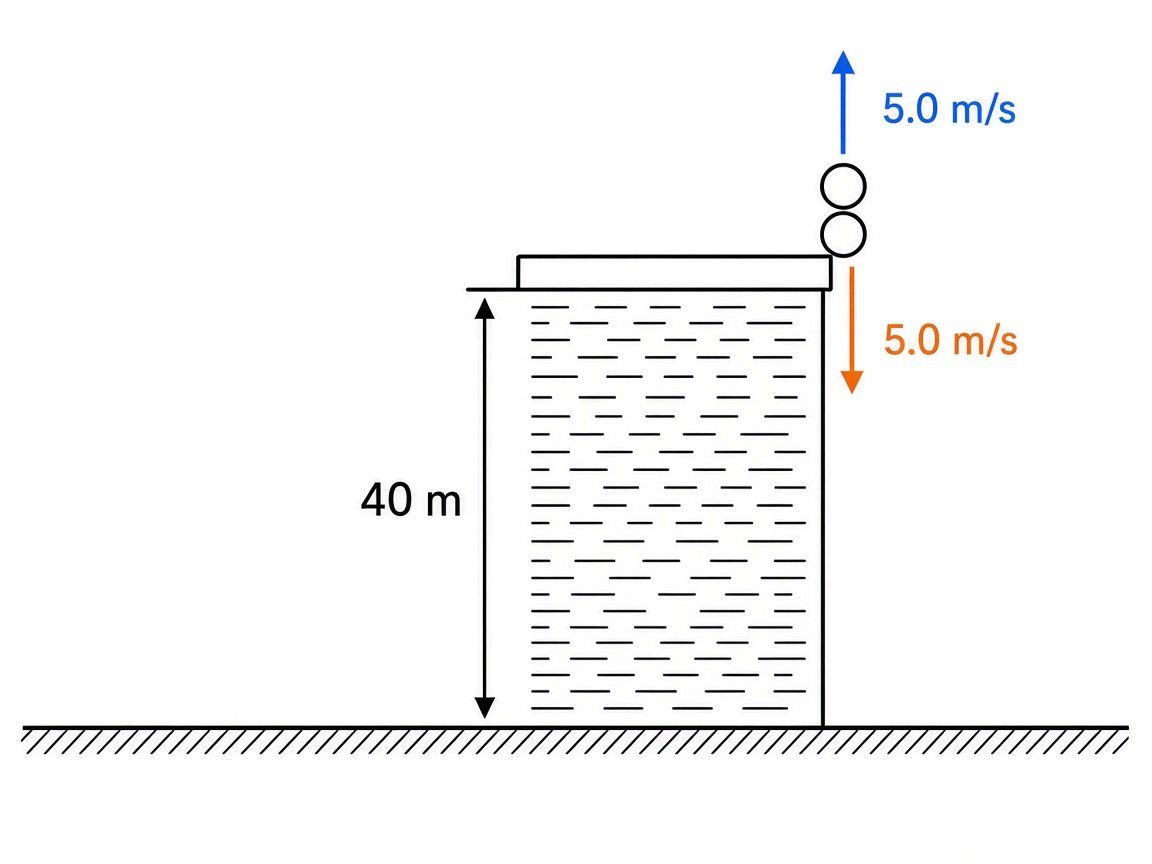
A stone is thrown from the edge of a cliff $40\,\mathrm{m}$ above level ground. Take up as positive, use $g=10\,\mathrm{m/s^2}$, and neglect air resistance. (a) The stone is thrown straight down with initial speed $5.0\,\mathrm{m/s}$. Determine the time it takes to reach the ground and its speed on impact. (b) A second stone is thrown straight up from the same point with initial speed $5.0\,\mathrm{m/s}$. Determine its impact speed. (c) Explain, without repeating the algebra, why the two impact speeds compare as they do, and determine how much later the second stone lands.

Two stones launch upward and downward at 5.0 meters per second from the same 40-meter cliff.

Question 3 of 5

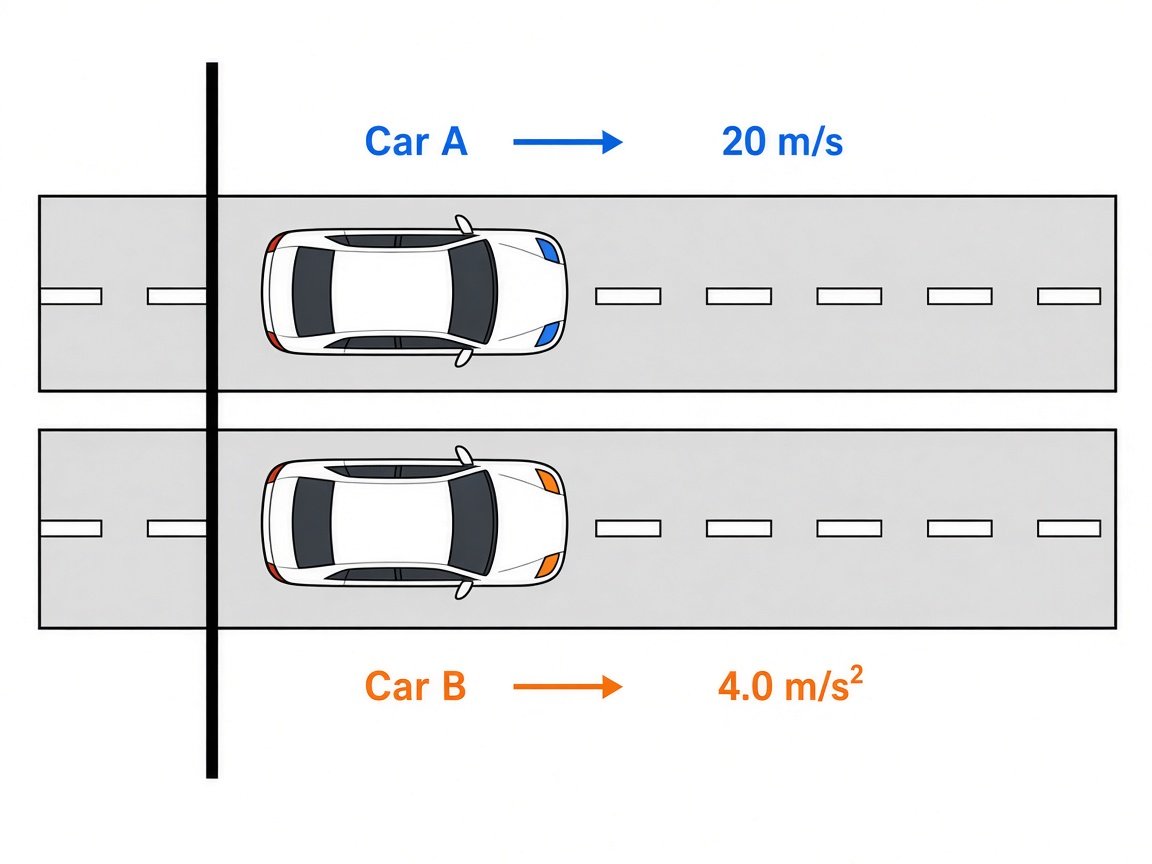
On a straight road, car $A$ passes a stop sign moving at a constant $20\,\mathrm{m/s}$. At the instant $A$ passes, car $B$ starts from rest at the sign and accelerates uniformly at $4.0\,\mathrm{m/s^2}$ in the same direction. (a) Write position expressions for both cars, measured from the sign. (b) Determine how long after the start $B$ catches $A$, and how far from the sign this happens. (c) Determine $B$’s speed at that moment and explain why it is twice $A$’s speed rather than equal to it.

Car A and car B begin together at a stop line; A moves at 20 meters per second while B accelerates.

Question 4 of 5

Each row of the table describes an object moving along the $x$-axis at one instant. (a) For each row, state whether the object’s speed is increasing or decreasing at that instant, or state that the object is momentarily at rest. (b) Explain why row 3 does not describe an object that is “decelerating” in the everyday sense, even though its acceleration is negative. (c) A student claims row 4 is impossible because an object at rest cannot have an acceleration. Explain why the student is wrong, using a physical example.

Row $v$ (m/s) $a$ ($\mathrm{m/s^2}$)
1 $+5.0$ $+2.0$
2 $+5.0$ $-2.0$
3 $-5.0$ $-2.0$
4 $0$ $-10$

Question 5 of 5

An object moves along a straight line with constant acceleration $a$, starting with velocity $v_0$. (a) Starting from $v=v_0+at$ and $\Delta x=\tfrac12(v_0+v)t$, derive $v^2=v_0^2+2a\,\Delta x$. (b) Use the result to explain why a car that doubles its initial speed needs four times the braking distance when the braking acceleration is unchanged. (c) A student claims the equation shows that a negative acceleration always produces a negative displacement. Evaluate the claim, using a numerical counterexample if it is wrong.