TOPIC 8.6 · STUDY
Biodiversity
Ecosystems with fewer parts, and with little diversity among those parts, are often less resilient when the environment changes. Keystone species, producers, and essential abiotic and biotic factors help maintain that diversity. A keystone species affects the system far out of proportion to how common it is, and removing it can collapse structure in both the short term and the long term.
8.6.A
Diversity and resilience
Resilience is the capacity to keep structure and function when conditions change. Natural and artificial systems with few kinds of parts, and little diversity among them, often lose function more readily. A field of one crop, or a tank with only a couple of species, has little backup if one part fails. A system with many interacting parts is more likely to keep moving energy and matter when one population declines.
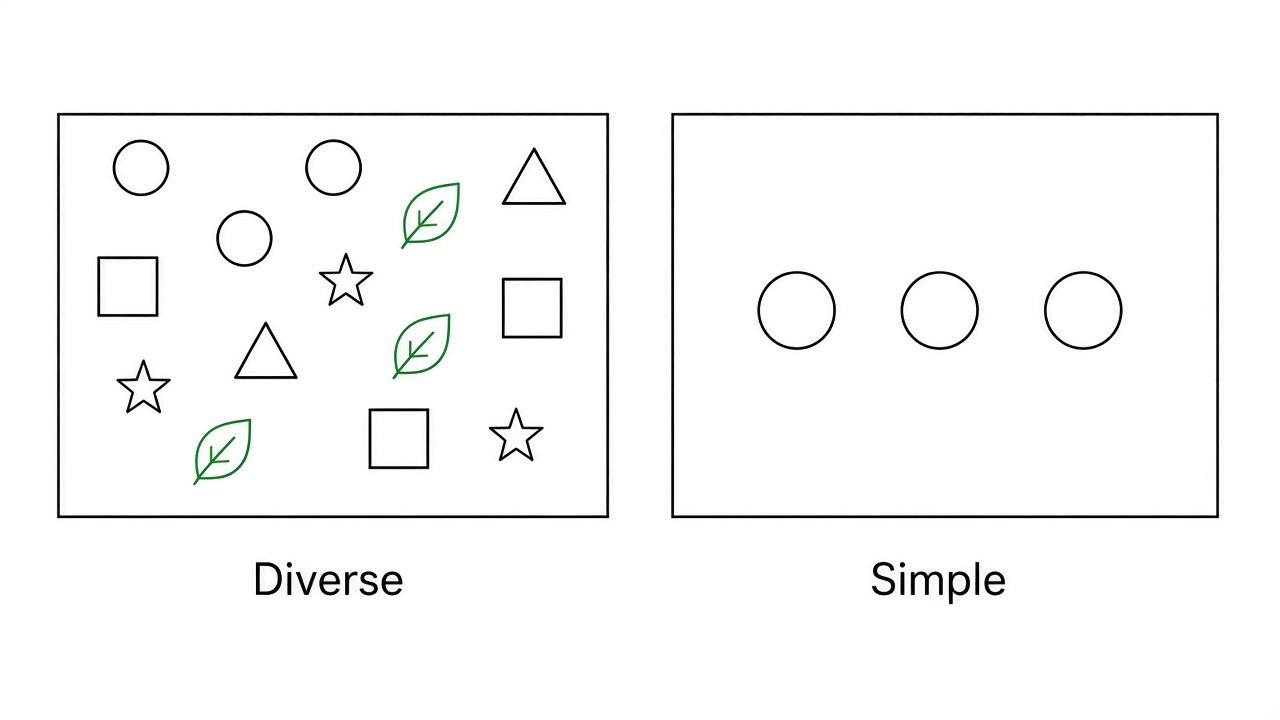
The diverse system has many kinds of parts. The simple system has one kind. The diverse system is often more resilient when conditions change.
Three kinds of components help maintain diversity. Keystone species control interactions that many other species depend on. Producers capture the energy that supports the rest of the community. Essential abiotic factors, such as water, temperature, light, and nutrients, and essential biotic interactions decide which species can persist. Losing several producer species removes that energy base. Suppose a diverse site falls from 24 species to 21 after a stress, and a simple site falls from 8 species to 3. The diverse site changed by $\frac{21-24}{24}\times 100\%=-12.5\%$. The simple site changed by $\frac{3-8}{8}\times 100\%=-62.5\%$. The larger proportional loss fits a system that started with fewer parts. Those counts illustrate the comparison. They are not a result to memorize.
8.6.B
Keystone species and structure
Adding or removing any component can change ecosystem structure over the short term and the long term. A keystone species is the sharp case. Its effect is large compared with its abundance. It may be uncommon and still hold the community together. Remove it, and the system often collapses or shifts to a different structure. Remove a common species that does not control those interactions, and the change is often smaller. Importance follows the role, not the head count.
A keystone predator can keep a dominant competitor or a dominant grazer in check. Soon after that predator is added, the dominant prey declines. Over a longer time, species that had been suppressed may increase, and diversity can rise. If the keystone is removed, the dominant prey can increase, overuse its resource, and leave a simpler community. The same pattern holds when a new predator becomes a keystone: structure changes on both time scales, and the change is large relative to the predator's numbers.
Key points
- Fewer parts, and less diversity among those parts, usually mean less resilience.
- Keystone species, producers, and essential abiotic and biotic factors help maintain diversity.
- Producers supply the energy that lets other species persist.
- A keystone effect is large compared with how common the species is.
- Removing a keystone often collapses or reorganizes community structure.
- Adding or removing a component can change both short-term and long-term structure.
A rare species can be a keystone. Do not decide importance by counting individuals alone.