TOPIC 8.7 · STUDY
Disruptions in Ecosystems
An adaptation is a genetic variant that selection favors because it helps in a particular environment. Mutations are not produced to meet an environmental need. Heterozygote advantage means the heterozygote has higher fitness than either homozygote. Invasive species, human activities such as eutrophication and biomagnification, and geological or meteorological events can all restructure ecosystems.
8.7.A
Variation, selection, and heterozygote advantage
An adaptation is a genetic variation favored by selection. It shows up as a trait that gives an advantage in a particular environment. A mutation that is not favored is still a genetic change, but it is not an adaptation. It may stay rare or be removed. The environment does not order the mutation it needs. Mutations arise without being directed by a specific pressure. Selection then keeps or removes variants that already exist. A drought that favors deep-rooted plants is choosing among genotypes already in the population. It is not writing a new mutation because the plants need it.
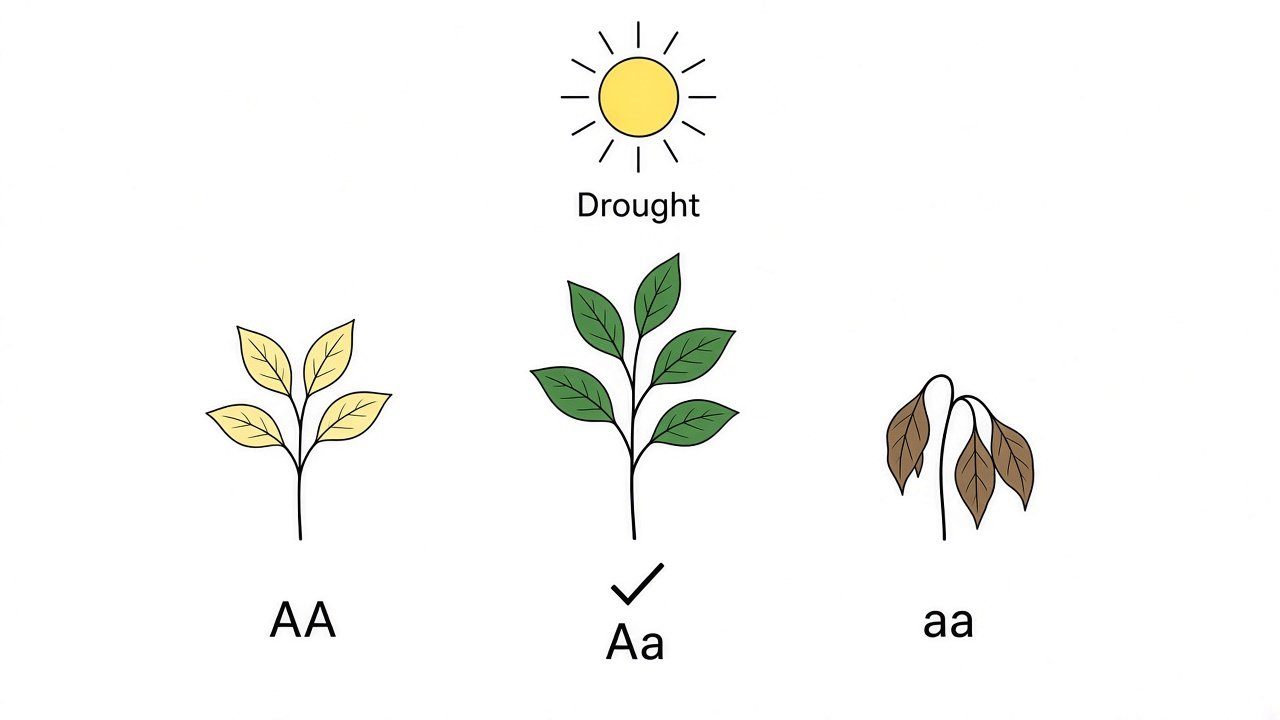
Under drought, Aa does better than AA or aa. The three genotypes were already present. The drought selected among them.
Heterozygote advantage means the heterozygous genotype has higher relative fitness than either homozygote. If relative fitness is 0.80 for AA, 1.00 for Aa, and 0.40 for aa, Aa is favored. One setting is a region where one homozygote is hit hard by a disease and the other homozygote pays a serious cost for two copies of a resistance allele. The heterozygote can resist the disease without that full cost. The ranking belongs to that environment. In a different environment another genotype can be favored.
8.7.B
Invasive species
An invasive species is introduced on purpose or by accident and then disrupts the new ecosystem. It may enter a niche with few predators or competitors, so its numbers grow quickly. It may also outcompete native species for food, space, or light. Either route changes community structure. Kudzu and zebra mussels illustrate that pattern. Explain enemy release, competition with natives, or both, from the situation you are given. A catalog of invaders is not required.
8.7.C
Human activities
Human activity speeds change at local and global scales, and that change can drive extinctions. Two processes named for this topic are eutrophication and biomagnification. In eutrophication, nutrient runoff fuels algal growth. When the bloom is decomposed, dissolved oxygen falls, and animals that need that oxygen die. Diversity drops. Biomagnification is a different process: a substance becomes more concentrated at higher trophic levels. A load of 2 units in producers can show up as 200 units in a top predator. The predator did not make the substance. Each consumer took in many prey, so the substance concentrated.
Logging, urbanization, and planting a single crop also remove or simplify habitat. They are human disruptions of structure, in the same broad class as nutrient pollution and food-chain toxins. The mechanism differs. The shared result is a faster change in which species persist.
8.7.D
Geological and meteorological change
Geological and meteorological events change habitats and where ecosystems occur. Biogeography records those shifts. Continental drift rearranges land and isolates or joins living communities over long times. A large meteor impact can change climate and habitat worldwide and can cause mass extinction, after which survivors occupy a rearranged biosphere. El Nino and other large meteorological swings change ocean and weather conditions, so populations move, crash, or recover. The shared effect is habitat change followed by a change in distribution. Logging is a human activity. A meteor impact is geological. Keep those causes apart.
Key points
- An adaptation is a genetic variant that selection favors in a particular environment.
- Mutations are not directed by need. Selection acts on variation that already exists.
- Heterozygote advantage means Aa has higher fitness than AA and higher fitness than aa.
- An invasive species may escape enemies, outcompete native species, or do both.
- Eutrophication is nutrient pollution that can deplete oxygen. Biomagnification concentrates a substance up the food chain.
- Logging, urbanization, and single-crop planting are human changes that can drive extinctions.
- Geological and meteorological events change habitats and the distribution of ecosystems.
This is the last topic in the course. It connects selection on variation that already exists with disruptions that change ecosystem structure.