Biodiversity MCQ Practice

Question 1 of 10

Resilience in an ecosystem refers to

  1. A. ability to withstand or recover from environmental change
  2. B. the value of $r_{\max}$ alone
  3. C. only the atomic number of nitrogen
  4. D. elimination of all species

Question 2 of 10

Essential abiotic factors that help maintain diversity include

  1. A. only consumer gut microbiomes
  2. B. only learned bird songs
  3. C. resources such as water, light, nutrients, and suitable climate
  4. D. only allele frequencies

Question 3 of 10

A wetland restored from 3 to 15 plant species is expected, all else equal, to become

  1. A. less resilient
  2. B. more resilient to environmental change
  3. C. unable to support producers
  4. D. a system with undefined carrying capacities only

Question 4 of 10

Natural ecosystems with many interacting species compared with simplified artificial systems are often

  1. A. more resilient
  2. B. always less stable under every disturbance
  3. C. forbidden from having keystone species
  4. D. identical in resilience by definition

Question 5 of 10

Which component is listed in the CED as helping maintain diversity?

  1. A. Only stellar fusion
  2. B. Only vacuum permittivity
  3. C. Only codon degeneracy charts
  4. D. Keystone species

Question 6 of 10

Loss of several producer species in a stream community most directly threatens

  1. A. the definition of a population
  2. B. energy support for higher trophic diversity
  3. C. the existence of atoms
  4. D. Hardy–Weinberg assumptions on another continent

Question 7 of 10

Adding a new predator that becomes keystone can

  1. A. restructure the community far beyond the predator's numbers
  2. B. only change rock cycle rates
  3. C. never affect short-term structure
  4. D. erase the concept of carrying capacity globally

Question 8 of 10

If orcas sharply reduce otter numbers in the kelp web, a cascading risk is
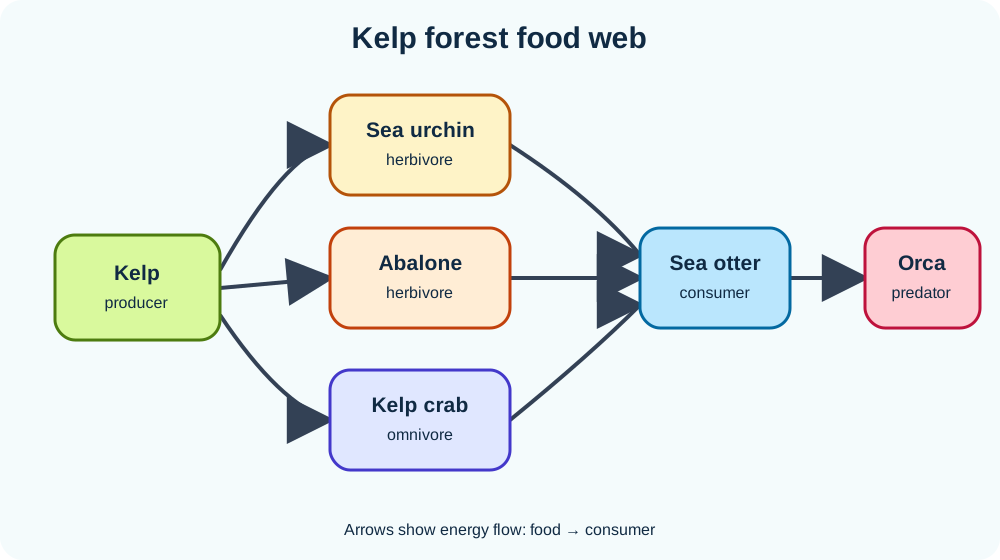
Kelp forest food web: kelp feeds sea urchins, abalone, and kelp crabs; these invertebrates feed sea otters, which may be prey for orcas. Arrows show energy flow from food to consumer.
  1. A. immediate evolution of photosynthetic urchins
  2. B. kelp becoming nitrogen gas
  3. C. urchin outbreaks that destroy kelp and reduce diversity
  4. D. elimination of all abiotic light

Question 9 of 10

The hallmark of a keystone species is

  1. A. being the most abundant organism always
  2. B. disproportionate ecological impact relative to abundance
  3. C. never interacting with other species
  4. D. existing only as a fossil

Question 10 of 10

Long-term community structure after keystone loss may

  1. A. remain identical by law
  2. B. ignore energy flow entirely
  3. C. include only extinct species
  4. D. stabilize in a new, often less diverse configuration