Biodiversity MCQ Practice

Question 1 of 10

Ecosystems with few component parts and little diversity among parts are often

  1. A. more resilient to environmental change
  2. B. less resilient to environmental change
  3. C. immune to all disturbances
  4. D. unable to contain producers

Question 2 of 10

Keystone species, producers, and essential abiotic/biotic factors help

  1. A. maintain ecosystem diversity
  2. B. eliminate all trophic structure
  3. C. prevent any resilience
  4. D. remove biogeochemical cycles

Question 3 of 10

A monoculture crop field versus a diverse prairie: which claim is best?

  1. A. The monoculture is always more resilient to pests
  2. B. Diversity never affects resilience
  3. C. The more diverse prairie is often more resilient to environmental change
  4. D. Resilience requires zero producers

Question 4 of 10

If a disease removes half the plant species from a low-diversity island community, resilience is expected to

  1. A. increase because fewer parts always stabilize systems
  2. B. become infinite
  3. C. be unaffected by species loss
  4. D. decrease because fewer diverse components remain

Question 5 of 10

Producers contribute to maintaining diversity primarily by

  1. A. capturing energy that supports food webs
  2. B. consuming only quaternary predators
  3. C. fixing carrying capacity to zero
  4. D. eliminating abiotic factors

Question 6 of 10

An artificial aquarium with two fish species and one plant is likely, relative to a diverse reef tank,

  1. A. more resilient to water-quality swings
  2. B. less resilient because it has fewer diverse components
  3. C. guaranteed never to change
  4. D. unable to have any abiotic conditions

Question 7 of 10

Keystone species have effects that are

  1. A. disproportionate relative to their abundance
  2. B. always proportional only to their biomass share
  3. C. zero by definition
  4. D. limited to abiotic weathering

Question 8 of 10

In the kelp web figure, sea otters that suppress urchins and protect kelp forests are acting as
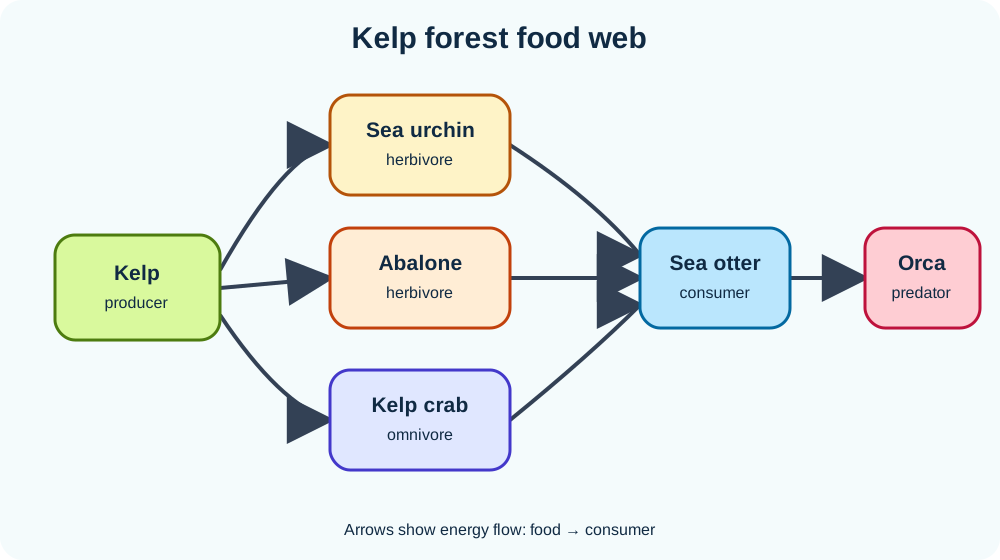
Kelp forest food web: kelp feeds sea urchins, abalone, and kelp crabs; these invertebrates feed sea otters, which may be prey for orcas. Arrows show energy flow from food to consumer.
  1. A. only decomposers
  2. B. chemosynthetic producers
  3. C. a keystone consumer whose removal can collapse the forest structure
  4. D. nitrogen-fixing bacteria

Question 9 of 10

Removing a keystone species often

  1. A. has no community effect
  2. B. causes large structural change or collapse
  3. C. increases abiotic-only ecosystems forever
  4. D. converts all consumers to autotrophs

Question 10 of 10

Short-term versus long-term structure after removing a keystone predator: the best expectation is

  1. A. no change at either timescale
  2. B. only allele charts change
  3. C. only rock cycle rates change
  4. D. community composition can shift quickly and remain altered