TOPIC 8.2 · STUDY
Energy Flow Through Ecosystems
Endotherms hold body temperature with metabolic heat. Ectotherms rely more on behavior, such as moving into sun or shade. A net energy gain supports storage, growth, and reproduction. A continuing net loss leads to loss of mass and, eventually, death. Energy flows through trophic levels while matter cycles. Autotrophs capture light or chemical energy. Heterotrophs obtain energy by consuming organic matter.
8.2.A
Strategies for acquiring and using energy
Organisms use energy to stay organized, grow, reproduce, and maintain homeostasis. Endotherms use thermal energy from metabolism to hold a steady body temperature. Ectotherms lack an efficient internal heater. They still regulate temperature by behavior: moving into sun or shade, or clustering with other individuals.
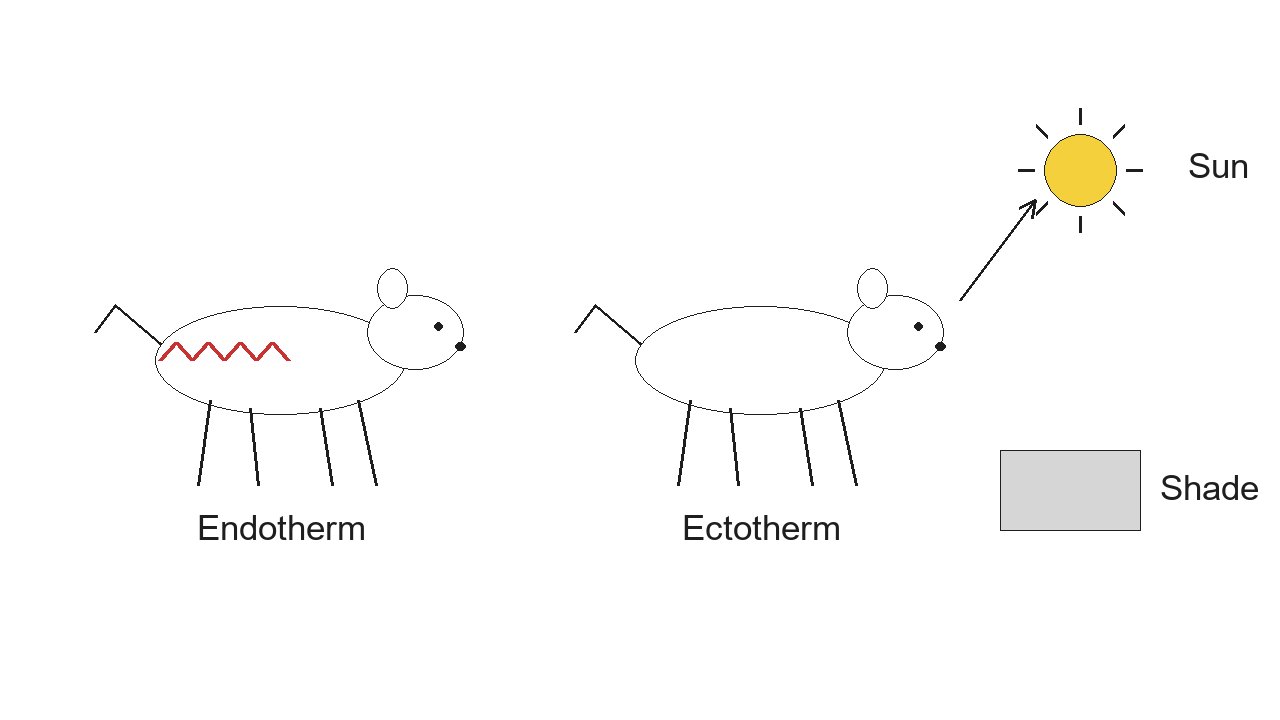
The endotherm produces metabolic heat. The ectotherm does not. It moves toward sun or shade to change its temperature.
A net gain of energy can be stored, used for growth, or put into more offspring. A net loss reduces mass and reproductive output. If the loss continues, the organism dies. Some organisms match reproduction to the energy supply. They may breed when food is abundant, or switch between asexual and sexual reproduction as resources change. A biennial life cycle, or a pause in reproduction during scarcity, is the same idea: timing tracks energy. You do not need a memorized list of species for each strategy.
8.2.B
Energy flow and matter cycles
Ecological organization, from least inclusive to most inclusive, runs population, community, ecosystem, biome. A population is one species. A community is the interacting populations in a place. An ecosystem adds the abiotic surroundings. A biome is a large region with a characteristic climate and life.
Energy flows through an ecosystem. Matter cycles between organisms and the environment. Each cycle conserves matter: atoms change form and location, and they are not destroyed. The cycles depend on one another, because the same organisms move carbon, water, nitrogen, and phosphorus.
| Cycle | What to track | Main transfers |
|---|---|---|
| Water | Oceans, surface water, atmosphere, and organisms | Evaporation, condensation, precipitation, and transpiration |
| Carbon | Carbon dioxide in air and carbohydrates in organisms | Photosynthesis, cellular respiration, decomposition, and combustion |
| Nitrogen | The atmosphere is the largest reservoir | Fixation, assimilation, ammonification, nitrification, and denitrification |
| Phosphorus | Rocks, soil, groundwater, and organisms | Weathering, uptake, eating, decomposition, and excretion |
Photosynthesis moves carbon from carbon dioxide into carbohydrates. Cellular respiration, decomposition, and combustion return carbon to the air as carbon dioxide. That is the carbon accounting for this topic. The light reactions and the Calvin cycle stay in Unit 3. In nitrogen fixation, nitrogen gas ($\mathrm{N_2}$) becomes ammonia ($\mathrm{NH_3}$). Ammonia gains hydrogen ions from soil water and becomes ammonium ($\mathrm{NH_4^+}$). Assimilation builds nitrogen into biomass. Ammonification releases ammonium as organic matter breaks down. Nitrification converts ammonium to nitrate. Denitrification converts nitrate back to nitrogen gas. Soil microorganisms carry out these steps. Phosphate ($\mathrm{PO_4^{3-}}$) leaves rocks by weathering. Producers take it up, consumers obtain it by eating, and decomposition or excretion returns it.
8.2.C
Energy availability and trophic levels
A change in available energy can change population size and can disrupt the ecosystem. Trophic levels are producers, then primary, secondary, tertiary, and quaternary consumers, plus decomposers. Sunlight is the energy input for most surface food webs. Less sunlight can shrink both the number and the size of those levels.
If producer biomass in an area falls, less energy is available to the consumers that depend on those producers, so those populations tend to shrink. If primary productivity rises and the fraction transferred stays similar, higher levels can be larger. Not all energy at one level reaches the next. Some is used in metabolism and leaves as heat, so upper levels are limited by what the producers captured.
8.2.D
Autotrophs and heterotrophs
Autotrophs capture energy from the physical or chemical environment. Photosynthetic autotrophs capture sunlight. That capture is primary productivity, the entry of energy that supports the rest of a food web. Chemosynthetic autotrophs capture energy from small inorganic molecules. They can do this without oxygen.
Heterotrophs cannot make that entry themselves. Carnivores, herbivores, omnivores, decomposers, and scavengers metabolize carbohydrates, lipids, and proteins in organic matter that traces back to autotrophs, and they build some of that matter into their own tissues. A decomposer and a scavenger are heterotrophs. They also return atoms to the matter cycles.
Key points
- Endotherms use metabolic heat. Ectotherms regulate temperature by behavior such as sun, shade, or clustering.
- A net energy gain supports storage, growth, and reproduction. A continuing net loss reduces mass and can end in death.
- Energy flows. Matter cycles and is conserved. Organization runs from population to community, ecosystem, and biome.
- Carbon moves by photosynthesis, cellular respiration, decomposition, and combustion. Do not rebuild the photosynthetic pathway here.
- The largest nitrogen reservoir is the atmosphere. Fixation turns $\mathrm{N_2}$ into $\mathrm{NH_3}$, then $\mathrm{NH_4^+}$.
- Less sunlight or less producer biomass can shrink the size of higher trophic levels.
- Photosynthetic autotrophs use light. Chemosynthetic autotrophs use inorganic molecules and can live without oxygen. Heterotrophs consume organic matter.
Name photosynthesis as energy capture and as the route that builds carbohydrates from carbon dioxide. Leave the chloroplast chemistry in Unit 3.