Energy Flow Through Ecosystems MCQ Practice

Question 1 of 10

An endotherm maintains a stable body temperature in a cool room by increasing metabolic heat production. An ectotherm in the same room becomes cooler unless it moves to a warmer microhabitat. Which statement is best?

  1. A. Only ectotherms use energy to maintain homeostasis.
  2. B. Endotherms rely more on metabolic heat; ectotherms often use behavior to regulate temperature.
  3. C. Ectotherms generate more metabolic heat than endotherms of equal size at rest.
  4. D. Temperature regulation never requires energy.
Question 2 of 10

A bird experiences a long period of net energy loss. Which outcome is most likely?

  1. A. Immediate speciation
  2. B. Unlimited reproductive output
  3. C. Loss of mass and reduced reproductive output
  4. D. Conversion from heterotroph to autotroph

Question 3 of 10

Some aphids switch from asexual to sexual reproduction when resources decline. Which idea does this illustrate?

  1. A. Reproductive strategies can change with energy availability.
  2. B. Reproduction is independent of energy.
  3. C. Only vertebrates alternate reproductive modes.
  4. D. Energy availability cannot affect life-history timing.

Question 4 of 10

Which statement correctly distinguishes energy flow from matter cycling in ecosystems?

  1. A. Energy flows through ecosystems while matter cycles between environment and organisms.
  2. B. Matter flows one way and energy cycles endlessly without input.
  3. C. Neither energy nor matter is conserved in biogeochemical cycles.
  4. D. Energy and matter are identical processes.

Question 5 of 10

In the carbon cycle, which pair of processes moves carbon into living carbohydrates and back to atmospheric $\mathrm{CO_2}$?

  1. A. Nitrification and denitrification only
  2. B. Evaporation and condensation only
  3. C. Photosynthesis and cellular respiration
  4. D. Phosphate weathering and assimilation only

Question 6 of 10

The largest reservoir of nitrogen in the nitrogen cycle is the

  1. A. lithospheric phosphate rock only
  2. B. atmosphere
  3. C. ozone layer exclusively
  4. D. consumer biomass alone

Question 7 of 10

A drought sharply reduces producer biomass in a grassland. Which prediction is most reasonable?

  1. A. All trophic levels increase indefinitely.
  2. B. Only quaternary consumers increase.
  3. C. Decomposers disappear while producers explode.
  4. D. Lower energy available from producers can reduce sizes of higher trophic levels.

Question 8 of 10

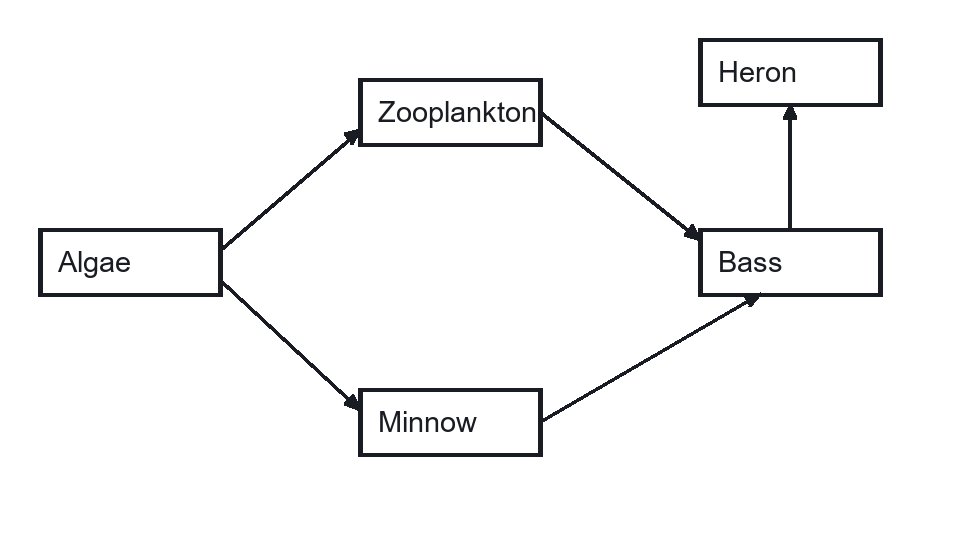
Using the food web figure, which organism is a secondary consumer that could be affected if minnow numbers crash?

Freshwater food web with algae, zooplankton, minnow, bass, and heron; arrows point from prey to predator.
  1. A. Algae only, because algae eat bass
  2. B. Bass, which consume minnows
  3. C. Zooplankton only, because they photosynthesize
  4. D. Heron only if arrows reverse direction

Question 9 of 10

Chemosynthetic bacteria near hydrothermal vents capture energy from inorganic molecules. They are best classified as

  1. A. autotrophs
  2. B. primary consumers only
  3. C. tertiary consumers only
  4. D. detritivores that photosynthesize

Question 10 of 10

Heterotrophs obtain energy by

  1. A. fixing atmospheric $\mathrm{N_2}$ into glucose without consuming organic matter
  2. B. creating new energy atoms from nothing
  3. C. metabolizing organic molecules originally produced by autotrophs
  4. D. absorbing only mineral phosphate as their sole energy source