TOPIC 2.1 · STUDY
Cell Structure and Function
Ribosomes build proteins in every known form of life. The endomembrane system folds, modifies, and ships many of those products. Mitochondria, chloroplasts, lysosomes, and vacuoles are membrane compartments for ATP production, photosynthesis, digestion, and storage.
2.1.A
How organelle structure supports cell function
A ribosome is ribosomal RNA plus protein. It has no membrane. Ribosomes occur in cells of every known form of life, which is evidence of common ancestry. They build a protein by following the sequence of a messenger RNA. Ribosomes floating in the cytosol release proteins there. Ribosomes bound to rough endoplasmic reticulum feed proteins into the membrane system that will package them.
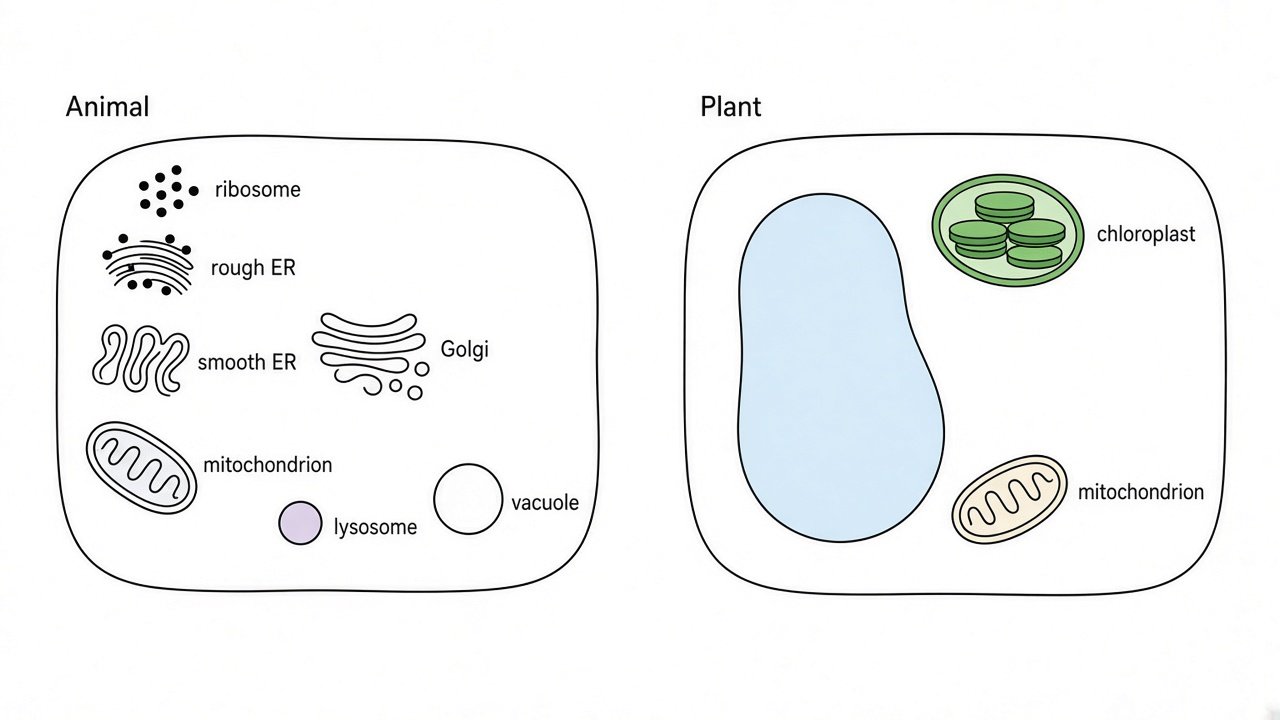
The animal cell shows a ribosome, rough ER, smooth ER, the Golgi, a mitochondrion, a lysosome, and a small vacuole. In the plant cell the large blue sac is the central vacuole, next to a chloroplast and a mitochondrion.
The endomembrane system is the group of membrane-bound parts that handle polysaccharides, lipids, and proteins together: endoplasmic reticulum, Golgi complex, lysosomes, vacuoles, transport vesicles, the nuclear envelope, and the plasma membrane. They modify, package, and move those molecules inside the cell and out toward the cell surface. The endoplasmic reticulum also helps the cell keep its shape and carries materials through the cytoplasm. Rough ER is covered with ribosomes. That arrangement compartmentalizes protein synthesis and makes proteins destined for membranes or for export. Smooth ER has no ribosomes. It synthesizes lipids and helps detoxify the cell.
The Golgi complex is a stack of flattened membrane sacs. It finishes folding newly made products and chemically modifies them. Adding sugar chains, called glycosylation, is one modification that can decide what a protein does or which compartment it is sent to. The Golgi then packs the products into vesicles for trafficking.
A mitochondrion has two membranes, so it has separate compartments for different reactions of aerobic cellular respiration. The outer membrane is smooth. The inner membrane is highly folded. Those folds add membrane area and let the cell synthesize ATP more efficiently. The step-by-step pathway of respiration is a later topic. The structure to use here is the double membrane and the folded inner membrane.
Lysosomes are membrane-enclosed sacs of hydrolytic enzymes. They digest material the cell has brought in. They also take part in apoptosis, which is programmed cell death. The membrane keeps those enzymes from digesting the rest of the cell at random. Vacuoles are membrane sacs with several storage jobs. In a plant cell one large central vacuole stores water and nutrients and pushes outward, which maintains turgor pressure. Animal vacuoles are smaller and more numerous, and they store cellular materials.
Chloroplasts are found in plants and in photosynthetic algae. A chloroplast has a double membrane and is the site of photosynthesis. The light reactions and the sugar-building cycle are a later topic. What belongs here is where photosynthesis happens and that the organelle is membrane-bound.
Key points
- Ribosomes are rRNA and protein, have no membrane, occur in all known life, and synthesize proteins from mRNA.
- The endomembrane system includes the ER, Golgi, lysosomes, vacuoles, vesicles, nuclear envelope, and plasma membrane.
- Rough ER has bound ribosomes and makes proteins. Smooth ER makes lipids and helps detoxify the cell.
- The Golgi folds and chemically modifies products, including by glycosylation, then packages them.
- Mitochondria have a smooth outer membrane and a folded inner membrane that supports efficient ATP synthesis.
- Lysosomes hold hydrolytic enzymes for digestion and also act in apoptosis.
- A plant central vacuole stores water and nutrients and maintains turgor. Chloroplasts are the site of photosynthesis in plants and photosynthetic algae.
A ribosome is not a membrane-bound organelle. Prokaryotic cells have ribosomes too.