Cell Structure and Function MCQ Practice

Question 1 of 10

Ribosomes are present in cells of all known life forms. Which statement best explains why that observation matters for evolutionary biology?

  1. A. Ribosomes are membrane-bound organelles unique to eukaryotes.
  2. B. Ribosomes store hereditary information instead of synthesizing proteins.
  3. C. Shared ribosomal structure and protein synthesis reflect common ancestry among all known life.
  4. D. Ribosomes are found only in cells that perform photosynthesis.
Question 2 of 10

A secretory protein is synthesized on membrane-bound ribosomes, then chemically modified and packaged for export. Which sequence of endomembrane components is most consistent with that pathway?

  1. A. Smooth ER → lysosome → plasma membrane
  2. B. Rough ER → Golgi complex → secretory vesicle → plasma membrane
  3. C. Free cytosolic ribosome → mitochondrion → chloroplast
  4. D. Golgi complex → nucleus → rough ER

Question 3 of 10

Which comparison of rough ER and smooth ER is accurate?

  1. A. Rough ER has membrane-bound ribosomes and aids protein synthesis; smooth ER supports lipid synthesis and detoxification.
  2. B. Rough ER digests macromolecules; smooth ER stores hereditary DNA.
  3. C. Both ER types are non-membranous and float freely in the cytosol.
  4. D. Smooth ER packages proteins for trafficking while rough ER generates ATP.

Question 4 of 10

Mitochondria have a smooth outer membrane and a highly folded inner membrane. How does that architecture support ATP production?

  1. A. The outer membrane stores chlorophyll for light capture.
  2. B. Folds decrease surface area so fewer reactions occur.
  3. C. The double membrane prevents all solute movement, stopping metabolism.
  4. D. Inner-membrane folds increase surface area for the reactions that synthesize ATP more efficiently.

Question 5 of 10

Lysosomes contain hydrolytic enzymes. Which cellular process do they contribute to beyond digesting engulfed material?

  1. A. Fixing carbon dioxide into sugars
  2. B. Programmed cell death (apoptosis)
  3. C. Replicating nuclear DNA
  4. D. Synthesizing ribosomal RNA exclusively

Question 6 of 10

In plant cells, a large central vacuole helps maintain turgor. What does that primarily involve?

  1. A. Exporting all ribosomes from the cell
  2. B. Converting light energy into ATP only
  3. C. Storing water and nutrients that press the cytoplasm against the cell wall
  4. D. Digesting the cell wall during every cell cycle

Question 7 of 10

Chloroplasts are found in plants and photosynthetic algae. Which structural feature is essential for their role?

  1. A. A double membrane enclosing the site of photosynthesis
  2. B. A single membrane continuous with the nuclear envelope only
  3. C. Hydrolytic enzymes that digest proteins for ATP
  4. D. Absence of any internal membranes

Question 8 of 10

The table lists organelles and one proposed primary function. Which row correctly matches structure to function?

Organelle Proposed function
Golgi complex Stores hereditary DNA
Ribosome Synthesizes proteins from mRNA
Lysosome Captures light energy
Smooth ER Packages proteins for export
  1. A. Golgi — stores hereditary DNA
  2. B. Ribosome — synthesizes proteins from mRNA
  3. C. Lysosome — captures light energy
  4. D. Smooth ER — packages proteins for export

Question 9 of 10

A researcher compares a secretory cell to a muscle cell. The secretory cell has much more rough ER and Golgi. The best explanation is that the secretory cell

  1. A. does not need ribosomes because proteins form spontaneously
  2. B. relies only on free ribosomes for all membrane protein trafficking
  3. C. produces and traffics more proteins through the endomembrane system
  4. D. lacks mitochondria and must import all ATP from neighbors

Question 10 of 10

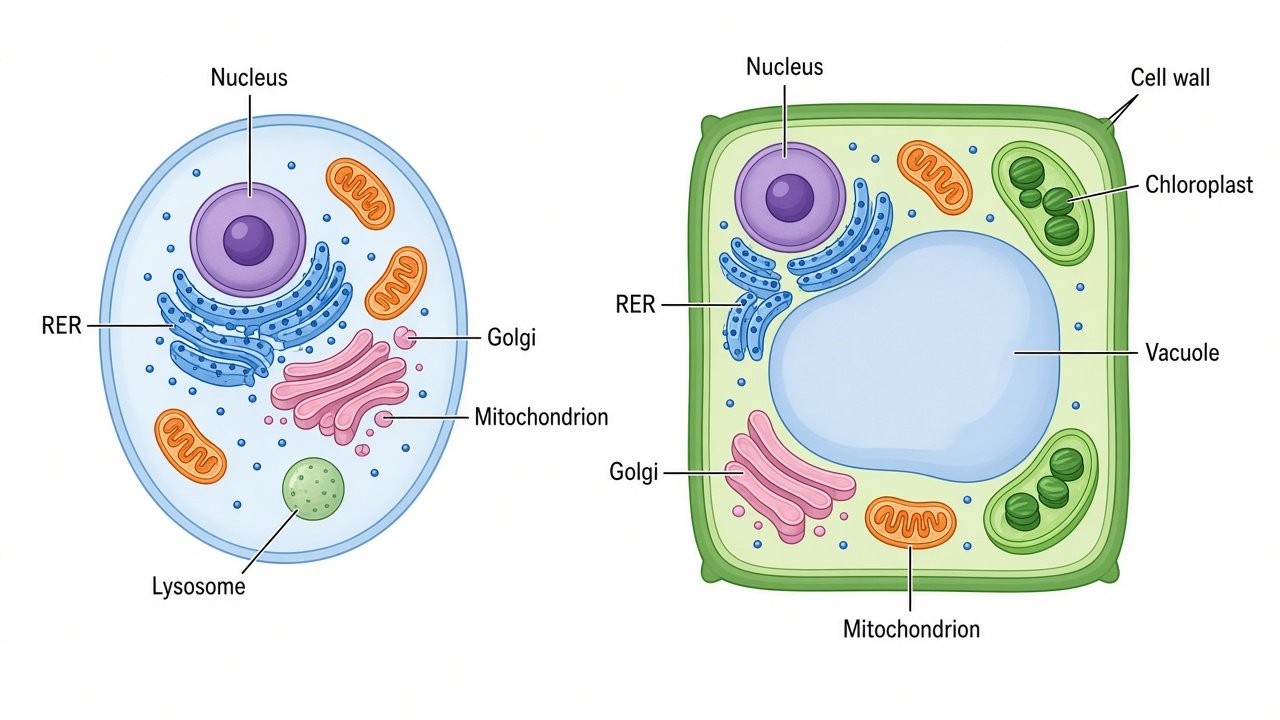
The figure shows labeled animal and plant cells. Which structure is present in the plant cell but not the animal cell and is the site of photosynthesis?

Side-by-side animal and plant cells with organelles labeled Nucleus, RER, Golgi, Mitochondrion, Lysosome, Vacuole, Chloroplast, and Cell wall.
  1. A. Lysosome
  2. B. Rough ER
  3. C. Mitochondrion
  4. D. Chloroplast