Cell Structure and Function MCQ Practice

Question 1 of 10

Which statement about ribosomes is correct?

  1. A. They are non-membrane structures of rRNA and protein that synthesize proteins according to mRNA.
  2. B. They are double-membrane organelles that perform photosynthesis.
  3. C. They are found only in plant cells and never in prokaryotes.
  4. D. They package finished proteins into secretory vesicles.
Question 2 of 10

A toxin blocks the Golgi complex from modifying newly made glycoproteins. Which cellular outcome is most likely?

  1. A. Immediate loss of all mitochondrial ATP production
  2. B. Conversion of lysosomes into chloroplasts
  3. C. Impaired folding/modification and trafficking of those cellular products
  4. D. Increased ribosomal RNA synthesis in the cytosol only

Question 3 of 10

Which organelle provides compartments for different metabolic reactions of aerobic cellular respiration?

  1. A. Central vacuole
  2. B. Mitochondrion
  3. C. Ribosome
  4. D. Cell wall

Question 4 of 10

Programmed cell death in a developing tissue often involves which organelle’s enzymes?

  1. A. Chloroplast thylakoids
  2. B. Free cytosolic ribosomes only
  3. C. Cellulose of the cell wall
  4. D. Lysosomes

Question 5 of 10

Animal cells typically have vacuoles that are

  1. A. smaller and more numerous than the large central vacuole of plant cells, and store cellular materials
  2. B. identical in size to plant central vacuoles and always maintain turgor against a wall
  3. C. absent because animals never store materials in membrane sacs
  4. D. the only site of photosynthesis in muscle tissue

Question 6 of 10

An investigator finds an organelle with a double membrane that captures light energy to build sugars. The organelle is a

  1. A. lysosome
  2. B. ribosome
  3. C. chloroplast
  4. D. Golgi stack

Question 7 of 10

Endoplasmic reticulum helps cells maintain shape and moves materials internally. This describes ER’s role in

  1. A. storing hydrolytic enzymes for extracellular digestion only
  2. B. mechanical support and intracellular transport
  3. C. forming the cell wall of bacteria
  4. D. replacing the plasma membrane entirely

Question 8 of 10

The table shows measured organelle volumes in two cell types. Cell Type S secretes large amounts of protein. Which inference is best supported?

Cell type Rough ER volume (%) Golgi volume (%) Mitochondria volume (%)
S (secretory) 22 8 12
M (muscle-like) 4 2 28
  1. A. Type S invests more volume in rough ER and Golgi for protein trafficking.
  2. B. Type S must lack ribosomes because secretion does not require proteins.
  3. C. Type M performs more photosynthesis because it has more mitochondria.
  4. D. Type M cannot have lysosomes if mitochondria are present.

Question 9 of 10

A mutation reduces the number of membrane folds in mitochondrial inner membranes without changing outer membranes. The most direct expected effect is

  1. A. increased chloroplast chlorophyll in animal cells
  2. B. decreased efficiency of ATP synthesis relative to wild-type mitochondria
  3. C. immediate conversion of mitochondria into lysosomes
  4. D. loss of all ribosomal protein synthesis in the cell

Question 10 of 10

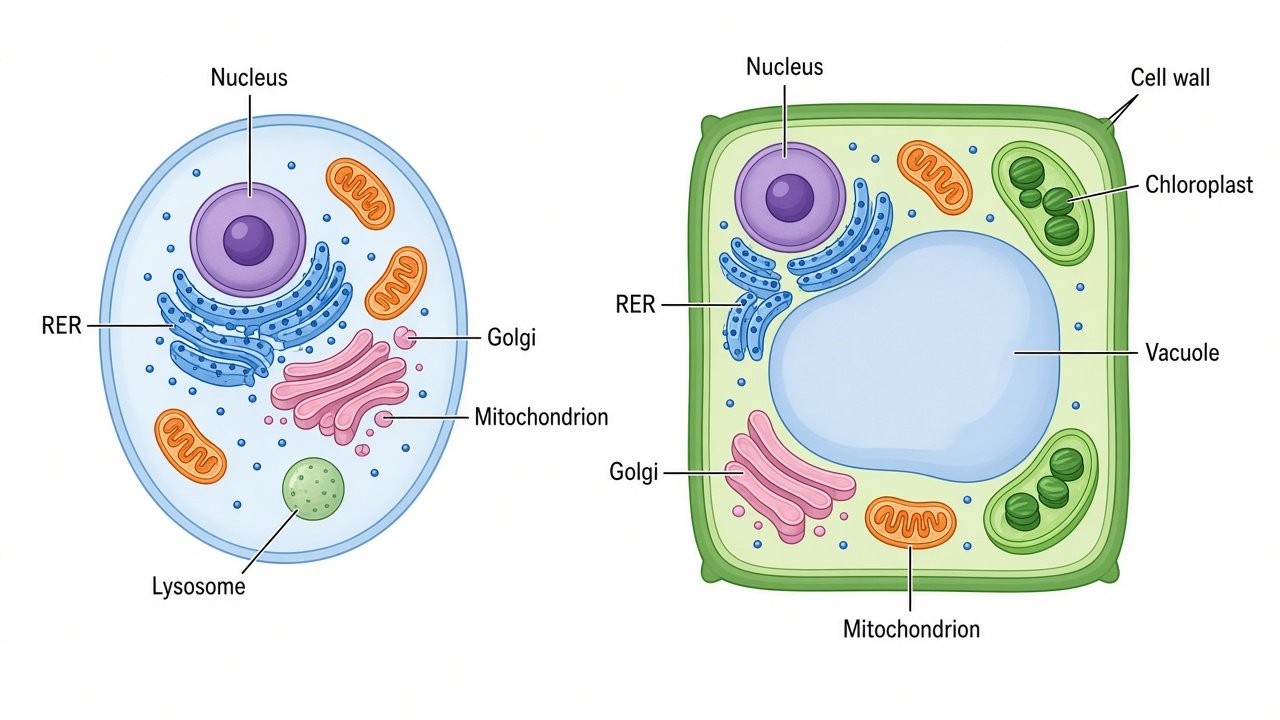
Using the figure of animal and plant cells, which labeled structure is a series of flattened membrane sacs that modifies and packages proteins?

Side-by-side animal and plant cells with organelles labeled Nucleus, RER, Golgi, Mitochondrion, Lysosome, Vacuole, Chloroplast, and Cell wall.
  1. A. Mitochondrion
  2. B. Central vacuole
  3. C. Golgi complex
  4. D. Ribosome (cytosolic dots)