TOPIC 14.9 · STUDY
Thin-Film Interference
Thin-film colors come from interference of light reflected at the two surfaces of a film. A reflection from a higher index shifts the phase by 180 degrees. Quantitative work in this topic uses normal incidence.
14.9.A
Thin-film interference
Two reflected rays interfere: one from the top surface of the film and one that crosses the film and reflects from the bottom surface. The film thickness is comparable to the wavelength. Refraction itself does not add a $180^\circ$ phase shift. Reflection from a higher index does. Reflection from a lower index does not.
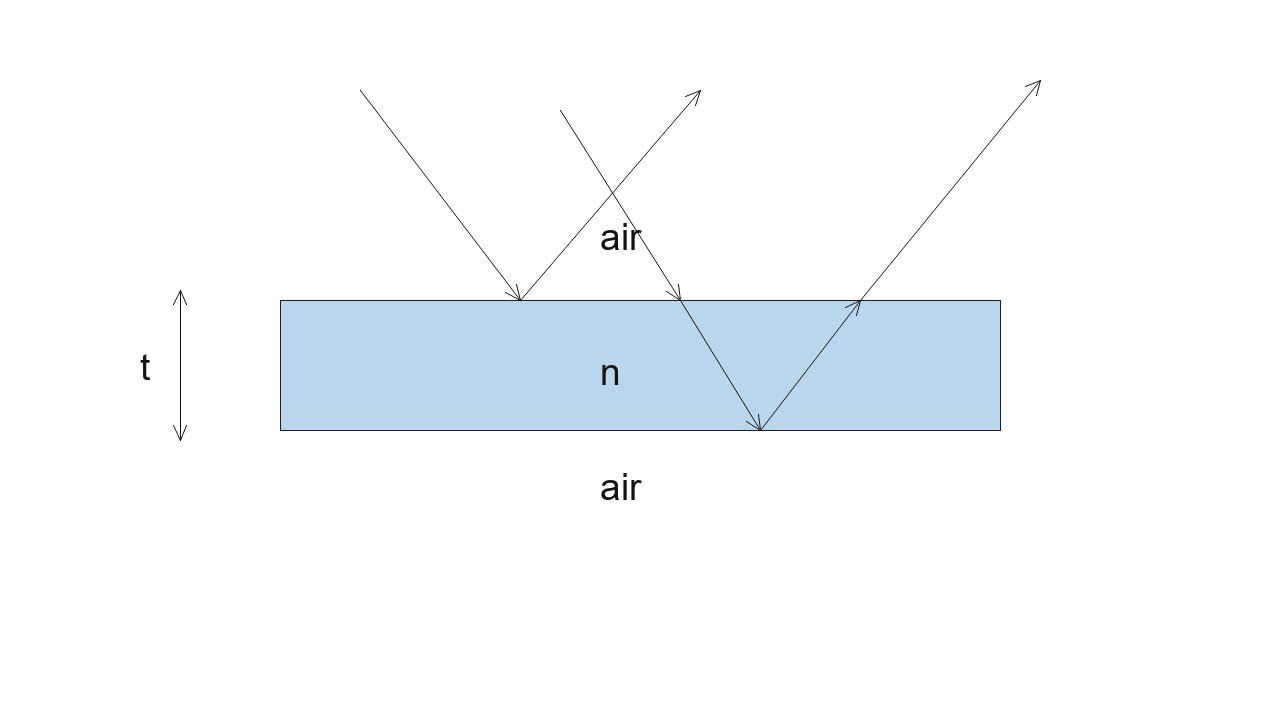
The two upward rays left the film after different paths. Their interference depends on the thickness and on which reflections changed phase.
A soap film in air has one relative phase flip: the front surface reflects from higher $n$, and the back surface reflects from air, which is lower $n$. At normal incidence the thinnest film that reflects a wavelength $\lambda$ strongly satisfies $2nt=\lambda/2$, so $$t=\frac{\lambda}{4n}.$$ For $n=1.33$ and $\lambda=532\,\mathrm{nm}$, $t=532/(4\times 1.33)=100\,\mathrm{nm}$. The next thicker constructive film is $3\lambda/(4n)=300\,\mathrm{nm}$. Different thicknesses select different colors, which is why a soap bubble or an oil slick looks banded.
An antireflection coating is designed so the reflected rays interfere destructively. For air, then coating, then glass, with $n$ increasing at each surface, both reflections have a $180^\circ$ shift. The relative shift from the two flips cancels, and a quarter-wave thickness supplies the condition for destructive reflection: $t=\lambda/(4n_c)$. For $n_c=1.40$ and $\lambda=560\,\mathrm{nm}$, $t=100\,\mathrm{nm}$. Quantitative thin-film problems in this course use normal incidence.
Key points
- Reflection from higher $n$: $180^\circ$ phase shift. Reflection from lower $n$: no phase shift.
- Refraction alone does not add that phase shift.
- Soap in air, thinnest strong reflection: $t=\lambda/(4n)$.
- Example: $n=1.33$ and $\lambda=532\,\mathrm{nm}$ give $t=100\,\mathrm{nm}$. The next thickness is $300\,\mathrm{nm}$.
- Colors change where the thickness changes.
- Antireflection coating: both reflections can phase-shift, and $t=\lambda/(4n_c)$ gives destructive reflection.
- Example: $n_c=1.40$ and $\lambda=560\,\mathrm{nm}$ give $t=100\,\mathrm{nm}$. Quantitative cases use normal incidence.
Count the phase flips before choosing the thickness condition. A soap film in air has one flip. A typical antireflection coating has two.