TOPIC 15.1 · STUDY
Quantum Theory and Wave-Particle Duality
Light travels as photons with energy hf and momentum E/c. Matter has a de Broglie wavelength h/p. Quantum descriptions matter when that wavelength is comparable to the size of the system, and bound systems have discrete allowed energies.
15.1.A
Photons and matter waves
A photon is a massless, electrically neutral quantum of light. Its energy and momentum magnitude in vacuum are $E=hf=hc/\lambda$ and $p=E/c=h/\lambda$. Use $h=6.63\times 10^{-34}\,\mathrm{J\cdot s}$ and $c=3.00\times 10^{8}\,\mathrm{m/s}$. A photon with $\lambda=6.00\times 10^{-7}\,\mathrm{m}$ has $$E=\frac{(6.63\times 10^{-34})(3.00\times 10^{8})}{6.00\times 10^{-7}}=3.32\times 10^{-19}\,\mathrm{J}$$ and $p=E/c=1.11\times 10^{-27}\,\mathrm{kg\cdot m/s}$.
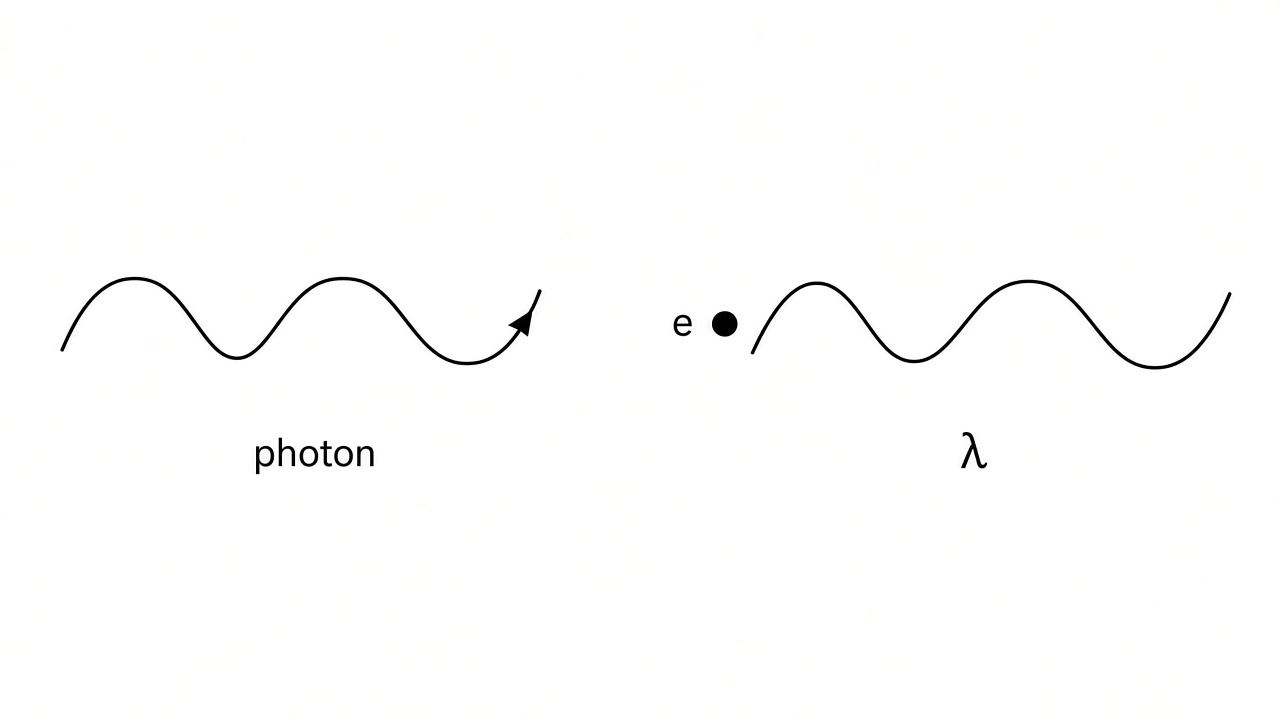
A photon carries a wave of definite energy. An electron has a de Broglie wavelength set by its momentum.
Any particle with momentum $p$ has de Broglie wavelength $\lambda=h/p$. A nonrelativistic electron of mass $m=9.11\times 10^{-31}\,\mathrm{kg}$ and speed $1.00\times 10^{6}\,\mathrm{m/s}$ has $$\lambda=\frac{6.63\times 10^{-34}}{(9.11\times 10^{-31})(1.00\times 10^{6})}=7.28\times 10^{-10}\,\mathrm{m}.$$ Its kinetic energy is $K=p^{2}/(2m)$, which is not equal to the energy of a photon that has the same wavelength. Equal $\lambda$ means equal $p$, but $E_{\gamma}=pc$ while $K=p^{2}/(2m)$.
At equal kinetic energy, $p=\sqrt{2mK}$, so $\lambda\propto 1/\sqrt{m}$. A particle with nine times the mass has one third the de Broglie wavelength. Electrons passing two slits can form an interference pattern when that wavelength is comparable to the slit scale. That pattern is wave behavior of matter.
When light enters glass, the photon frequency, and therefore $E=hf$, stays the same. The speed becomes $c/n$. For $n=1.50$ the speed is $c/1.50$. Photons travel in straight lines until they interact with matter. A bound electron in an atom does not have a continuous range of energies. Quantum theory allows only a discrete set. Blackbody spectra, atomic spectra, and the photoelectric effect were among the results that classical mechanics could not explain.
Key points
- Photon: $E=hf=hc/\lambda$ and $p=E/c$. A photon is massless and neutral.
- Example $\lambda=6.00\times 10^{-7}\,\mathrm{m}$: $E=3.32\times 10^{-19}\,\mathrm{J}$ and $p=1.11\times 10^{-27}\,\mathrm{kg\cdot m/s}$.
- de Broglie: $\lambda=h/p$. Electron example: $7.28\times 10^{-10}\,\mathrm{m}$.
- Same wavelength does not mean a photon energy equals an electron kinetic energy.
- At equal kinetic energy, $\lambda\propto 1/\sqrt{m}$.
- Frequency is unchanged when a photon enters a new medium. Speed becomes $c/n$.
- Bound systems have discrete allowed energies.
Wave behavior of matter shows up when the de Broglie wavelength is comparable to the size of the apparatus or the atom.