TOPIC 15.2 · STUDY
The Bohr Model of Atomic Structure
The mass number counts nucleons and the atomic number counts protons. Isotopes share the atomic number. In the Bohr model the Coulomb force supplies the centripetal force, and an allowed orbit fits an integer number of de Broglie wavelengths.
15.2.A
Nuclei and the Bohr model
In ${}^{A}_{Z}\mathrm{X}$, the mass number $A$ is the number of nucleons and the atomic number $Z$ is the number of protons. The neutron number is $A-Z$. Neutral ${}^{27}_{13}\mathrm{Al}$ has 13 protons, 14 neutrons, and 13 electrons. The ion ${}^{27}_{13}\mathrm{Al}^{3+}$ still has 13 protons and 14 neutrons, but only 10 electrons, so its net charge is not zero. Isotopes of one element share $Z$ and differ in neutron number. A different $Z$ means a different element. Nearly all of the atom's mass is in the nucleus.
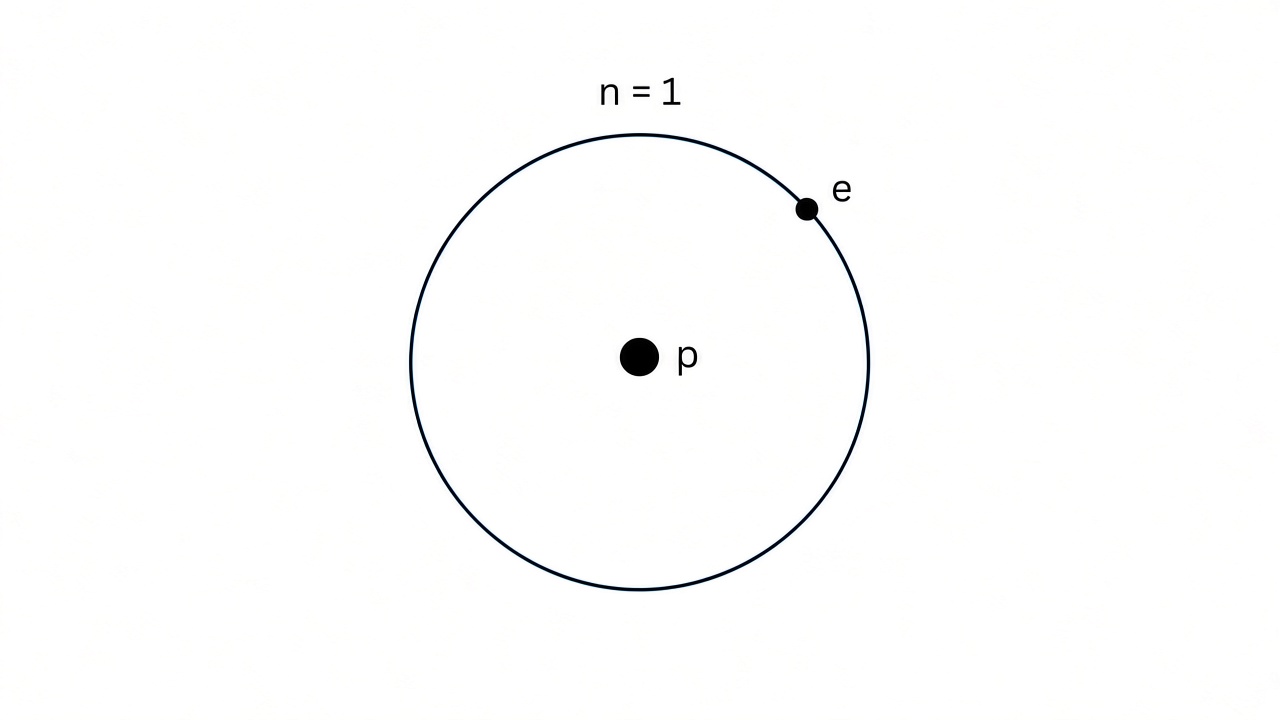
In the Bohr model the electron moves in a circle about the proton. The n = 1 orbit fits one de Broglie wavelength around the circumference.
The Coulomb force supplies the centripetal force: $$\frac{ke^{2}}{r^{2}}=\frac{mv^{2}}{r}.$$ The standing-wave condition is $2\pi r=n\lambda=nh/(mv)$, with $n=1,2,3,\ldots$. The $n=1$ circumference equals one wavelength. The $n=2$ circumference equals $2\lambda$. The angular momentum on an allowed orbit is $mvr=nh/(2\pi)$. For $n=2$ that magnitude is $h/\pi$.
Eliminating $v$ gives $r\propto n^{2}$. Classical physics would allow any radius. The integer $n$ allows only discrete radii, and therefore only discrete energies. This course uses the Bohr picture for those energy levels. It does not ask for orbital shapes or probability clouds.
Key points
- $A$ counts nucleons. $Z$ counts protons. Neutrons equal $A-Z$.
- Isotopes share $Z$. A different $Z$ is a different element. An ion has nonzero net charge.
- Nuclear mass dominates the atom.
- Force balance: $ke^{2}/r^{2}=mv^{2}/r$.
- Standing wave: $2\pi r=n\lambda$ with $\lambda=h/(mv)$.
- Angular momentum: $mvr=nh/(2\pi)$. Radius scales as $n^{2}$.
- Analysis stays at energy levels. Orbital shapes are outside this course.
The Bohr standing-wave condition is what makes the radii discrete. A classical orbit could have any size.