TOPIC 15.3 · STUDY
Emission and Absorption Spectra
A single-electron atom absorbs or emits a photon only when the photon energy equals the difference between two allowed levels. Emission spectra are bright lines. Absorption spectra are dark lines in a continuous spectrum. Each element has its own set of frequencies.
15.3.A
Spectra and energy levels
Energy-level diagrams in this course are for single-electron atoms. A photon is absorbed or emitted only when its energy matches the difference between two allowed states. That change is a change in the interaction energy of the electron and the nucleus.
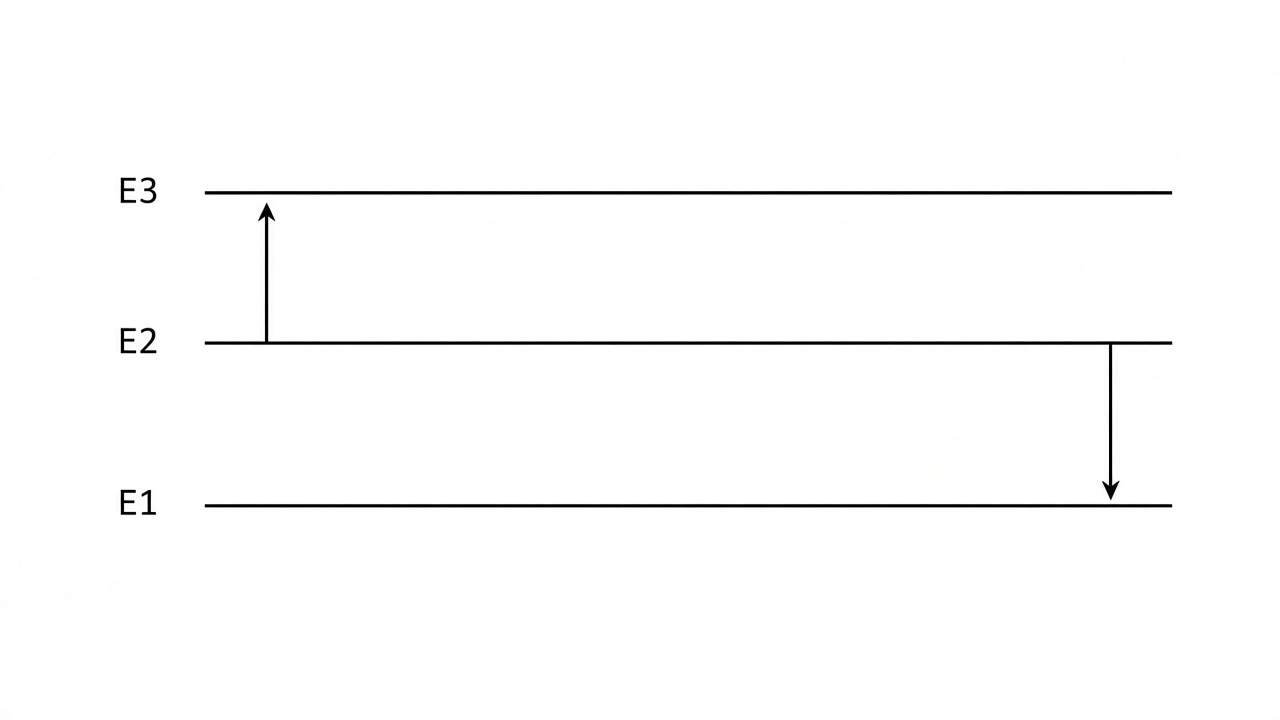
The upward arrow is absorption from E2 to E3. The downward arrow is emission from E2 to E1.
Hydrogen levels include $E_1=-13.6\,\mathrm{eV}$ and $E_2=-3.40\,\mathrm{eV}$. A transition between them involves $$\Delta E=E_2-E_1=10.2\,\mathrm{eV}.$$ With $1\,\mathrm{eV}=1.60\times 10^{-19}\,\mathrm{J}$, that energy is $1.63\times 10^{-18}\,\mathrm{J}$. The wavelength is $$\lambda=\frac{hc}{E}=\frac{1.99\times 10^{-25}}{1.63\times 10^{-18}}=1.22\times 10^{-7}\,\mathrm{m}=122\,\mathrm{nm}.$$ The largest energy gap gives the shortest wavelength.
Binding energy is the energy needed to remove the electron to $E=0$. From the ground state that energy is $13.6\,\mathrm{eV}$. From $E_2$ it is only $3.40\,\mathrm{eV}$, because the electron is already closer to zero. A $2.00\,\mathrm{eV}$ photon is not absorbed in the $1\to 2$ transition, because $2.00\,\mathrm{eV}$ is not $10.2\,\mathrm{eV}$.
An emission spectrum is a set of bright lines from downward transitions. An absorption spectrum is a set of dark lines where a cool vapor removes those same frequencies from white light. Either set identifies the element, because each element has its own allowed levels.
Key points
- Photon energy must equal the difference between two allowed levels.
- Diagrams here are for single-electron atoms.
- Hydrogen $1\to 2$: $\Delta E=10.2\,\mathrm{eV}$ and $\lambda=122\,\mathrm{nm}$.
- The largest gap gives the shortest wavelength.
- Ground-state binding energy for this hydrogen atom is $13.6\,\mathrm{eV}$.
- Emission lines are bright. Absorption lines are dark.
- Each element has a unique set of frequencies.
A photon whose energy falls between two level gaps is not absorbed. Intensity does not create a new allowed energy.