TOPIC 15.4 · STUDY
Blackbody Radiation
A blackbody absorbs all radiation that hits it and emits a continuous spectrum that depends only on its temperature. A hotter body peaks at a shorter wavelength and, at the same area, radiates much more power because power scales as temperature to the fourth.
15.4.A
Blackbody radiation
A blackbody absorbs all incident radiation. In equilibrium it emits thermal radiation, converting internal energy into electromagnetic energy. Its continuous spectrum, graphed as intensity per unit wavelength versus wavelength, depends only on the kelvin temperature.
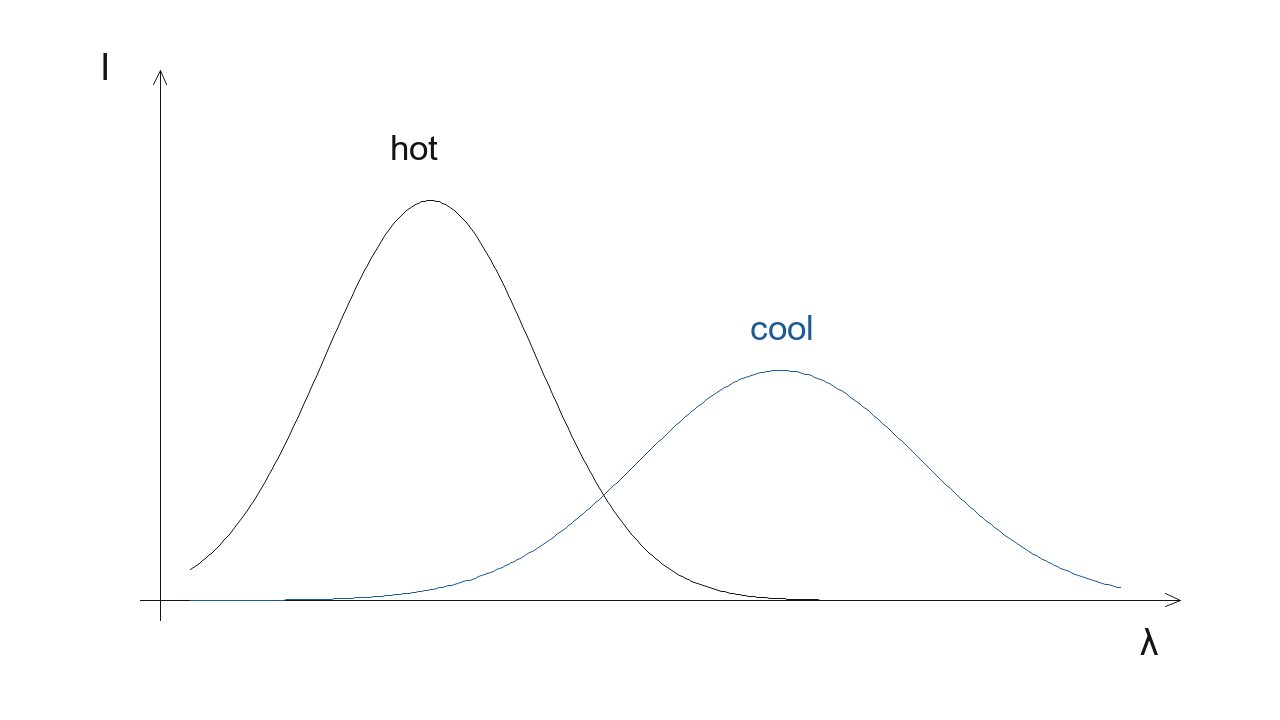
The hotter body peaks at a shorter wavelength and reaches a higher intensity. That shift is Wien's law.
Wien's law: as temperature rises, the wavelength of the peak moves shorter. A bluish star is hotter than a reddish star of similar size. Radiated power follows $P\propto AT^{4}$. Doubling the kelvin temperature at fixed area multiplies the power by $2^{4}=16$. A body with area $4A$ and temperature $T/2$ radiates $$\frac{P}{P_0}=4\times\left(\frac{1}{2}\right)^{4}=\frac{1}{4}$$ as much as a body of area $A$ and temperature $T$. Raising the temperature by 10 percent multiplies the power by $(1.10)^{4}=1.46$.
Classical physics does not produce the measured shape of that curve. Planck's law does, by treating the emitted light energy as quantized. A real surface can reflect some wavelengths, so it is only approximately a blackbody.
Key points
- A blackbody absorbs all incident radiation and emits in equilibrium.
- The spectrum depends only on temperature.
- Higher temperature: the peak moves to shorter wavelength.
- Power: $P\propto AT^{4}$. Doubling $T$ multiplies power by 16.
- Area $4A$ and temperature $T/2$: power ratio $1/4$.
- A 10 percent temperature increase multiplies power by 1.46.
- The spectral shape requires quantized light energy.
The graph is intensity per unit wavelength, not total power. The area under a hotter curve is larger because $P\propto T^{4}$.