TOPIC 15.5 · STUDY
The Photoelectric Effect
A photon ejects an electron only if its energy hf is at least the work function. The leftover energy is the maximum kinetic energy of the electron. Below the threshold frequency, a brighter beam still ejects none.
15.5.A
The photoelectric effect
The work function $\phi$ is the minimum energy required to emit an electron from the material. Einstein's relation is $$K_{\max}=hf-\phi.$$ Emission requires $f\ge f_0$, where the threshold frequency is $f_0=\phi/h$. Use $h=4.14\times 10^{-15}\,\mathrm{eV\cdot s}$ when energies are in electronvolts.
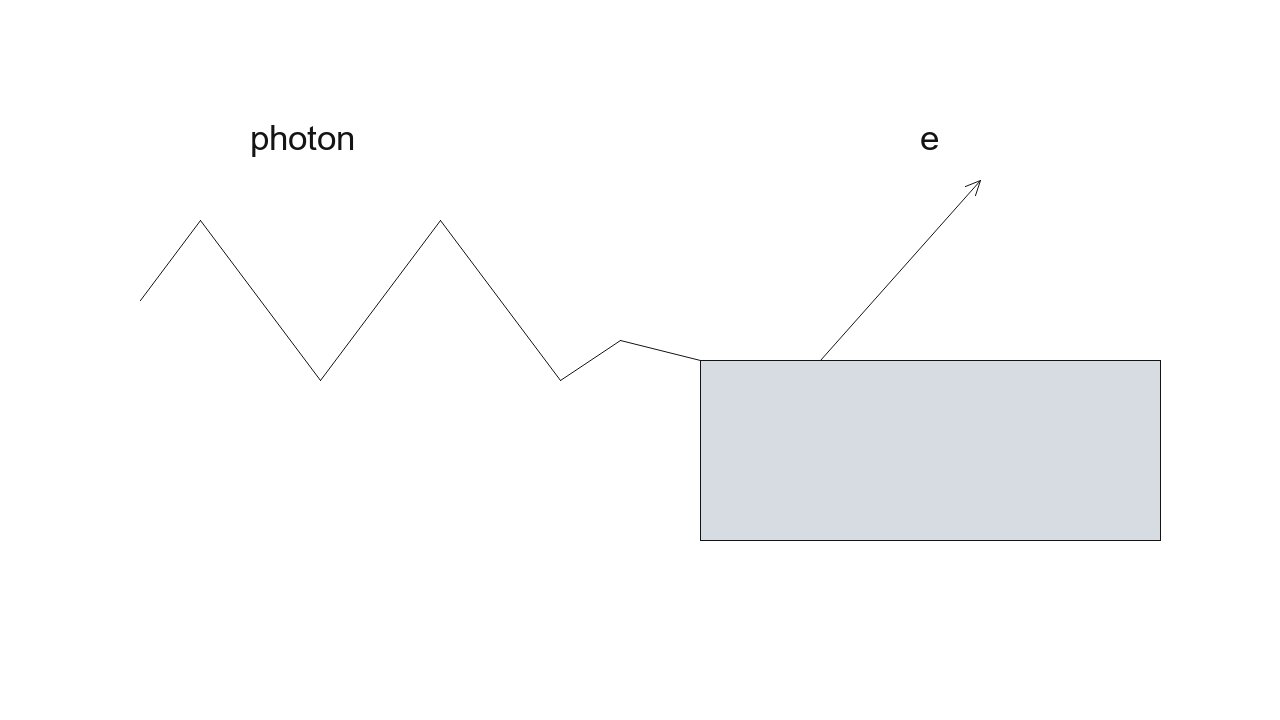
One photon gives its energy to one electron. The electron leaves only if that energy covers the work function.
Example: $\phi=1.80\,\mathrm{eV}$ and $f=1.00\times 10^{15}\,\mathrm{Hz}$. Then $hf=(4.14\times 10^{-15})(1.00\times 10^{15})=4.14\,\mathrm{eV}$, so $$K_{\max}=4.14-1.80=2.34\,\mathrm{eV}.$$ The stopping potential is the potential difference that brings the photocurrent to zero. Because $eV_s=K_{\max}$, this case has $V_s=2.34\,\mathrm{V}$. The threshold is $f_0=1.80/(4.14\times 10^{-15})=4.35\times 10^{14}\,\mathrm{Hz}$.
A graph of $K_{\max}$ versus $f$ is a straight line of slope $h$ and vertical intercept $-\phi$. Raising the frequency by $\Delta f$ raises $K_{\max}$ by $h\Delta f$. Raising the intensity, at a frequency above threshold, ejects more electrons. It does not raise $K_{\max}$. Below threshold, no intensity ejects electrons. That frequency threshold is the evidence for photons: each packet delivers $hf$, not a share of a continuous wave.
Key points
- $K_{\max}=hf-\phi$. Threshold: $f_0=\phi/h$.
- Example: $\phi=1.80\,\mathrm{eV}$ and $f=1.00\times 10^{15}\,\mathrm{Hz}$ give $K_{\max}=2.34\,\mathrm{eV}$.
- Stopping potential: $eV_s=K_{\max}$, so $V_s=2.34\,\mathrm{V}$ in that example.
- Threshold frequency for that metal: $4.35\times 10^{14}\,\mathrm{Hz}$.
- Slope of $K_{\max}$ versus $f$ is $h$. Intercept is $-\phi$.
- Intensity changes the number of electrons, not $K_{\max}$.
- Below threshold, a brighter beam still emits no electrons.
A classical wave would predict that a bright low-frequency beam eventually frees electrons. The threshold frequency says it does not.