TOPIC 14.5 · STUDY
The Doppler Effect
The Doppler effect compares a rest frequency with the frequency an observer hears when the source and observer move relative to the medium. Motion toward raises the observed frequency. Motion away lowers it. This topic stays qualitative.
14.5.A
Qualitative Doppler effect
The rest frequency $f_0$ is the frequency when the source and observer are not approaching or receding. The observed frequency is what the observer measures. The shift depends on the relative velocity of source and observer.
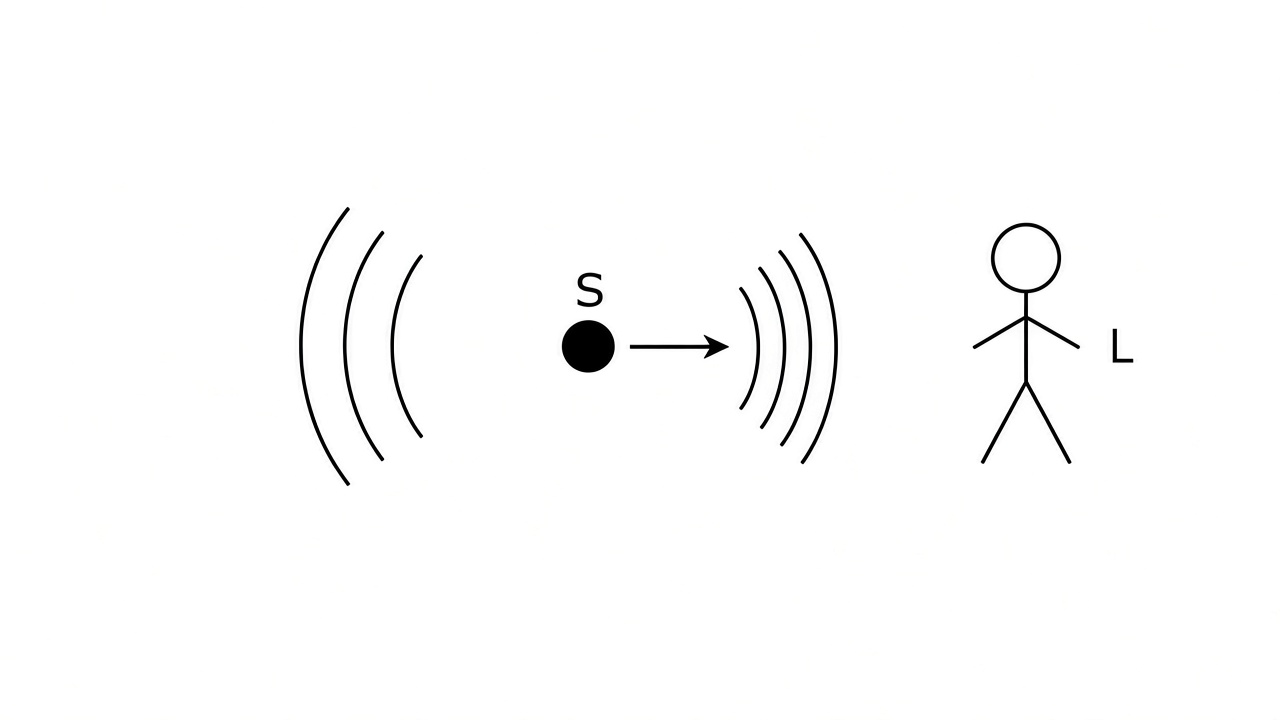
Ahead of a source moving toward the listener, the wavefronts are closer together, so the observed frequency is higher.
A source moving toward a stationary listener gives an observed frequency greater than $f_0$. A source moving away gives an observed frequency smaller than $f_0$. A listener moving toward a stationary source also hears a higher frequency. A listener moving away hears a lower frequency. An ambulance that approaches and then passes produces a drop in pitch: first above $f_0$, then below $f_0$.
A faster approach produces a larger upward shift. If the source and the observer have the same velocity relative to the air, the observed frequency equals $f_0$. Light from a source that is moving away is shifted toward longer wavelength, a redshift, which is the same qualitative idea.
The course asks which observed frequency is higher, which is lower, or which shift is larger. It does not ask for a calculated numerical frequency.
Key points
- Toward: observed frequency greater than the rest frequency.
- Away: observed frequency less than the rest frequency.
- Same velocity for source and observer: observed frequency equals the rest frequency.
- A larger relative speed toward the observer makes a larger upward shift.
- Either the source or the observer can be the one that moves.
- A redshift means the source is moving away.
- The comparisons are qualitative. A plugged-in Doppler formula is not required.
Equal speeds in opposite directions are not the same velocity. Only matching speed and direction leaves the observed frequency at the rest frequency.