Question 1 of 5
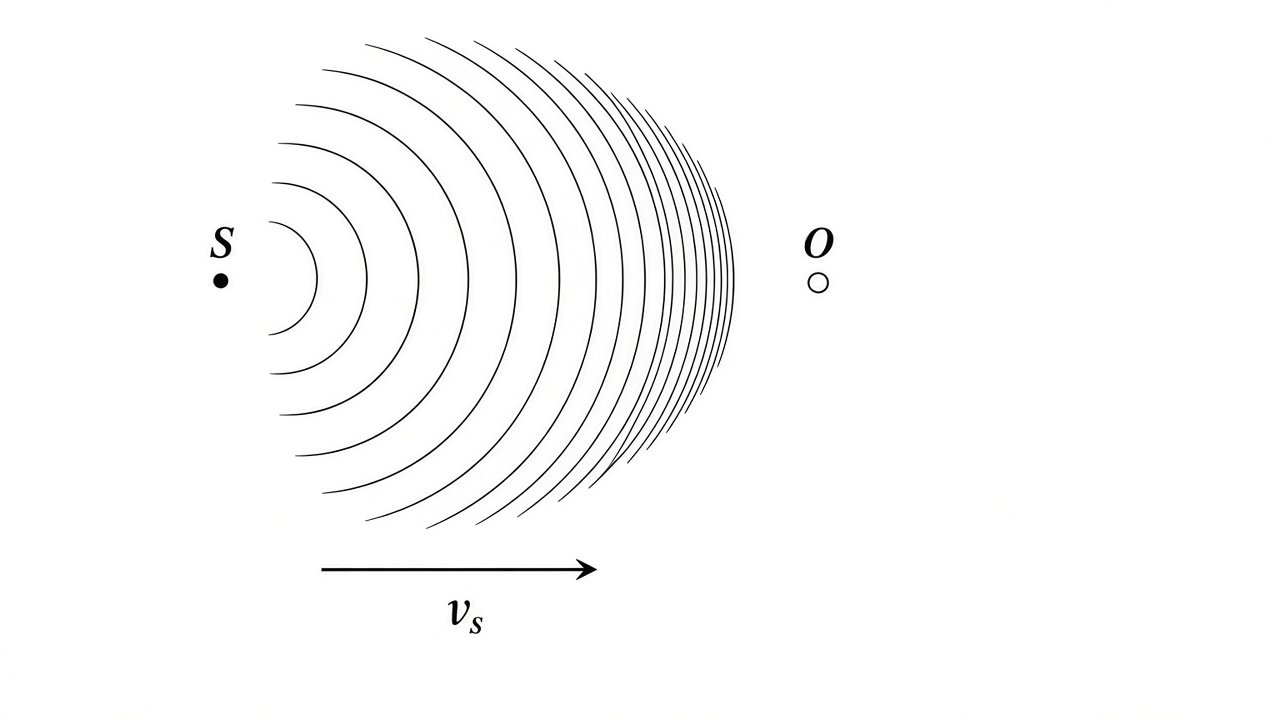
A train horn sounds $f_0$ at rest relative to the tracks. (a) Describe observed frequency as the train approaches a crossing. (b) As it recedes. (c) State the AP Physics 2 limitation on Doppler calculations.
Responses receive AI feedback against a rubric after submission. Scores are practice estimates.
A train horn sounds $f_0$ at rest relative to the tracks. (a) Describe observed frequency as the train approaches a crossing. (b) As it recedes. (c) State the AP Physics 2 limitation on Doppler calculations.
Two drones emit the same $f_0$. Drone A flies toward you faster than drone B. (a) Compare observed frequencies. (b) Relate the size of the shift to relative speed. (c) If both hover with you on a moving flatcar (same velocity), compare observed frequencies to $f_0$.
Define qualitatively: (a) rest frequency, (b) observed frequency, (c) how relative motion toward/away changes the comparison.
A student hears a higher pitch from a stationary speaker while running toward it, then a lower pitch while running away. (a) Identify what is moving. (b) Explain both observations. (c) Explain why computing a numerical $f'$ with the full Doppler formula is not required here for AP Physics 2.
Complete qualitative comparisons for sound: (a) source toward, observer at rest; (b) source away; (c) source and observer same velocity.