TOPIC 14.6 · STUDY
Wave Interference and Standing Waves
Overlapping waves add by superposition. Slightly different frequencies produce beats. Standing waves on a string or in a pipe fit a whole number of loops set by the length and the ends.
14.6.A
Superposition and beats
When pulses overlap, their displacements add. Equal pulses in the same direction give a resultant amplitude twice one pulse. Equal pulses in opposite directions cancel at the moment of complete overlap. After they separate, each pulse continues with its original shape. Waves pass through each other. They do not bounce off one another.
Pulses of amplitude $+A$ and $-A/2$ overlap to give $+A/2$. That overlap is partially destructive because the signs differ and the sizes are unequal.
Two tones of slightly different frequency drift between being in phase and out of phase. The loudness rises and falls at the beat frequency $f_{\mathrm{beat}}=|f_1-f_2|$. Forks at $440\,\mathrm{Hz}$ and $444\,\mathrm{Hz}$ produce beats at $4\,\mathrm{Hz}$.
14.6.B
Standing waves
A standing wave is the interference of opposite-traveling waves confined to a region. A node has zero amplitude at all times. An antinode has the maximum amplitude.
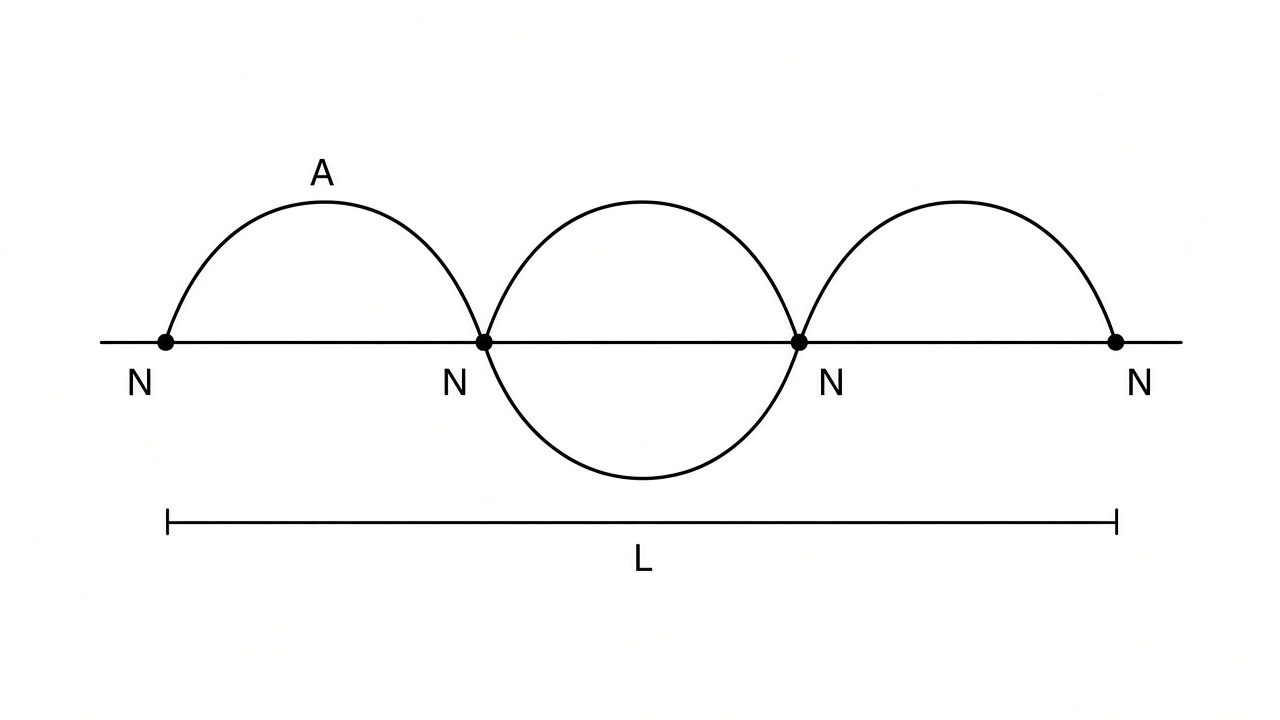
Three loops means the third harmonic. Nodes sit at both ends and at the two interior crossings.
A string fixed at both ends has $\lambda=2L/n$ and $f=nv/(2L)$, with $n=1,2,3,\ldots$. For $L=0.60\,\mathrm{m}$ and $n=2$, $\lambda=0.60\,\mathrm{m}$. With $v=120\,\mathrm{m/s}$, $$f=\frac{nv}{2L}=\frac{2(120)}{1.20}=200\,\mathrm{Hz}.$$ The fundamental has $\lambda_1=2L=1.20\,\mathrm{m}$ and $f_1=100\,\mathrm{Hz}$. The second harmonic has three nodes, counting the ends, and two antinodes.
An open pipe has a displacement antinode at each open end, so its fundamental is $f=v/(2L)$, the same pattern as the string. A pipe closed at one end has a node at the closed end and an antinode at the open end, so the fundamental wavelength is $4L$ and $f_1=v/(4L)$. Only odd harmonics fit. For $L=0.25\,\mathrm{m}$ and $v=340\,\mathrm{m/s}$, the closed-pipe fundamental is $340\,\mathrm{Hz}$ and the next mode is $3f_1=1020\,\mathrm{Hz}$. An open pipe of the same length has fundamental $680\,\mathrm{Hz}$, twice the closed-pipe fundamental.
Key points
- Superposition: displacements add. Pulses pass through and keep their shapes.
- Beat frequency: $|f_1-f_2|$. Example: $440\,\mathrm{Hz}$ and $444\,\mathrm{Hz}$ give $4\,\mathrm{Hz}$.
- String fixed at both ends: $\lambda=2L/n$ and $f=nv/(2L)$.
- Example $L=0.60\,\mathrm{m}$, $n=2$, $v=120\,\mathrm{m/s}$: $f=200\,\mathrm{Hz}$.
- A node has zero amplitude. An antinode has maximum amplitude.
- Closed pipe: node at the closed end, antinode at the open end, $f_1=v/(4L)$, odd harmonics only.
- Same length and speed: the open-pipe fundamental is twice the closed-pipe fundamental.
The second harmonic of an equal-length open pipe is not the next mode of a closed pipe. The closed pipe skips even harmonics.