TOPIC 14.7 · STUDY
Diffraction
Diffraction is the spreading of a wave at an edge or through an opening. It is strongest when the opening is comparable to the wavelength. A single slit produces a wide central bright band and weaker side bands.
14.7.A
Single-slit diffraction
Diffraction is spreading around an obstacle or through an opening. It is most pronounced when the opening size is comparable to the wavelength. An opening much wider than the wavelength shows little spreading. A gap about one wavelength wide spreads the wave strongly.
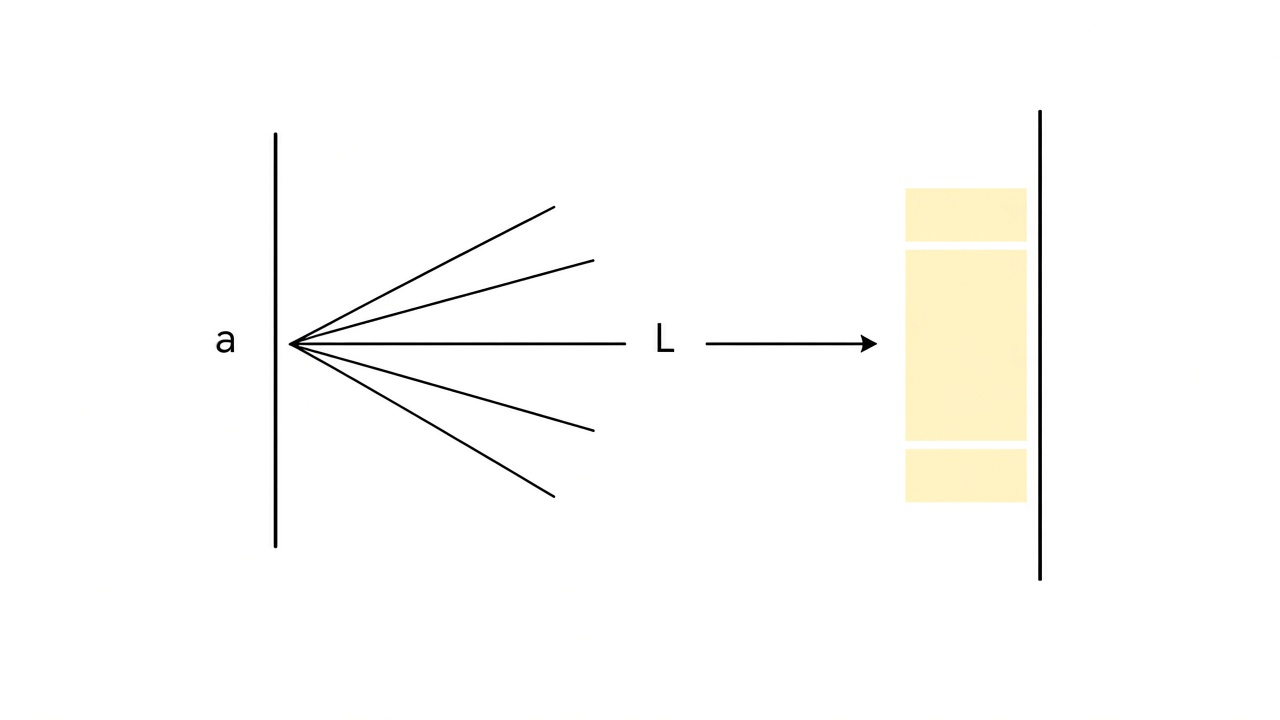
The narrow opening spreads the wave. The single-slit pattern has a wide central bright band and weaker side bands.
Path differences among parts of the slit depend on the slit width $a$ and the angle $\theta$ from the forward direction. Dark fringes satisfy $a\sin\theta=m\lambda$. For small angles, $\sin\theta\approx y/L$, so the minima sit at $$y_{\min}=\frac{m\lambda L}{a}.$$ Here $m=1,2,3,\ldots$ labels the order of the minimum. The small-angle form is for angles of roughly $10^\circ$ or less.
Example: $\lambda=6.0\times 10^{-7}\,\mathrm{m}$, $a=2.0\times 10^{-4}\,\mathrm{m}$, and $L=1.0\,\mathrm{m}$. The first minimum is $$y=\frac{(6.0\times 10^{-7})(1.0)}{2.0\times 10^{-4}}=3.0\times 10^{-3}\,\mathrm{m}.$$ The second minimum is twice as far, $6.0\times 10^{-3}\,\mathrm{m}$. Narrowing the slit increases the spacing. Increasing the wavelength increases it. Red light makes a wider pattern than blue light at the same $a$ and $L$.
Key points
- Diffraction is spreading at an edge or through an opening.
- It is strongest when the opening is comparable to the wavelength.
- Dark fringes: $a\sin\theta=m\lambda$. Small angle: $y_{\min}=m\lambda L/a$.
- Example: $\lambda=6.0\times 10^{-7}\,\mathrm{m}$, $a=2.0\times 10^{-4}\,\mathrm{m}$, $L=1.0\,\mathrm{m}$ gives $y=3.0\times 10^{-3}\,\mathrm{m}$ for $m=1$.
- A narrower slit or a longer wavelength spreads the minima farther apart.
- The pattern is a wide central bright band with weaker side bands.
- The small-angle form needs a small angle, roughly $10^\circ$ or less.
In the small-angle formula, a is the width of the single opening. A wider opening pulls the minima closer to the center.